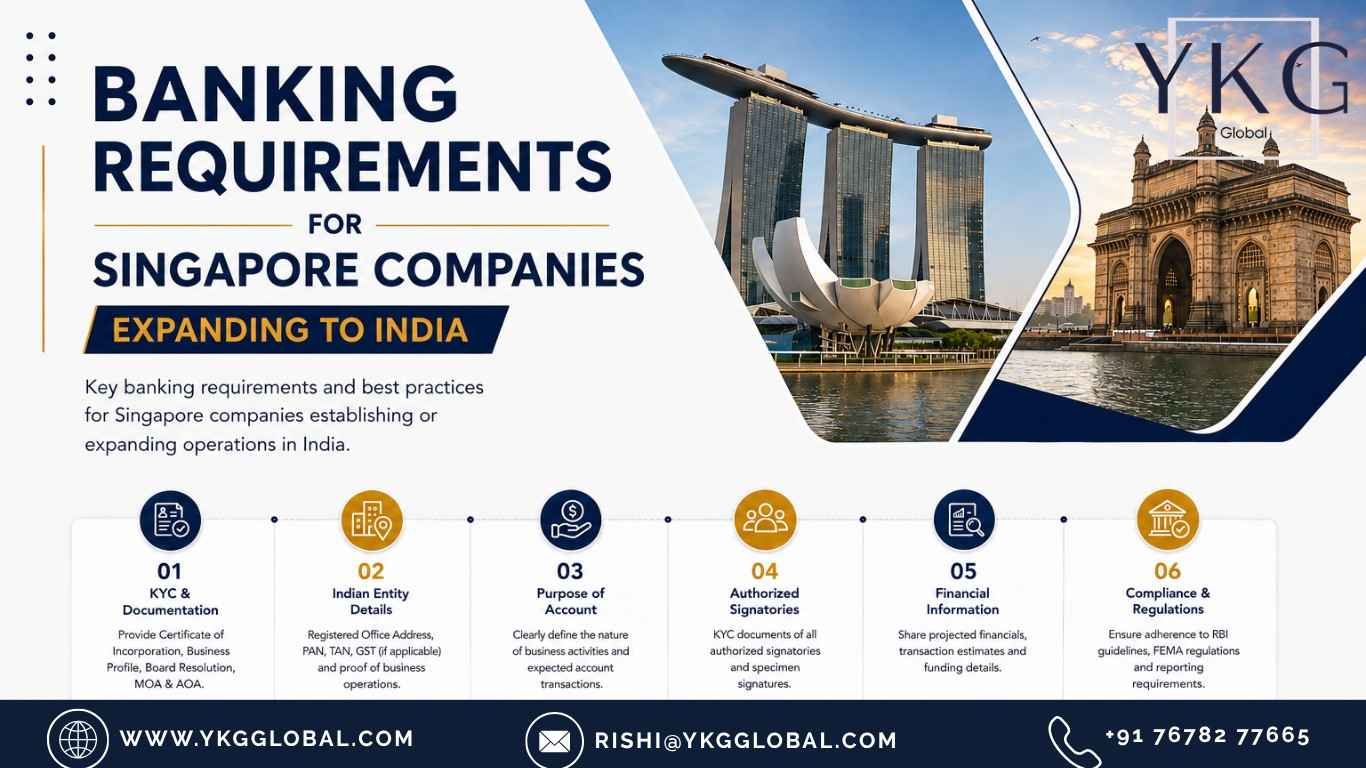
Banking Requirements for Singapore Companies Expanding to India
India has become one of the most attractive investment destinations for Singapore businesses looking to expand across Asia. Strong bilateral trade relations, the India–Singapore Comprehensive Economic Cooperation Agreement (CECA), growing foreign investment, and India's rapidly expanding consumer market continue to encourage Singapore-based companies to establish operations in sectors such as technology, fintech, logistics, manufacturing, healthcare, renewable energy, consulting, and financial services.
While company incorporation is often the first priority, many businesses underestimate the importance of planning their corporate banking strategy early. A corporate bank account is not just required for daily transactions it is central to receiving investments, managing supplier payments, processing payroll, paying statutory taxes, handling cross-border transactions, and maintaining financial compliance.
Before approving a corporate account, Indian banks carefully evaluate the company's legal structure, ownership, business activities, regulatory registrations, and compliance with Reserve Bank of India (RBI) and Foreign Exchange Management Act (FEMA) guidelines.
Whether your Singapore business is establishing a Wholly Owned Subsidiary, Private Limited Company, Branch Office, Liaison Office, or Joint Venture, understanding the banking requirements before commencing operations helps avoid delays and supports a smoother market entry.
At YKG Global, we assist Singapore companies with company registration, corporate bank account opening, FEMA advisory, RBI compliance, tax registrations, accounting, and ongoing corporate compliance, ensuring businesses establish a strong financial foundation in India.
Understanding India's Corporate Banking Requirements for Foreign Companies
Indian banks follow comprehensive due diligence procedures before opening business accounts for foreign-owned companies. These checks ensure compliance with banking regulations while protecting the integrity of the financial system.
Banks generally assess:
1. Legal structure of the company.
2. Shareholding and ownership pattern.
3. Identity of directors and Ultimate Beneficial Owners (UBOs).
4. Nature of business activities.
5. Source of investment funds.
6. Expected transaction volumes.
7. International business relationships.
8. Regulatory registrations completed in India.
Preparing these details in advance significantly improves the banking experience and reduces approval timelines.
Business Structures Eligible for Corporate Banking
The legal entity chosen during incorporation influences the banking process.
Singapore businesses commonly establish:
1. Wholly Owned Subsidiary
Suitable for companies seeking complete ownership and long-term business operations in India.
2. Private Limited Company
One of the most preferred structures for foreign investors due to operational flexibility and limited liability.
3. Branch Office
Allows overseas companies to conduct approved commercial activities under RBI regulations.
4. Liaison Office
Designed for market research, communication, and coordination activities without commercial transactions.
5. Joint Venture
Ideal for Singapore companies partnering with Indian businesses to leverage local expertise and market access.
Choosing the appropriate entity helps simplify banking documentation and compliance requirements.
Key Documents Banks Usually Require
Although documentation requirements vary by bank, most institutions request information to verify the company's legal status, ownership, and intended business operations.
Typical documentation includes:
1. Certificate of Incorporation.
2. PAN of the company.
3. Memorandum and Articles of Association.
4. Board Resolution authorising account opening.
5. Identity and address proof of directors.
6. Registered office address proof.
7. Shareholding information.
8. Ultimate Beneficial Owner (UBO) declaration.
9. Business profile.
10. Expected transaction details.
Complete and accurate documentation helps reduce verification delays.
Choosing a Banking Partner That Supports International Growth
Not all banks provide the same level of support for foreign-owned businesses. Singapore companies should evaluate banks based on their international banking capabilities and future operational requirements.
Important considerations include:
1. Cross-border payment facilities.
2. Multi-currency banking.
3. Foreign exchange services.
4. Trade finance solutions.
5. Digital business banking.
6. Relationship management.
7. Import-export banking support.
8. Integration with accounting systems.
Selecting the right banking partner from the beginning helps businesses manage international operations more efficiently.
Navigating RBI and FEMA Compliance with Confidence
For Singapore companies expanding into India, opening a corporate bank account goes beyond submitting documents to a bank. Every application is reviewed in accordance with the regulations issued by the Reserve Bank of India (RBI) and the Foreign Exchange Management Act (FEMA) to ensure that foreign investments and business activities comply with Indian law.
Banks conduct due diligence to verify the company's ownership structure, authorised signatories, source of investment funds, business activities, and regulatory registrations. Depending on whether the business operates as a Wholly Owned Subsidiary, Private Limited Company, Branch Office, or Liaison Office, the documentation and approval process may vary.
Completing the required regulatory formalities before approaching a bank can significantly improve the chances of faster account activation.
Common Banking Mistakes Singapore Companies Should Avoid
Many businesses experience delays not because of banking policies but due to avoidable preparation errors.
Some of the most common mistakes include:
1. Approaching a bank before completing company registration.
2. Submitting incomplete or inconsistent KYC documentation.
3. Providing insufficient information about business activities.
4. Delays in obtaining PAN or GST registration.
5. Choosing a bank that does not support international business operations.
6. Incomplete Ultimate Beneficial Owner (UBO) declarations.
7. Not preparing board resolutions for authorised signatories.
8. Ignoring RBI and FEMA documentation requirements.
A well-prepared application not only speeds up approval but also establishes credibility with the banking institution.
Integrating Banking with Taxation and Financial Compliance
A corporate bank account should function as part of an integrated financial management system rather than as an isolated banking facility.
After opening the account, Singapore companies should establish processes for:
1. Recording all business transactions.
2. Managing GST obligations where applicable.
3. Maintaining accounting records.
4. Processing employee payroll.
5. Monitoring cross-border fund transfers.
6. Filing statutory tax returns.
7. Updating banking records after changes in directors or shareholders.
8. Meeting ongoing corporate compliance requirements.
Maintaining accurate financial records supports transparency, improves operational efficiency, and simplifies regulatory reporting.
Best Practices for Smooth Corporate Banking Operations
Successful businesses treat banking as an ongoing relationship rather than a one-time process.
To maintain a strong banking relationship:
1. Keep company records updated.
2. Respond promptly to KYC and compliance requests.
3. Maintain transparent financial transactions.
4. Review banking facilities as the business grows.
5. Inform the bank about significant corporate changes.
6. Maintain proper accounting and audit records.
7. Ensure compliance with RBI and FEMA reporting requirements where applicable.
These practices help businesses access additional banking services such as trade finance, foreign exchange solutions, and working capital facilities.
India–Singapore Economic Relations: Why Banking Matters More Than Ever
India and Singapore continue to strengthen their economic partnership through growing trade, investment, and cross-border collaboration. Singapore remains one of the largest sources of Foreign Direct Investment (FDI) into India, with businesses actively investing in technology, financial services, logistics, infrastructure, renewable energy, healthcare, and advanced manufacturing.
As bilateral business activity increases, companies require banking partners that can efficiently support:
1. Cross-border fund transfers
2. Multi-currency transactions
3. Trade finance
4. Foreign exchange management
5. Digital banking
6. International payment solutions
7. Treasury and cash management
A well-planned banking strategy enables Singapore companies to manage operations efficiently while supporting long-term expansion in the Indian market.
Why Choose YKG Global?
Expanding into India requires coordinated support across company formation, banking, taxation, and regulatory compliance. At YKG Global, we help Singapore businesses establish a compliant and efficient business presence in India.
Our services include:
1. Company Registration in India
2. Corporate Bank Account Opening Assistance
3. RBI & FEMA Advisory
4. PAN and GST Registration
5. Accounting & Bookkeeping
6. Tax Advisory and Compliance
7. Corporate Secretarial Services
8. Payroll Support
9. Business Licence Assistance
10. Cross-Border Investment Advisory
11. India Market Entry Consulting
12. Ongoing Corporate Compliance Management
From incorporation to ongoing financial compliance, our experienced team provides practical support to help Singapore companies expand into India with confidence.
Opening a corporate bank account in India is a critical step for Singapore companies establishing a successful business presence. By understanding RBI and FEMA requirements, preparing accurate documentation, and maintaining ongoing compliance, businesses can streamline financial operations and support long-term growth. YKG Global offers end-to-end assistance with company registration, corporate banking, taxation, and compliance, helping Singapore companies expand into India efficiently and confidently.