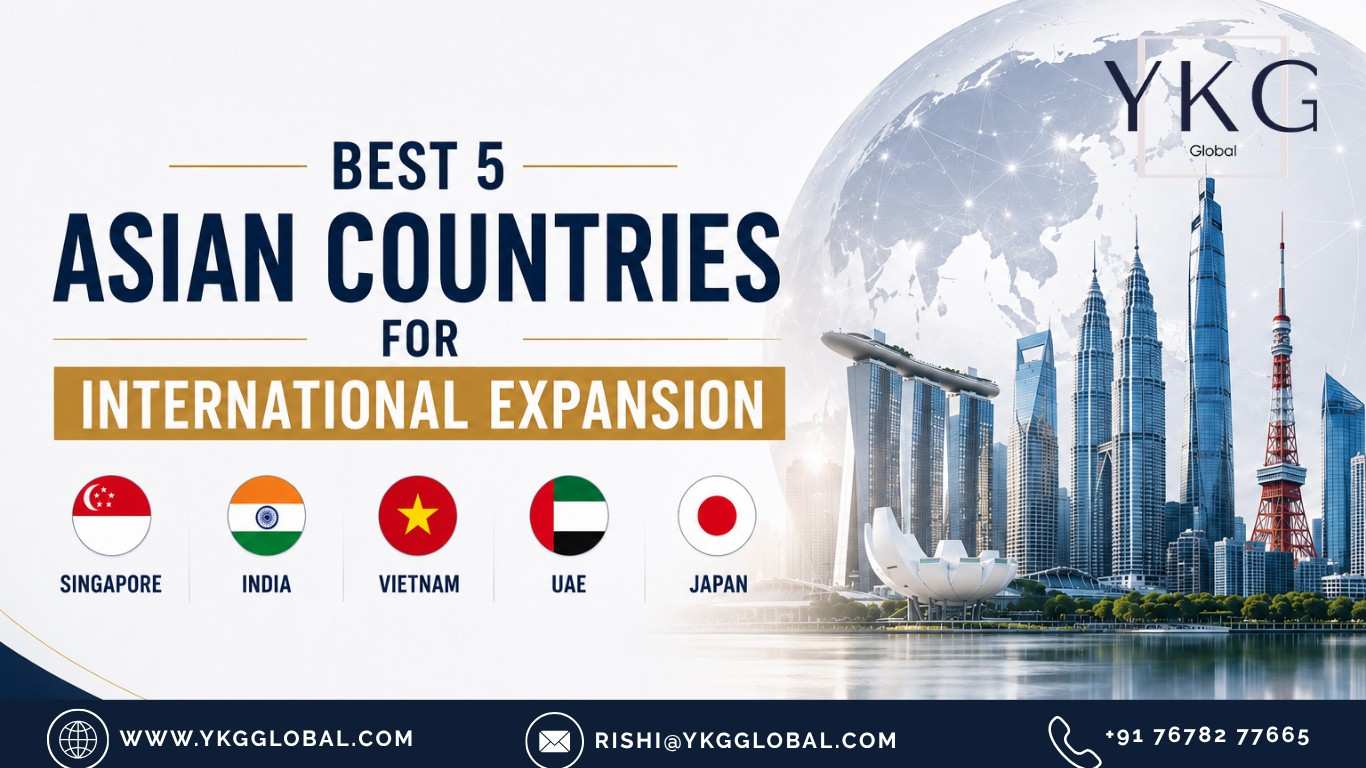
Best 5 Asian Countries for International Expansion
Asia has become one of the most important regions for businesses looking to expand internationally. Rapid digitalisation, growing consumer markets, improving infrastructure, strong manufacturing ecosystems, and increasing cross-border trade have created opportunities across multiple industries.
For international companies, however, choosing the right Asian market is not simply about finding the country with the largest economy.
A successful international expansion strategy in Asia requires businesses to consider several factors, including:
1. Market size and growth potential
2. Ease of doing business
3. Infrastructure
4. Skilled workforce
5. Digital economy
6. Trade connectivity
7. Regulatory environment
8. Consumer demand
9. Access to regional markets
10. Availability of business support
11. Long-term scalability
Different countries offer different advantages. Singapore may be ideal for regional headquarters and international operations, while India offers enormous consumer and technology opportunities. Japan provides a mature and sophisticated market, whereas Vietnam has become increasingly important for manufacturing and supply-chain diversification.
For businesses planning international expansion in 2026, five Asian markets stand out: Singapore, India, Japan, Vietnam, and the United Arab Emirates.
1. Singapore – The Strategic Gateway to Asia
Singapore remains one of the strongest choices for companies looking for a regional base in Asia.
Its location connects businesses with major markets across Southeast Asia, East Asia, and beyond. The country has developed a strong ecosystem covering financial services, technology, logistics, professional services, manufacturing, and international trade.
1.1 Why Expand to Singapore?
Singapore is particularly attractive for companies looking for:
A. Regional headquarters
B. International business operations
C. Financial services
D. Technology and innovation
E. ASEAN market access
F. International trade
G. Supply-chain management
The country's highly developed infrastructure and international business ecosystem make it suitable for multinational companies as well as high-growth businesses.
Singapore also has strong connectivity with major Asian economies, allowing companies to coordinate regional operations from a central location.
1.2 Best Industries for Singapore
Singapore can be particularly attractive for:
A. Fintech
B. Technology
C. Financial services
D. Logistics
E. Professional services
F. Healthcare
G. Advanced manufacturing
H. E-commerce
I. Regional headquarters
J. Key Consideration
Singapore is highly competitive, so companies should enter the market with a clear value proposition and well-defined regional expansion strategy.
2. India – One of Asia's Largest Growth Markets
India is one of the most compelling destinations for international business expansion in Asia because of its enormous domestic market, growing middle class, expanding digital economy, and rapidly developing business ecosystem.
For international companies, India offers both a large consumer market and access to a growing technology and talent ecosystem.
2.1 Why Expand to India?
India can offer opportunities in:
A. Technology
B. IT services
C. Manufacturing
D. Healthcare
E. Financial services
F. E-commerce
G. Renewable energy
H. Education
I. Consumer products
J. Professional services
The country's expanding digital economy has also created opportunities for international companies in fintech, software, digital commerce, artificial intelligence, and technology-enabled services.
India's large talent pool is another important advantage for companies seeking engineering, technology, finance, research, and business-service capabilities.
2.2 India as a Manufacturing and Supply-Chain Destination
International businesses are increasingly evaluating India as part of their supply-chain diversification strategies.
Manufacturing, electronics, automotive, pharmaceuticals, renewable energy, and industrial sectors provide opportunities for companies looking to establish production or sourcing operations.
2.3 Key Consideration
India is a highly diverse market. Businesses need to understand federal and state-level requirements, taxation, licensing, industry regulations, and local market differences before entering.
A carefully designed India market entry strategy is therefore essential.
3. Japan – A Mature Market for High-Value Businesses
Japan offers a completely different opportunity compared with emerging Asian markets.
It is a mature, technologically advanced economy with sophisticated consumers, strong infrastructure, established industries, and significant demand for high-quality products and services.
For companies offering specialised or premium solutions, Japan can be an attractive international expansion destination.
3.1 Why Expand to Japan?
Japan is particularly relevant for:
A. Advanced technology
B. Automotive
C. Robotics
D. Healthcare
E. Electronics
F. Luxury products
G. Financial services
H. Industrial technology
I. Clean energy
J. Professional services
The country's sophisticated consumer base can provide opportunities for businesses that focus on quality, innovation, reliability, and specialised products.
Japan also has strong relationships across the Asia-Pacific region, making it relevant for companies pursuing broader regional strategies.
3.2 Technology and Innovation
Japan's established technology ecosystem creates opportunities for international companies working in robotics, automation, electronics, artificial intelligence, healthcare technology, and advanced manufacturing.
3.3 Key Consideration
Market entry requires cultural understanding, relationship-building, localisation, and careful attention to Japanese business practices.
Companies should not assume that a strategy successful in another Asian market will automatically work in Japan.
4. Vietnam – A Growing Hub for Manufacturing and Supply Chains
Vietnam has emerged as an important destination for companies looking to expand their manufacturing and supply-chain operations in Asia.
Its strategic location, growing industrial base, expanding consumer market, and increasing integration into global trade have attracted international businesses across multiple sectors.
4.1 Why Expand to Vietnam?
Vietnam can be particularly attractive for:
A. Manufacturing
B. Electronics
C. Textiles
D. Consumer goods
E. Logistics
F. E-commerce
G. Technology
H. Food processing
I. Industrial production
Businesses seeking to diversify production and sourcing operations beyond traditional manufacturing markets may consider Vietnam as part of their broader Asian supply-chain strategy.
4.2 Growing Consumer Market
Vietnam's expanding urban population and digital adoption are also creating opportunities in consumer-facing sectors.
E-commerce, digital services, retail, technology, and consumer products have significant potential as the economy continues to develop.
4.3 Key Consideration
Companies entering Vietnam should carefully assess licensing, corporate structuring, employment, taxation, sector-specific regulations, and local operational requirements.
Understanding the local business environment before incorporation can reduce market-entry complications.
5. United Arab Emirates – A Global Business Hub Connecting Asia and Beyond
Although geographically positioned at the intersection of Asia, Europe, and Africa, the UAE is increasingly relevant to businesses developing an Asian and Middle Eastern expansion strategy.
Dubai and Abu Dhabi provide strong international connectivity, sophisticated infrastructure, and access to diverse global markets.
5.1 Why Consider the UAE?
The UAE can be attractive for:
A. International trading
B. Logistics
C. Financial services
D. Technology
E. E-commerce
F. Professional services
G. Real estate
H. Healthcare
I. Tourism
J. Regional headquarters
Its strategic location makes the UAE particularly useful for businesses that want to coordinate operations across multiple regions.
5.2 International Connectivity
The UAE's airports, ports, financial ecosystem, and logistics infrastructure support international trade and cross-border business operations.
For companies targeting markets across the Middle East, South Asia, Africa, and parts of Asia, the UAE can function as a strategic regional hub.
5.3 Key Consideration
Businesses need to select an appropriate corporate structure and understand the applicable mainland, free-zone, tax, licensing, and compliance framework before entering the UAE market.
How Do These Asian Markets Compare?
Each country offers a different expansion opportunity.
1. Singapore
Best for: Regional headquarters, finance, technology, international services and ASEAN expansion.
2. India
Best for: Large consumer markets, technology, manufacturing, digital businesses and talent.
3. Japan
Best for: Advanced technology, premium products, automotive, robotics and sophisticated markets.
4. Vietnam
Best for: Manufacturing, sourcing, supply-chain diversification and emerging consumer opportunities.
5. UAE
Best for: International trade, logistics, regional headquarters and Middle East-Asia connectivity.
The best country ultimately depends on the company's industry, target customers, operational requirements, expansion objectives, and long-term strategy.
How to Choose the Right Asian Country for Your Business
Selecting a market based solely on economic size can lead to poor expansion decisions.
Before choosing an Asian market, businesses should evaluate:
1. Market Demand
Is there sufficient demand for your products or services?
2. Competition
Who are the existing local and international competitors?
3. Regulatory Environment
What licenses, registrations, approvals, and compliance requirements apply?
4. Business Structure
Should the company establish a subsidiary, branch, representative structure, or another suitable entity?
5. Talent Availability
Can the company access the skills required for its operations?
6. Infrastructure
Does the country provide the technology, transportation, logistics, banking, and communication infrastructure required by the business?
7. Regional Connectivity
Can the selected market serve as a gateway to neighbouring countries?
8. Long-Term Scalability
Can the business expand its operations as demand increases?
These factors should be evaluated together when developing an Asia market expansion strategy.
Why International Companies Should Not Use a One-Size-Fits-All Strategy
Asia is not a single market.
Consumer behaviour, regulations, languages, business culture, taxation, labour markets, infrastructure, and competitive conditions vary significantly between countries.
A successful expansion strategy therefore requires localisation.
For example, a technology company may choose Singapore as its regional headquarters, India for technology talent and operations, Japan for strategic customers, and Vietnam for supply-chain diversification.
This demonstrates that international expansion does not always mean choosing only one country.
A multi-country Asian strategy may sometimes create greater opportunities.
Why Choose YKG Global?
International expansion requires more than registering a company in another country.
Businesses need support with market research, corporate structuring, compliance, taxation, banking, licensing, and operational planning.
YKG Global supports international businesses with:
1. International company formation
2. Market entry strategy
3. Corporate structuring
4. Business registration
5. Corporate banking assistance
6. Tax and compliance advisory
7. Regulatory support
8. Accounting and bookkeeping
9. Cross-border business advisory
10. International expansion consulting
Our approach helps businesses evaluate their objectives and develop a practical structure for entering and operating across international markets.
The best Asian countries for international expansion are not necessarily the same for every business.
Singapore stands out as a regional business and financial hub, India offers scale and rapid growth, Japan provides access to a mature and technologically advanced economy, Vietnam presents strong manufacturing and supply-chain opportunities, while the UAE offers strategic connectivity between Asia and global markets.
The right choice depends on your industry, target market, operational model, regulatory requirements, and long-term expansion goals.
Instead of choosing a country simply because it is popular, businesses should evaluate where their products, services, capital, talent, and business model can achieve sustainable growth.