Pte Ltd vs LLP in Singapore: Key Differences
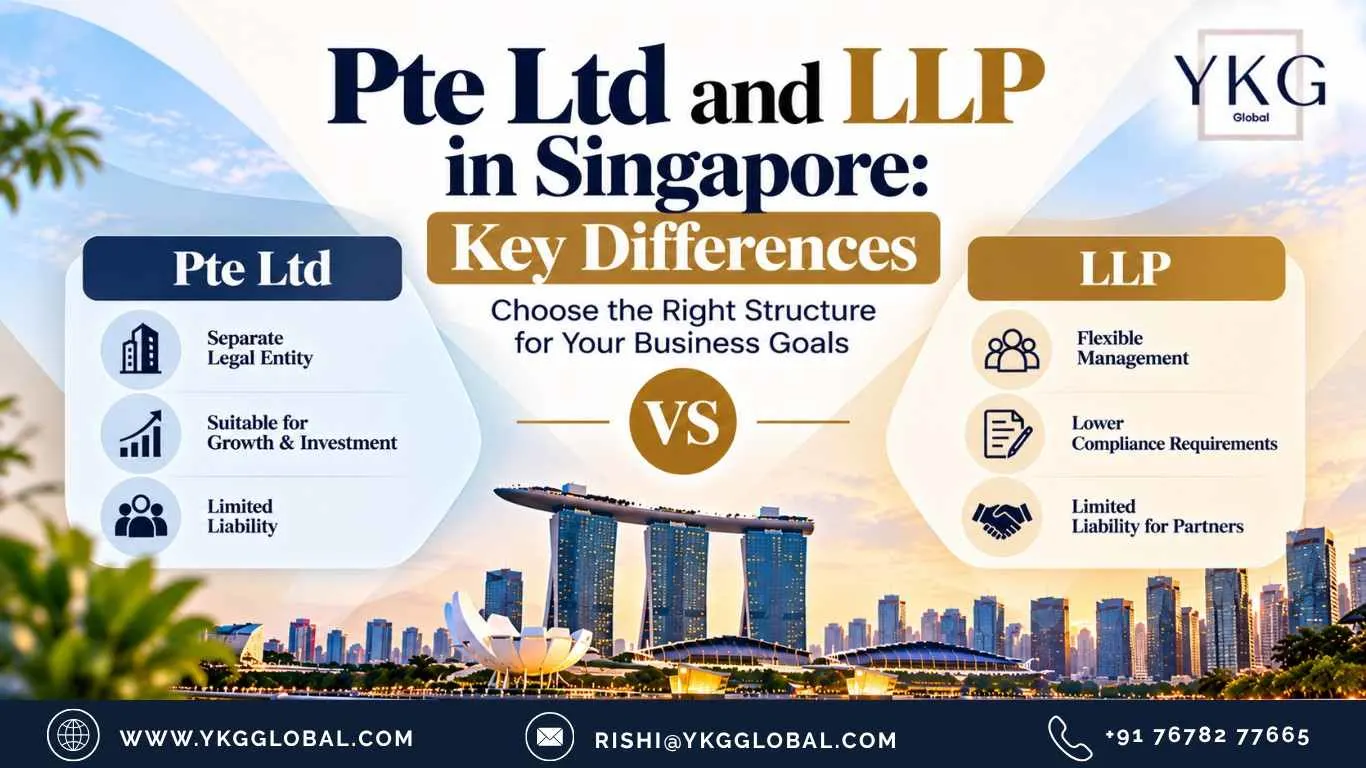
Singapore offers several business structures, but choosing between a Private Limited Company (Pte Ltd) and a Limited Liability Partnership (LLP) is an important decision for entrepreneurs and foreign investors. Although both structures provide a separate legal identity and certain liability protections, they differ in ownership, management, taxation and regulatory obligations.
A Pte Ltd is generally suited to businesses seeking a formal corporate structure, share-based ownership and opportunities for expansion. An LLP is often preferred by professional firms, consultants and partners who want flexibility in managing their business.
Before proceeding with company incorporation singapore, founders should consider their business model, investment plans, expected profits and long-term objectives. The right structure should support both current operations and future growth.
1. What Is a Pte Ltd in Singapore?
A Private Limited Company is a separate legal entity registered under Singapore's Companies Act. It can own assets, enter into contracts, employ staff and conduct business independently of its shareholders.
Ownership is divided into shares, while directors are responsible for managing the company in accordance with applicable laws. Shareholders and directors may be different people.
A Pte Ltd is commonly used by trading businesses, technology startups, manufacturing companies, consulting firms and international groups establishing a Singapore presence.
1.1 Key advantages include:
A. Limited liability for shareholders, subject to applicable legal exceptions.
B. Share-based ownership that can accommodate additional investors.
C. Continuity despite changes in shareholders or directors.
D. A recognised corporate structure for commercial contracts and expansion.
E. The ability to retain profits within the company for future business activities.
A Pte Ltd has more formal compliance requirements than an LLP, but this structure can be valuable when a business intends to scale or attract investment.
2. What Is an LLP in Singapore?
A Limited Liability Partnership combines partnership-style management with the status of a separate legal entity. It can enter into contracts, hold property and conduct business in its own name.
An LLP must have at least two partners and at least one manager who is ordinarily resident in Singapore. Partners generally have protection against personal liability for another partner's wrongful acts, but they remain responsible for their own wrongful acts and other liabilities imposed by law.
LLPs are often suitable for consulting firms, professional practices and businesses where partners actively contribute expertise and share profits.
2.1 Key advantages include:
A. Flexible arrangements for management and profit sharing.
B. Separate legal identity from the individual partners.
C. Protection from certain liabilities arising from another partner's actions.
D. Fewer formal corporate governance requirements than a Pte Ltd.
E. A partnership-based operating model for businesses managed collaboratively.
An LLP still has registration, record-keeping, tax and annual declaration obligations. Its simpler structure does not remove the need for proper administration.
3. Pte Ltd vs LLP: The Key Differences
3.1 Ownership and investment
A Pte Ltd is owned by shareholders, and ownership is represented by shares. This makes it easier to structure equity, introduce investors and transfer ownership through share transactions.
An LLP is owned by its partners. Their rights, contributions, profit-sharing arrangements and decision-making responsibilities are generally established through an LLP agreement.
Which is better? A Pte Ltd is usually more suitable for a startup seeking investors or a company planning substantial expansion. An LLP may be better for a small group of partners operating a professional or consulting business together.
3.2 Liability protection
In a Pte Ltd, shareholders are generally liable only to the extent of their agreed investment or unpaid share capital. However, directors must fulfil their legal duties, and personal guarantees can create separate personal obligations.
In an LLP, partners generally are not personally liable for another partner's wrongful acts merely because they are partners. However, they remain accountable for their own misconduct and may be personally liable under guarantees or other applicable legal obligations.
Which is better? Both structures provide meaningful liability protection. The appropriate choice depends on the risks associated with the business, its contracts and the responsibilities of its owners.
3.3 Management and decision-making
A Pte Ltd follows a formal governance structure. Directors manage the company's affairs, while shareholders exercise their rights under company law and the company's constitution.
An LLP allows partners to agree on how the business will be managed. They can define responsibilities, voting rights, profit distribution and procedures for resolving disagreements.
Which is better? An LLP offers flexibility for a partner-managed practice. A Pte Ltd may be preferable when ownership and day-to-day management need to be separated.
3.4 Taxation
A Pte Ltd is generally subject to Singapore corporate income tax, with a headline rate of 17% on chargeable income. Qualifying companies may benefit from applicable exemptions or tax rebates.
An LLP is generally treated as a partnership for income tax purposes. The LLP itself is not taxed at entity level on its business income. Instead, each partner is taxed on their share of the income according to their tax status. Individual partners are generally taxed under individual income tax rules, while corporate partners are generally taxed under corporate income tax rules.
The most suitable structure depends on expected profits, whether income will be retained or distributed, the owners' tax positions and any cross-border considerations.
Which is better? A Pte Ltd may suit a business that intends to retain profits for reinvestment. An LLP may align with a business where partners receive their respective shares of profits. A tax comparison should be based on actual financial projections rather than headline rates alone.
3.5 Compliance requirements
A Pte Ltd must maintain statutory records, appoint a company secretary within six months of incorporation and file annual returns with ACRA. Its financial statement and audit obligations depend on the applicable rules and the company's circumstances.
An LLP must maintain required records and registers, update relevant information with ACRA and file an annual declaration confirming whether it is solvent or insolvent.
Which is better? An LLP generally has fewer formal corporate administration requirements. A Pte Ltd involves additional compliance, which may be worthwhile for a business requiring a structured corporate framework.
3.6 Continuity and future growth
A Pte Ltd generally continues to exist independently of changes in its shareholders. Its shareholding can change without necessarily affecting the company's legal existence.
An LLP also continues until it is formally dissolved or struck off. However, changes in partners can affect management and profit-sharing arrangements, depending on the LLP agreement.
Which is better? A Pte Ltd is often more convenient for businesses planning to introduce investors, expand internationally or eventually sell the business.
4. Which Structure Should Foreign Entrepreneurs Choose?
Foreign entrepreneurs should consider the nature of their planned operations before deciding how to setup company in singapore.
A Pte Ltd may be suitable for a foreign business establishing a subsidiary, regional headquarters, trading operation or technology company. It offers a corporate ownership structure that can accommodate individual or corporate shareholders.
An LLP may be appropriate when two or more partners want to establish a consulting or professional services business and retain flexibility in their internal arrangements.
For setting up company in singapore by foreigner, residency and registration requirements are particularly important. A Pte Ltd must have at least one director who is ordinarily resident in Singapore and must appoint a company secretary within the prescribed period. An LLP must have at least one manager who is ordinarily resident in Singapore.
Foreigners without Singpass must engage a registered corporate service provider for the applicable registration process. Incorporating a business does not automatically provide immigration or work rights in Singapore.
Founders should also check whether their proposed activities require licences or regulatory approvals.
5. How to Choose the Right Structure
Before deciding to register a business in singapore, evaluate the following factors.
5.1 Choose a Pte Ltd if:
A. You expect to raise capital or introduce shareholders.
B. You want a corporate structure for a subsidiary or international business.
C. You plan to reinvest profits and expand operations.
D. You need clearly defined ownership and management responsibilities.
5.2 Consider an LLP if:
A. The business will be managed by two or more partners.
B. Partners want flexibility in sharing profits and responsibilities.
C. The business is primarily a professional or consulting practice.
D. Share-based investment is not central to the business plan.
Also consider the expected compliance workload, contractual risks, tax treatment and exit plans. A structure that appears suitable at registration may become less practical if the business model changes significantly.
6. Steps to Register a Pte Ltd or LLP
The registration process begins with selecting the appropriate structure and reserving an approved business name through ACRA's Bizfile platform.
For a Pte Ltd, founders generally need to prepare shareholder and director details, share capital information, a registered office address and the company's constitution. They must also satisfy the applicable local director requirements.
For an LLP, founders need at least two partners, a qualifying local manager, a Singapore registered office address and the required position-holder information.
Foreign founders who need assistance can work with a registered corporate service provider to complete the applicable registration process.
After registration, the business should establish accounting and record-keeping procedures, review tax filing requirements and obtain any necessary licences. A Pte Ltd must meet its corporate filing obligations, while an LLP must comply with its annual declaration and other continuing requirements.
Choosing the right structure before registration can help reduce the need for later restructuring.
How YKG Global Helps You
Selecting the appropriate structure requires consideration of ownership, compliance, tax and future business plans. YKG Global assists businesses with international company registration, entity setup and cross-border compliance.
For entrepreneurs considering business incorporation singapore, support may include:
1. Assessing whether a Pte Ltd or LLP better fits the proposed business model.
2. Assisting with registration documentation and coordination.
3. Identifying relevant ongoing corporate and tax compliance obligations.
4. Reviewing cross-border considerations for overseas shareholders and international business groups.
5. The objective is to help founders understand their options and prepare for the obligations associated with operating in Singapore.