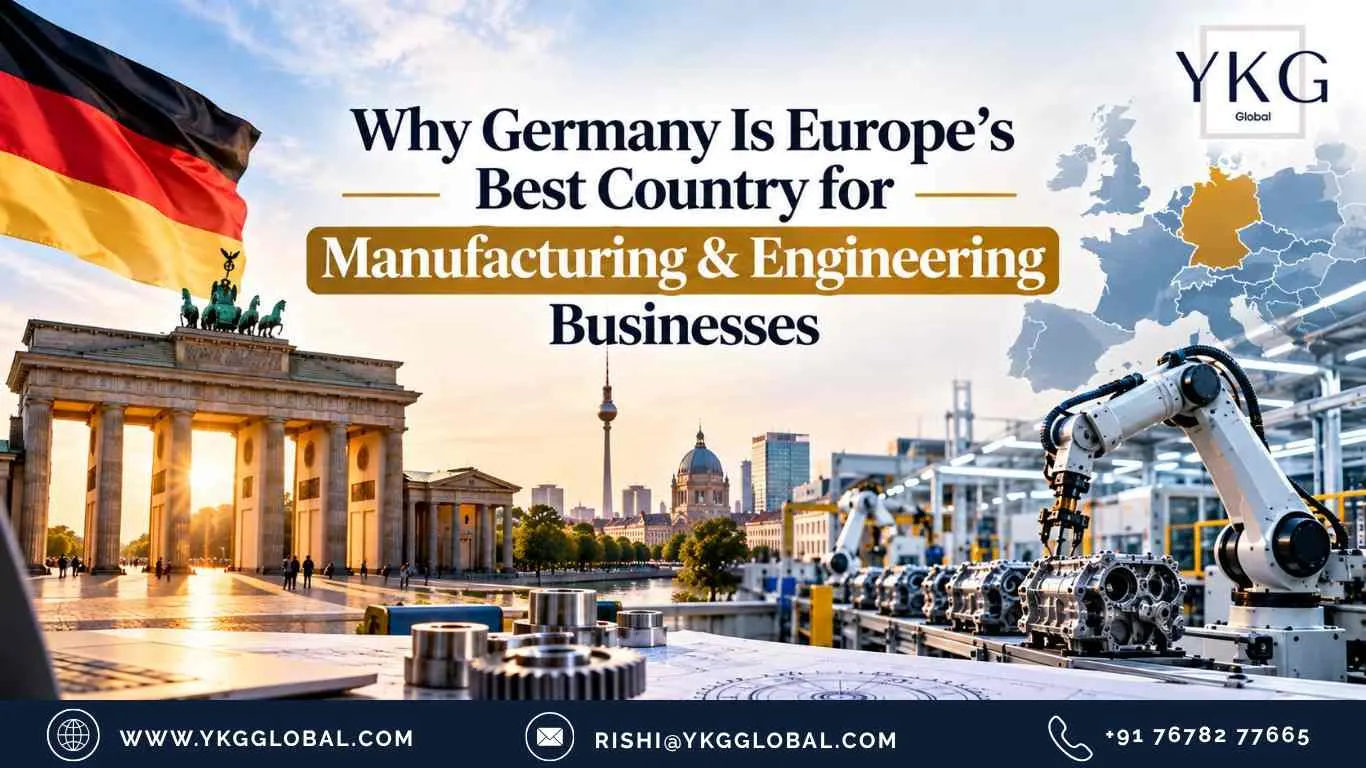
Why Germany Is Europe’s Best Country for Manufacturing and Engineering Businesses
Germany has built its reputation on precision engineering, industrial innovation, and high-quality manufacturing. From automotive components and industrial machinery to chemicals, electrical equipment, and advanced technologies, the country has an established ecosystem for businesses that develop and manufacture complex products.
For international companies planning European expansion, Germany offers more than access to a large domestic market. It combines experienced engineering talent, specialised suppliers, research institutions, industrial infrastructure, and access to the European Union's single market.
However, Germany is not automatically the right choice for every manufacturer. Operating costs, skilled-labour availability, energy requirements, and regulatory obligations must all be considered before making an investment.
This guide explains why Germany remains a compelling location for manufacturing and engineering businesses, which industries can benefit most, and what foreign companies should understand before establishing operations.
1. A Strong Industrial Base Across Multiple Sectors
Germany's manufacturing strength comes from a diverse industrial economy rather than a single dominant sector. Automotive production, mechanical engineering, chemicals, pharmaceuticals, electrical equipment, and industrial technologies all contribute to its manufacturing capabilities.
Germany's official economic information reported that manufacturing accounted for approximately 19.7% of gross value added in 2024. This highlights the sector's importance to the country's wider economy.
For businesses evaluating a manufacturing company in germany, this established industrial base offers access to specialised suppliers, technical service providers, equipment manufacturers, and experienced business partners.
1.1 Industries with established opportunities
A. Automotive and mobility: Components, vehicle systems, electric mobility, and production technologies.
B. Mechanical engineering: Industrial machinery, automation systems, precision equipment, and factory solutions.
C. Electrical and electronics: Industrial controls, sensors, electrical components, and automation technologies.
D. Chemicals and pharmaceuticals: Industrial chemicals, specialised materials, and pharmaceutical production.
E. Renewable energy and industrial technology: Energy-efficient equipment, power systems, and technologies supporting industrial decarbonisation.
The best opportunity depends on the product, customer base, and production model. Businesses should identify where their capabilities complement existing industrial demand rather than assuming that every sector offers equal growth potential.
2. Access to Established Suppliers and Industrial Clusters
One of Germany's most valuable advantages is the concentration of specialised companies within particular regions. These industrial clusters bring together manufacturers, component suppliers, engineering firms, research institutions, and technical service providers.
For example, Baden-Württemberg is associated with automotive engineering, machinery, and precision manufacturing. Bavaria has important automotive, electronics, and technology industries, while North Rhine-Westphalia has a strong industrial base spanning chemicals, engineering, and manufacturing.
These clusters can help businesses identify suppliers, recruit specialised employees, collaborate on product development, and build relationships with industrial customers.
When researching manufacturers in germany, foreign businesses should examine the relevant regional ecosystem, not just the largest companies. Smaller specialised suppliers may be equally important when sourcing components, arranging production, or developing a reliable supply chain.
Practical consideration: Choose a location based on supplier proximity, customer access, workforce availability, transport connections, and the cost of operating a facility. The most famous industrial region may not be the most economical option for your particular business.
3. Skilled Engineering Talent and Technical Expertise
Manufacturing and engineering businesses depend on people who can design products, operate equipment, maintain production systems, and improve manufacturing processes.
Germany has an established technical education system, vocational training pathways, universities, and applied research institutions. Its dual vocational training model combines classroom learning with practical workplace experience, helping develop skills relevant to industrial occupations.
This can benefit businesses that require technicians, production specialists, industrial engineers, and skilled tradespeople.
However, companies should not assume that every skill category is readily available. Demographic changes, regional labour shortages, and competition for specialised talent can affect recruitment.
3.1 What foreign businesses should plan for
A. Identify the technical roles needed before selecting a production location.
B. Check regional availability of engineers, technicians, and skilled production workers.
C. Budget for recruitment, training, and employee integration.
D. Assess whether German-language skills are necessary for safety, operations, and customer communication.
E. Understand employment contracts, workplace requirements, and applicable labour regulations.
F. Germany can provide access to a strong technical talent pool, but successful recruitment requires realistic workforce planning.
4. Research, Development, and Industrial Innovation
Germany is particularly relevant for businesses that compete through engineering quality, product performance, and continuous innovation.
Universities, applied research organisations, and industrial companies contribute to an ecosystem in which research can be translated into commercial applications. Institutions such as Fraunhofer institutes are known for applied research and collaboration with industry.
This environment can be useful for businesses developing automation systems, advanced materials, energy-efficient machinery, industrial software, and specialised manufacturing processes.
For example, an engineering company developing a new production system may benefit from collaboration with a research organisation to test prototypes, improve efficiency, or validate technical performance.
Companies should investigate the availability of relevant research partners and any applicable innovation support before committing to a location. Funding programmes have specific eligibility conditions, and support should never be assumed to be automatic.
5. Access to the European Single Market
Germany's central European location is a significant advantage for companies that intend to sell across multiple European countries.
Its road, rail, air, and freight infrastructure supports the movement of industrial components, finished products, and production equipment. Businesses can use Germany as a base for serving customers in neighbouring European markets, subject to applicable product, customs, tax, and regulatory requirements.
For an engineering company supplying machinery to customers across Europe, a German presence can support customer relationships, technical service, spare-parts distribution, and coordination with regional suppliers.
However, access to the European single market does not mean that every product can be sold without further compliance work. Product safety, conformity assessment, labelling, environmental rules, and sector-specific regulations may apply.
Practical consideration: Before establishing a distribution or production facility, map your target customers, transport routes, delivery timelines, and product compliance obligations. This will help determine whether Germany is the most suitable base for your European operations.
6. Quality Standards and International Business Credibility
German engineering is widely associated with precision, reliability, and technical performance. For industrial businesses, operating in a recognised manufacturing ecosystem can help with supplier relationships, technical collaboration, and access to customers that value engineering expertise.
This reputation is particularly relevant in sectors where product quality, equipment reliability, documentation, and after-sales support influence purchasing decisions.
However, establishing a company in Germany does not automatically make its products superior or guarantee customer confidence. Businesses must demonstrate their capabilities through quality-control systems, appropriate certifications, dependable delivery, and consistent product performance.
Foreign manufacturers should also assess the standards relevant to their particular industry. Depending on the product, these may include quality-management certifications, machinery safety requirements, environmental obligations, or customer-specific supplier approval procedures.
7. How to Establish a Manufacturing or Engineering Business in Germany
For foreign investors, business planning should begin well before the first production line is installed. Legal structure, site selection, funding, recruitment, tax, and regulatory requirements can all influence the cost and timing of market entry.
Step 1: Select the appropriate business structure
A foreign company can establish a German subsidiary or, where appropriate, register a branch office. The right structure depends on ownership, liability, management arrangements, tax considerations, and the intended scope of German operations.
A GmbH, Germany's private limited liability company, is a common choice for foreign investors seeking a separate German legal entity. It has formal incorporation requirements, including notarisation and registration.
Step 2: Complete company formation and registration
The process for company formation in germany depends on the selected legal structure and the circumstances of the founders.
For a GmbH, the process generally involves preparing the articles of association, completing the required notarisation, arranging the share capital, and applying for entry in the commercial register.
Businesses should also complete the applicable tax registration and notify the relevant local trade office about their activities. Additional permits may be necessary for regulated manufacturing operations.
Step 3: Understand the commercial register
The germany commercial register, known in German as the Handelsregister, records important information about registered businesses and companies. A GmbH becomes a legal entity upon registration in the commercial register.
The german business register is a separate information platform that makes certain business information available to the public. Companies should understand the difference between the commercial register, business-register publications, and other registration obligations.
Foreign founders should arrange the required corporate documents and check whether translations, authentication, or additional evidence are needed for their specific situation.
Step 4: Secure the industrial location
The site should match the company's production requirements. Consider power supply, logistics, zoning, environmental restrictions, access to suppliers, and proximity to customers.
Manufacturing facilities may need additional approvals for construction, emissions, waste handling, workplace safety, or specific production processes. These requirements should be investigated before signing a long-term lease or committing to a property purchase.
Step 5: Arrange finance, recruitment, and operations
Prepare a realistic financial plan covering equipment, premises, payroll, raw materials, utilities, insurance, and working capital.
Businesses should also plan recruitment, supplier contracts, quality management, and operational compliance. These arrangements can be as important to long-term success as the initial company registration.
8. Starting a Business in Germany as a Foreigner: What to Know
Starting a company in germany as a foreigner is possible, but the process depends on the founder's nationality, residence status, chosen legal structure, and business activity.
Foreign ownership is generally possible for many types of German businesses. However, incorporating a company and obtaining permission to reside in Germany or personally manage the business are separate matters.
Founders from outside the EU or European Economic Area should check the applicable visa and residence requirements if they intend to live in Germany or manage the business from there. Sector-specific approvals and investment-related rules may also need consideration, depending on the circumstances.
Before proceeding, clarify who will act as director, where management decisions will be made, how the business will be funded, and whether the proposed activities require special licences.
Professional support can help coordinate incorporation, tax registration, and compliance requirements, particularly where the parent company and owners are based overseas.
9. Challenges Businesses Should Evaluate Before Investing
Germany offers significant industrial strengths, but companies should assess its practical limitations as carefully as its advantages.
1. Operating costs: Labour, property, utilities, and compliance expenses can be substantial. Build a detailed financial model rather than relying on broad comparisons between countries.
2. Regulatory complexity: Companies may need to manage tax, employment, environmental, product-safety, and industry-specific obligations. Requirements depend on the activity and location.
3. Energy requirements: Energy-intensive production should be assessed against realistic energy prices, supply arrangements, and efficiency opportunities.
4. Recruitment: Specialist roles may be difficult to fill in certain regions. A workforce strategy should be prepared before production begins.
Market conditions: Industrial demand can fluctuate. Germany's Federal Statistical Office reported that industrial production fell by 1.1% overall in 2025 compared with 2024, illustrating why businesses should assess market conditions and sector-specific demand rather than assume uninterrupted growth.
Germany is best evaluated as a long-term industrial base whose suitability depends on the company's products, customers, costs, and operational capabilities.
How YKG Global Helps You
YKG Global supports businesses with international company formation, corporate compliance, and cross-border business advisory.
For companies planning to enter Germany, we can help coordinate incorporation requirements, assess the documentation needed for establishing a local entity, and explain relevant corporate compliance responsibilities.
We can also assist with planning the relationship between a foreign parent company and its German subsidiary or branch. The appropriate approach depends on the business model, ownership structure, and intended operations.
Manufacturing companies should obtain specialist advice on German tax, employment, environmental, technical, and licensing matters where applicable. Incorporation support is one part of establishing a compliant and commercially viable operation.