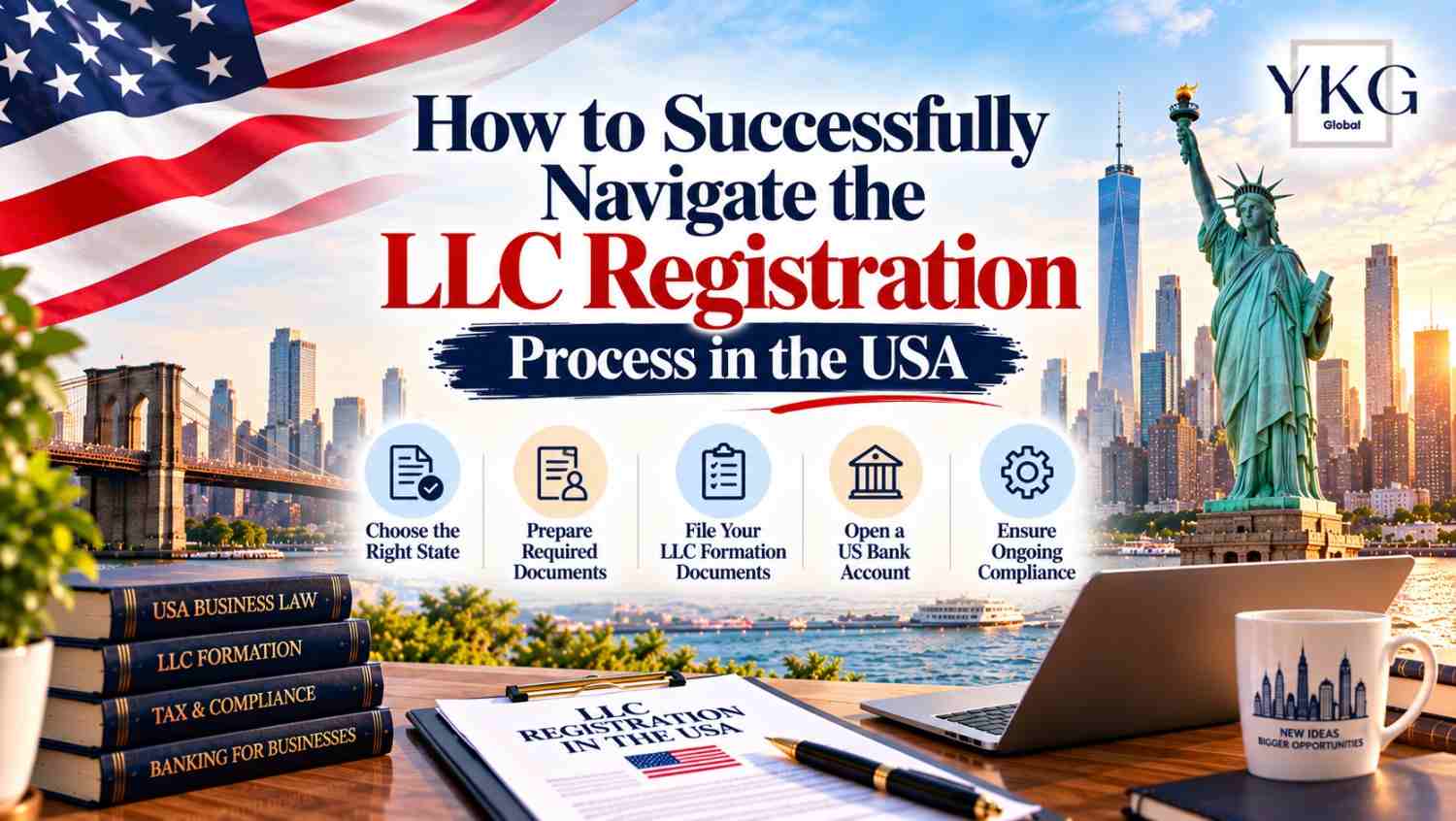
How to Successfully Navigate the LLC Registration Process in the USA
The United States offers entrepreneurs access to a large consumer market, established financial infrastructure, a strong business ecosystem, and opportunities to work with customers across industries. For many small businesses, consultants, digital service providers, and international entrepreneurs, a Limited Liability Company (LLC) is a practical structure to consider when entering the American market.
However, forming an LLC involves more than submitting an application. Entrepreneurs must choose a suitable state, check business-name availability, appoint a registered agent, prepare formation documents, understand tax obligations, and meet ongoing state requirements.
A well-planned company registration in usa process can help founders avoid unnecessary administrative complications and establish a stronger foundation for their operations.
What Is an LLC and Why Do Businesses Choose It?
An LLC is a business entity formed under state law. It generally provides limited liability protection to its members, subject to applicable law and circumstances. Members may include individuals and, in many states, companies or foreign entities.
Entrepreneurs often consider an LLC because it offers:
1. Limited liability: Members are generally not personally responsible for the LLC’s debts solely because they own the business.
2. Flexible ownership: An LLC can generally have one or multiple members.
3. Tax flexibility: Federal tax treatment depends on the number of members and any elections made.
4. Operational flexibility: The operating agreement can establish how the company is managed and how decisions are made.
An LLC is not automatically the best choice for every business. Founders should compare it with a corporation or other structure based on their ownership plans, fundraising needs, tax position, and commercial objectives.
Step 1: Choose the Right State for Your LLC
One of the most important decisions in the LLC registration in usa process is selecting the state in which to form the company.
There is no universally best state for every business. The right choice depends on where the company will operate, where its owners are based, the nature of its activities, and its long-term plans.
Consider the following factors:
1. Business location: Where will the company’s employees, office, customers, or business operations be located?
2. State compliance: What annual reports, tax filings, and other obligations apply?
3. Business activities: Does the state have relevant licensing or industry-specific requirements?
4. Future expansion: Will the company need to register in additional states?
States such as Delaware, Wyoming, and Florida are frequently considered by entrepreneurs, but their suitability depends on the facts. Forming an LLC in one state does not automatically eliminate registration or tax obligations in another state where the business operates.
Before deciding, compare the overall compliance requirements rather than relying only on a state's reputation.
Step 2: Select and Verify Your Business Name
Your LLC's name must satisfy the rules of the state where it is formed. States generally require the name to be distinguishable from existing registered entities and to include an appropriate designation, such as “LLC” or “Limited Liability Company.”
As part of united states company registration, founders should:
1. Search the relevant state's business-entity database.
2. Check the state's naming rules and restricted terms.
3. Review whether a similar trademark is already in use.
4. Check domain-name and social-media availability if the brand will operate online.
A name accepted by a state does not automatically provide nationwide trademark protection. Businesses planning to build a recognisable brand should consider a separate trademark search and appropriate intellectual property advice.
Step 3: Appoint a Registered Agent
An LLC generally needs a registered agent in its formation state. This agent receives official correspondence, legal notices, and service of process on behalf of the business.
Depending on state law, the registered agent may be an eligible individual resident or a business authorised to provide the service. The agent must meet the state's address and availability requirements.
For founders living outside the United States, a professional registered-agent service can help satisfy this requirement. However, a registered agent is not necessarily the same as a business office, tax representative, or authorised person for banking.
Confirm that the agent's details are correct before submitting formation documents, as incorrect information can delay the application or cause compliance problems.
Step 4: File the LLC Formation Documents
The formal registration process is generally handled by the state agency responsible for business entities, often the Secretary of State.
To register llc in usa, the founders typically submit Articles of Organization or a similarly named formation document. The exact terminology and filing process differ by state.
The application commonly asks for:
1. The proposed LLC name.
2. The registered agent's name and address.
3. The principal business address, where required.
4. Information about management or authorised persons.
5. Other details required by the relevant state.
Some states allow online filings, while others provide alternative submission methods. Processing times also vary, so businesses with launch deadlines should check the current requirements directly with the state authority.
After approval, retain the filed formation documents and any certificate or confirmation issued by the state. These records may be needed for banking, tax registration, contracts, and other business formalities.
Step 5: Prepare an Operating Agreement
An operating agreement sets out the LLC's internal governance arrangements. It can address ownership percentages, capital contributions, management responsibilities, voting rights, distributions, transfer of ownership, and procedures for resolving disputes.
Even where state law does not require an LLC to file an operating agreement, preparing one is generally a sensible practice.
For a single-member LLC, the agreement can document the owner's authority and the company's operating arrangements. For a multi-member LLC, it can help prevent misunderstandings by clarifying how important decisions are made.
The agreement is generally an internal company document rather than a formation document filed publicly with the state. Requirements and legal effects vary, so it should reflect the company's actual ownership and management structure.
Step 6: Obtain an Employer Identification Number (EIN)
An Employer Identification Number (EIN) is a federal tax identification number issued by the Internal Revenue Service (IRS). An LLC may need one for tax filings, hiring employees, opening a business bank account, or other business purposes.
The appropriate sequence is generally to form the LLC with the state first and then apply for an EIN when required.
For eligible applicants with a principal place of business in the United States, the IRS provides an online application. Applicants whose principal place of business is outside the United States generally cannot use that online application and may need to apply by an alternative method, such as telephone, fax, or mail, subject to IRS procedures.
The EIN application itself is free when made directly through the IRS.
Foreign founders should pay particular attention to the responsible-party details, taxpayer identification requirements, and application method applicable to their circumstances.
Step 7: Understand Federal and State Tax Obligations
LLC registration and tax registration are separate considerations. Completing the formation process does not mean that all federal, state, or local tax obligations have been addressed.
For federal income tax purposes, the IRS generally treats a domestic LLC with one member as a disregarded entity by default. An LLC with two or more members is generally treated as a partnership by default. An eligible LLC may elect corporate tax treatment.
These default classifications can have different reporting consequences. State tax treatment may also differ, and some states impose additional taxes or annual charges on LLCs.
Before commencing operations, review whether the business needs to register for:
1. Federal income-tax reporting.
2. State income or franchise taxes.
3. Sales and use taxes.
4. Payroll and employment taxes.
5. Industry-specific taxes or registrations.
Foreign-owned LLCs may have additional US tax filing and information-reporting obligations. The correct treatment depends on the owners, the entity's classification, its activities, and applicable tax rules.
Step 8: Open a Business Bank Account
A dedicated business bank account helps separate company transactions from the personal finances of its owners and supports clearer accounting records.
Banks establish their own onboarding and due-diligence requirements. They may request the LLC's formation documents, EIN confirmation, operating agreement, ownership information, identification documents, and details about the business's activities.
International founders should check these requirements before assuming that formation of an LLC guarantees access to a US bank account. Banks may assess the owner's location, business model, source of funds, expected transactions, and other risk factors.
Keeping complete records of company income, expenses, capital contributions, and distributions also helps support accurate financial reporting and tax compliance.
Step 9: Check Licences, Permits, and Ongoing Compliance
An LLC must continue meeting applicable obligations after formation. Depending on its activities and location, the company may need federal, state, county, or city licences and permits.
Ongoing requirements can include:
1. Filing annual or periodic reports with the state.
2. Maintaining a valid registered agent.
3. Paying applicable state taxes and fees.
4. Renewing business licences and permits.
5. Maintaining accounting and tax records.
6. Updating company information when required.
If the LLC conducts business in another state, it may need to register there through a process commonly called foreign qualification. Whether this is necessary depends on the company's activities and the relevant state's rules.
Compliance calendars and organised records can help founders avoid missed deadlines and maintain the LLC in good standing.
Common Mistakes to Avoid During LLC Formation
A smooth llc company registration in usa process depends on understanding both formation requirements and the obligations that follow.
Avoid these common mistakes:
1. Choosing a state based only on popularity: A state that works well for one business may create unnecessary administration for another.
2. Assuming an LLC eliminates every personal risk: Liability protection has limits and does not remove personal responsibility for every guarantee, wrongful act, or legal obligation.
3. Ignoring tax classification: An LLC's legal form does not automatically determine its most appropriate tax treatment.
4. Using incorrect application details: Inconsistent names, addresses, ownership information, or registered-agent details can delay filings.
5. Overlooking annual requirements: An approved formation document does not remove the need for ongoing compliance.
6. Assuming non-residents follow the same procedures as US residents: International founders may face different EIN application procedures, tax reporting rules, and banking requirements.
How YKG Global Helps You
YKG Global supports entrepreneurs and international businesses planning to establish or expand their presence in the United States. The appropriate support depends on the founder's circumstances, ownership structure, and intended business activities.
Our assistance can include:
1. Explaining the LLC formation process and helping identify the state-specific steps to review.
2. Coordinating documentation and registration requirements for register company in usa projects.
3. Helping founders understand EIN application procedures and the documents commonly required.
4. Identifying tax, reporting, and ongoing compliance considerations that may need professional review.
5. Supporting international entrepreneurs in coordinating company formation with their wider cross-border business plans.
For founders considering usa company registration, the objective should be to establish the right legal structure while planning for tax responsibilities, banking requirements, and continuing compliance from the outset.
Call us or fill out our contact form to schedule a consultation today.
📧 Email: Rishi@ykgglobal.com
🌐 Website: www.ykgglobal.com
📱 Call/WhatsApp: +91 76782 77665
📍 Offices: Delhi | Mumbai | Dubai | Singapore