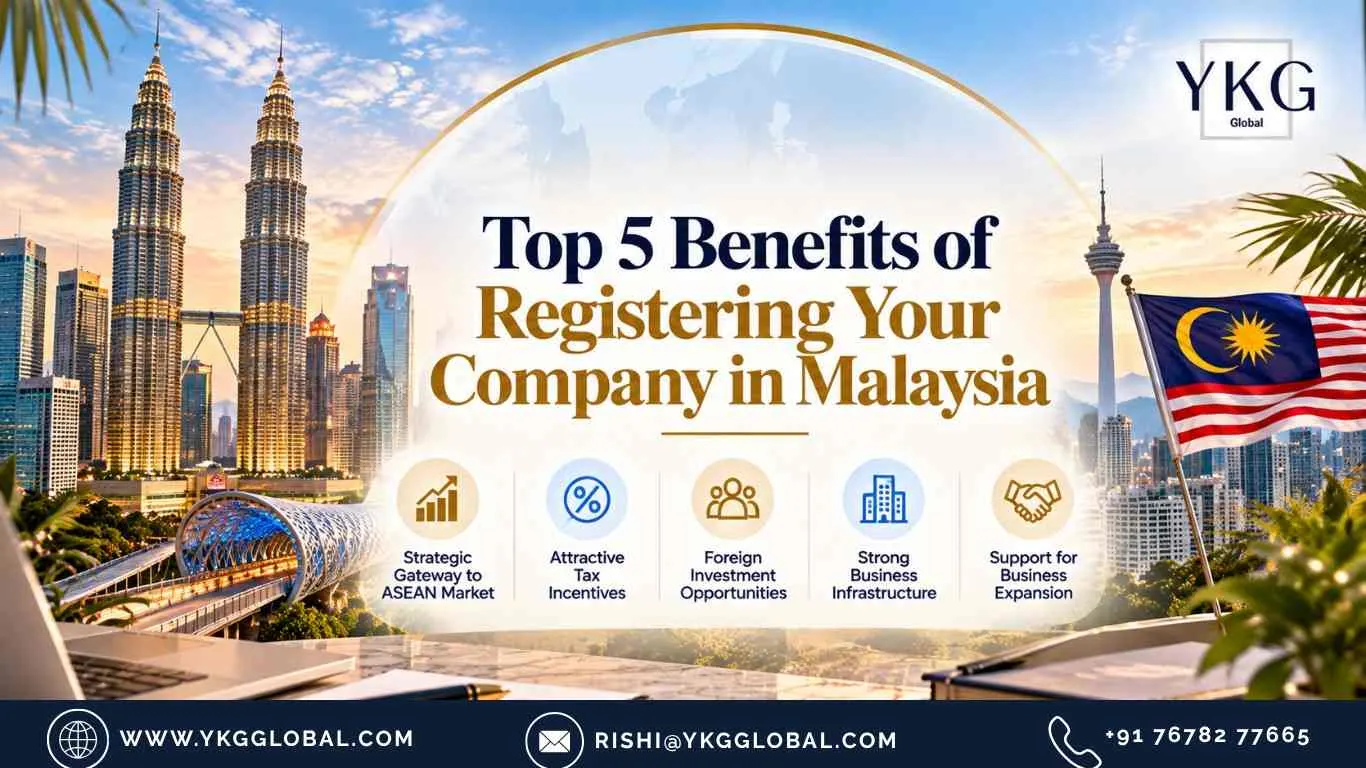
Top 5 Benefits of Registering Your Company in Malaysia
Malaysia has become an important destination for companies looking to establish operations in Southeast Asia. Its strategic position, developed infrastructure, diversified economy and established investment ecosystem make it relevant for both local entrepreneurs and international companies.
Recent investment data also shows continued investor interest. In the first half of 2026, Malaysia recorded RM218.5 billion in approved investments across services, manufacturing and primary sectors, with foreign investments accounting for RM126.9 billion.
For entrepreneurs considering company registration in Malaysia, the advantages go beyond simply obtaining a legal corporate structure. Registration can provide a foundation for entering the Malaysian market, developing regional operations, accessing business infrastructure and building longer-term commercial relationships.
Here are five important benefits to consider.
1. Strategic Access to the ASEAN Market
One of the biggest advantages of choosing Malaysia is its location in the centre of Southeast Asia.
Malaysia is positioned along important international trade routes and has established connections through airports, ports, highways and other transport infrastructure. Its location between major Asian markets can make it a practical base for companies that want to serve customers or suppliers across the region.
Malaysia also has an extensive network of international trade agreements. According to the Malaysian Investment Development Authority, the country has implemented 17 free trade agreements, including bilateral and regional agreements covering markets across Asia-Pacific and beyond.
This can be particularly relevant for companies involved in:
A. Import and export
B. Manufacturing
C. Technology and digital services
D. Logistics and distribution
E. Professional services
F. Regional headquarters and shared services
G. Consumer products
For an international entrepreneur, register a company in Malaysia can therefore be part of a wider regional expansion strategy rather than only a domestic market entry decision.
However, access to particular markets, tariff treatment and regulatory advantages depend on the company's activities, products, origin requirements and applicable trade rules.
2. Access to a Developed Business and Infrastructure Ecosystem
A second benefit is Malaysia's established commercial infrastructure.
Companies need more than a legal entity to operate effectively. They also require banking facilities, telecommunications, transportation, commercial premises, professional services, logistics and access to suppliers and employees.
Malaysia has developed infrastructure supporting a wide range of industries. MIDA reports that the country has more than 500 industrial parks, including specialised parks and high-technology facilities. These locations can provide access to utilities, logistics facilities, broadband connectivity, industrial premises and other supporting infrastructure.
This infrastructure is especially relevant for companies involved in manufacturing, technology, logistics, engineering and supply-chain operations.
The country's business ecosystem also supports service-sector companies. In the first half of 2026, the services sector attracted RM149.6 billion in approved investments, representing the largest share of Malaysia's approved investment activity. Information and communications was a major contributor, including investments connected with data centres, cloud computing and digital infrastructure.
Consequently, Malaysia company registration can provide a formal structure from which a company develops local operations and connects with suppliers, customers and professional service providers.
3. Opportunities for Foreign Investors and Regional Expansion
Malaysia is not limited to domestic entrepreneurs. Foreign investors can establish Malaysian companies, subject to the requirements applicable to their structure and industry.
Under Malaysia's Companies Act 2016 framework, a private company generally requires at least one director who ordinarily resides in Malaysia and at least one promoter. The Companies Commission of Malaysia also provides for online incorporation procedures.
For foreign founders, this makes the planning stage particularly important. Ownership, directorship, business activities, sector-specific conditions and the availability of a qualifying Malaysia-resident director should be considered before incorporation.
Malaysia also permits 100% foreign equity ownership in manufacturing and certain service sectors, although ownership conditions can vary depending on the specific sector and applicable regulations.
This means company formation in Malaysia can be relevant to international businesses that want to:
A. Establish a Southeast Asian operating company
B. Build a regional sales presence
C. Set up manufacturing or supply-chain operations
D. Provide services to Malaysian customers
E. Develop technology or digital operations
F. Coordinate regional activities from Malaysia
At the same time, foreign ownership should never be assumed to be unrestricted across every industry. Regulated sectors may have additional licensing, approval or equity requirements.
4. A Structured Legal Identity for Commercial Operations
Another important benefit is the legal separation and formal identity created by incorporation.
A Malaysian company incorporated under the Companies Act 2016 becomes a separate corporate entity. This distinction can be important when entering contracts, maintaining corporate records, dealing with suppliers, employing personnel and establishing longer-term commercial relationships.
The Companies Commission of Malaysia recognises several company structures, including companies limited by shares, companies limited by guarantee and unlimited companies. For many commercial ventures, the private company limited by shares is a commonly considered structure.
A formal corporate structure can also make it easier to define:
A. Share ownership
B. Directors and management responsibilities
C. Corporate decision-making
D. Company records
E. Contracts and commercial relationships
F. Financial and accounting responsibilities
The business registration Malaysia process therefore should not be viewed simply as obtaining a registration number. The chosen structure determines how the company is organised and how its statutory obligations are managed.
A company must also maintain a registered office in Malaysia and have a company secretary meeting the statutory requirements. SSM states that the first company secretary must be appointed within 30 days of incorporation.
5. A Foundation for Long-Term Business Growth
The fifth benefit is scalability.
Entrepreneurs may begin with a small operation but later need employees, suppliers, commercial premises, financing arrangements, additional shareholders or expanded business activities. Establishing an appropriate corporate structure at the beginning can provide a foundation for these developments.
Malaysia's investment environment is also evolving toward higher-value and technology-driven activities. In 2026, MIDA highlighted growth in areas including digital infrastructure, artificial intelligence, cloud computing, cybersecurity, advanced manufacturing and other technology-intensive sectors.
This creates opportunities for companies whose long-term plans extend beyond basic market entry.
A properly planned Malaysia company setup can support expansion through different stages, such as:
A. Establishing the company and completing statutory registrations.
B. Setting up operational and financial arrangements.
C. Developing local customer and supplier relationships.
D. Hiring employees and expanding business activities where permitted.
E. Entering additional Malaysian or regional markets.
F. Expanding production, technology or service capabilities.
Growth does not happen automatically after incorporation. The company still needs to comply with corporate, tax, employment, licensing and industry-specific requirements applicable to its activities.
What Should You Consider Before Incorporating in Malaysia?
The benefits of incorporation need to be evaluated against the company's actual business model.
Before deciding to incorporate a company in Malaysia, entrepreneurs should consider:
1. The intended business activities and industry classification
2. Whether the activity requires a specific licence or approval
3. Foreign ownership or equity conditions
4. The requirement for a Malaysia-resident director
5. Registered office and company secretary requirements
6. Tax and accounting obligations
7. Employment and immigration requirements where relevant
8. Intellectual property and data-related considerations
9. Import, export and customs requirements where applicable
These factors can differ considerably between industries. A manufacturing company, technology company, trading company and financial services company may face very different regulatory requirements even though all use a Malaysian corporate structure.
Why Choose YKG Global?
YKG Global supports entrepreneurs and international companies evaluating company registration in Malaysia as part of their global business expansion plans.
Our assistance can cover the corporate setup process, documentation coordination, incorporation requirements and related business establishment considerations. The objective is to help clients understand the Malaysian corporate framework and organise the setup according to their intended activities.
Malaysia can offer a strong combination of regional connectivity, infrastructure, investment opportunities and business ecosystem support. However, the real benefit of incorporation depends on selecting an appropriate structure and understanding the requirements that apply to the specific business.