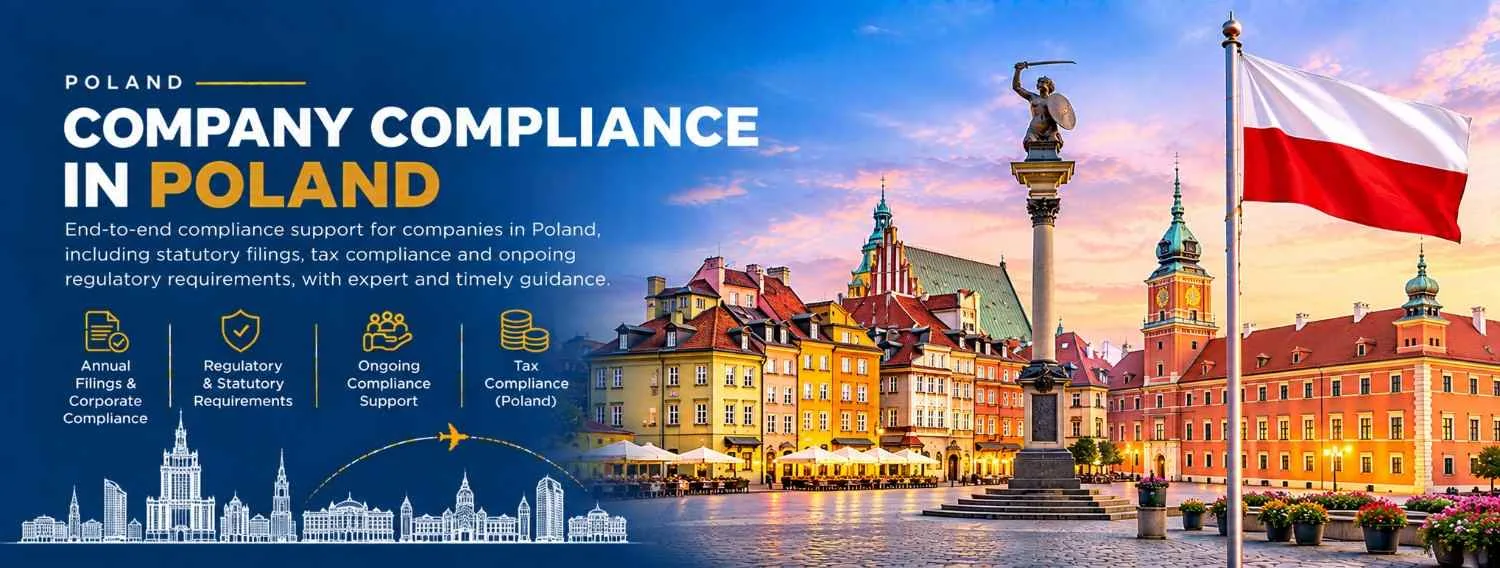
Annual Compliance and Filing in Poland
A Polish limited liability company (spółka z ograniczoną odpowiedzialnością, or sp. z o.o.) must satisfy several reporting obligations after incorporation. These responsibilities continue even when shareholders live abroad or business activity remains limited.
Annual compliance in Poland centres on electronic financial statements, shareholder approval, National Court Register submissions and corporate income tax reporting.
Poland's system is distinctive because submitting a tax return does not replace filing financial statements with the court registry. Companies must also monitor beneficial ownership changes and maintain accounting records in prescribed formats.
1. Poland's Three-Stage Annual Reporting Cycle
For companies using a calendar financial year, annual reporting follows three principal stages.
1.1 Prepare Financial Statements
The management board generally ensures that annual financial statements are prepared within three months after financial year-end.
1.2 Obtain Shareholder Approval
The ordinary shareholders' meeting generally approves the financial statements within six months after year-end.
1.3 Submit Documents to KRS
Approved financial statements and supporting documents must generally reach the National Court Register within 15 days after approval.
These stages form the foundation of Poland company annual filing requirements.
2. Electronic Financial Statements and Signatures
Poland requires prescribed financial statements to be prepared electronically.
2.1 Required Documents
Depending on company circumstances, the reporting package may include:
• Balance sheet.
• Profit and loss account.
• Notes and accounting disclosures.
• Management report, where required.
• Auditor's report, where applicable.
2.2 Electronic Format
Companies generally prepare structured financial statements using the applicable Ministry of Finance format.
2.3 Electronic Signatures
Financial statements require prescribed signatures from responsible persons, subject to statutory procedures for management boards.
2.4 Foreign Directors
Overseas directors should arrange suitable electronic signing arrangements well before the filing deadline.
Proper KRS financial statement filing requires both accurate accounting information and technically valid electronic documents.
3. The Shareholders' Meeting and Profit Distribution
The annual shareholders' meeting is a significant governance event for a Polish limited liability company.
3.1 Ordinary Meeting Agenda
The meeting generally considers:
• Approval of annual financial statements.
• Approval of the management report, where applicable.
• Allocation of profits or treatment of losses.
• Discharge of management and supervisory board members.
3.2 Deadline
For a calendar-year company, the ordinary shareholders' meeting generally takes place by 30 June.
3.3 Dividend Decisions
Dividend distributions must satisfy applicable company law requirements and the company's financial position.
3.4 Retaining Resolutions
Meeting minutes and shareholder resolutions should be maintained with statutory corporate records.
4. KRS Filing and Overdue Accounts
The National Court Register, known as KRS, maintains corporate records and receives prescribed financial documents.
4.1 Filing Procedure
Eligible companies submit documents electronically through the relevant financial document repository.
4.2 Unapproved Accounts
If financial statements are not approved within the statutory period, they must still be filed in accordance with the applicable procedure.
Following approval, the company submits the approved documents within the prescribed period.
4.3 Consequences of Non-Compliance
Overdue reporting may result in court enforcement proceedings, fines and other statutory consequences.
4.4 Changes to Corporate Particulars
Changes involving directors, registered offices, articles or share capital may require separate KRS applications.
5. CIT-8 Corporate Income Tax Return
Corporate income tax is administered independently of the court registry.
5.1 Annual CIT-8 Filing
Companies generally submit an electronic CIT-8 return reporting taxable income or losses.
5.2 Filing Deadline
The return is generally due by the end of the third month after the tax year closes.
For a calendar-year company, this ordinarily means 31 March.
5.3 Corporate Tax Rates
Poland's standard corporate income tax rate is 19%.
A preferential 9% rate may apply to qualifying small taxpayers and certain new businesses for eligible income, subject to statutory conditions.
5.4 Tax Payment
Any remaining corporate income tax is generally payable by the annual return deadline.
Accurate CIT-8 tax return Poland preparation requires reconciling accounting profit with taxable income and applicable adjustments.
6. Beneficial Ownership and the CRBR Register
Polish companies must maintain prescribed information concerning their ultimate beneficial owners.
6.1 Central Register
The Central Register of Beneficial Owners, or CRBR, records individuals exercising qualifying ownership or control.
6.2 Reporting Changes
Applicable changes generally require notification within 14 days, subject to statutory rules for calculating the deadline.
6.3 Overseas Ownership
Where shareholders are foreign companies, determining ultimate beneficial ownership may require examining multiple ownership layers.
6.4 Penalties
Failure to report required information accurately may expose companies to substantial administrative penalties.
CRBR beneficial ownership reporting is event-driven rather than a routine annual confirmation filed with financial statements.
7. VAT, JPK and Digital Tax Compliance
Poland's tax administration places considerable emphasis on structured electronic reporting.
7.1 VAT Registration
Businesses conducting taxable activities must assess Polish VAT registration requirements and applicable exemptions.
7.2 JPK_V7 Reporting
Registered VAT taxpayers generally submit prescribed electronic VAT records and declarations through the JPK_V7 framework.
7.3 Reporting Frequency
Monthly or quarterly settlement arrangements depend on taxpayer eligibility and applicable rules.
7.4 KSeF Electronic Invoicing
Poland's National e-Invoicing System, KSeF, introduces mandatory structured invoicing in phases during 2026, with implementation dates depending on taxpayer circumstances.
Companies should confirm their applicable commencement date and available transitional provisions.
8. Statutory Audits and Foreign-Owned Companies
Not every Polish limited liability company requires a statutory financial statement audit.
8.1 Audit Assessment
Audit obligations depend on legal form, business activities and statutory size criteria.
8.2 Size Thresholds
Certain entities must undergo an audit when at least two prescribed thresholds concerning assets, revenue and employment are exceeded in the preceding financial year.
8.3 Foreign Shareholders
Foreign ownership alone does not automatically create a statutory audit obligation.
8.4 Cross-Border Transactions
Related-party services, financing, royalties and management charges may create transfer pricing or withholding tax responsibilities.
Understanding Poland statutory audit requirements helps international groups plan reporting costs and appoint auditors when necessary.
9. How YKG Global Helps You
YKG Global supports Polish companies and international investors with statutory reporting and tax compliance coordination through appropriately qualified local professionals.
9.1 Financial Statement Preparation
Coordinating annual accounting records and electronic reporting documentation.
9.2 KRS Compliance
Supporting shareholder resolutions, statutory filings and corporate record updates.
9.3 Corporate Tax Reporting
Assisting with CIT-8 documentation, tax computations and applicable reporting schedules.
9.4 Beneficial Ownership
Coordinating CRBR information and changes involving foreign shareholders.
9.5 Ongoing Tax Compliance
Supporting VAT, electronic invoicing and cross-border reporting coordination.
Through its company compliance services Poland, YKG Global helps businesses manage regulatory deadlines and maintain organised financial records.
Call us or fill out our contact form to schedule a consultation today.
📧 Email: Rishi@ykgglobal.com
🌐 Website: www.ykgglobal.com
📱 Call/WhatsApp: +91 76782 77665
📍 Offices: Delhi | Mumbai | Dubai | Singapore