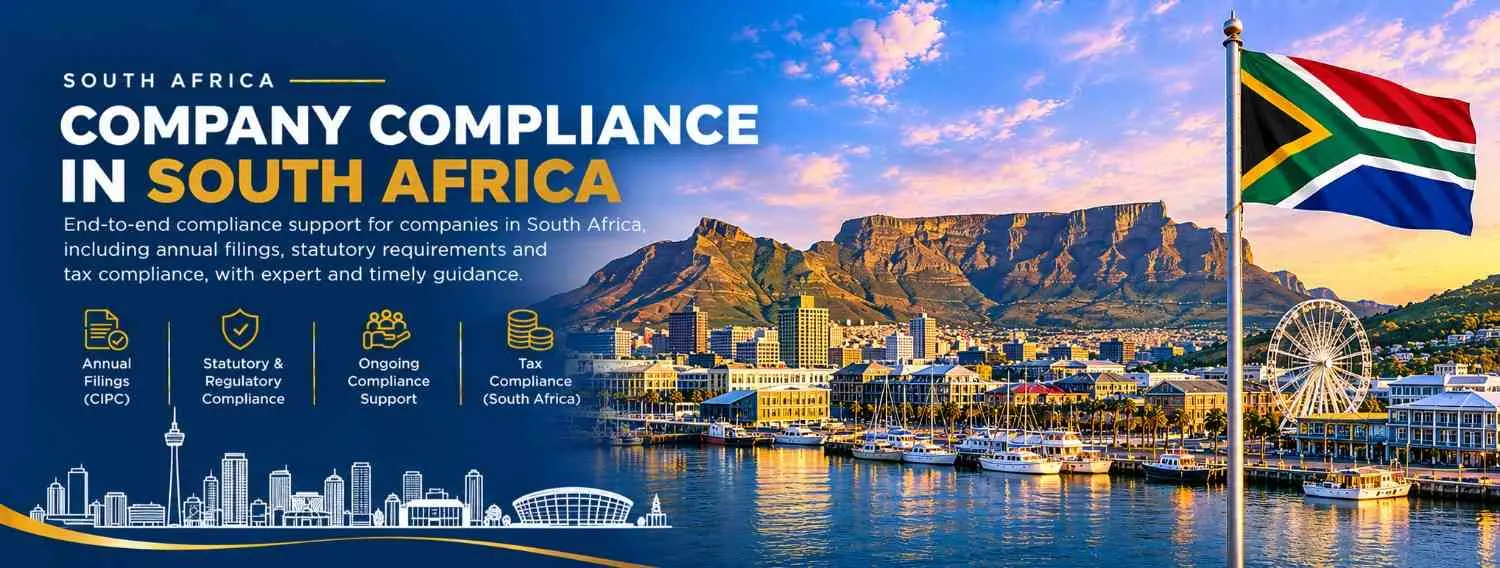
Annual Compliance and Filing in South Africa
Operating a company in South Africa involves more than maintaining a valid registration certificate. Businesses must meet corporate disclosure, financial reporting and taxation obligations administered by different regulatory authorities.
Annual compliance in South Africa is primarily governed by the Companies Act, 2008, the Companies and Intellectual Property Commission (CIPC), and the South African Revenue Service (SARS).
A distinctive feature of South African compliance is that annual returns, beneficial ownership declarations and financial accountability information are interconnected. Companies cannot treat these as entirely separate administrative tasks.
For foreign investors, subsidiaries and locally owned private companies, understanding these requirements is essential for maintaining legal status and avoiding penalties.
1. Understanding South Africa's Compliance Framework
South African companies generally interact with two principal authorities.
1.1 Companies and Intellectual Property Commission
CIPC oversees company registration, annual returns, corporate records and beneficial ownership disclosures.
1.2 South African Revenue Service
SARS administers corporate income tax, provisional tax, VAT and employment-related taxes.
1.3 Separate Compliance Calendars
CIPC filings follow the company's incorporation anniversary, while corporate tax returns generally follow its financial year-end.
Businesses should therefore maintain separate statutory and taxation calendars.
2. CIPC Annual Returns and Filing Deadlines
Every registered company must assess its annual return obligations under the Companies Act.
2.1 Filing Period
Companies generally submit annual returns within 30 business days after their incorporation anniversary.
For example, a company incorporated on 10 June normally enters its annual filing period following 10 June each year.
2.2 Information Required
The CIPC annual return filing process generally involves:
• Company registration number and legal particulars.
• Annual turnover information.
• Updated beneficial ownership information.
• Financial statements or applicable accountability information.
• Confirmation of prescribed compliance details.
2.3 Annual Return Fees
CIPC annual return fees depend on the company's turnover and applicable fee category.
Late submissions attract additional charges. Businesses should verify their applicable amount through the CIPC filing portal.
3. Beneficial Ownership Reporting Is Mandatory
South Africa has strengthened its corporate transparency requirements through amendments addressing money laundering and financial crime.
3.1 Beneficial Ownership Declarations
Companies must maintain and submit prescribed information identifying individuals who ultimately own or control the business.
3.2 Annual Return Integration
CIPC requires beneficial ownership information to be current before allowing the annual return process to proceed.
3.3 Supporting Registers
Depending on the entity's circumstances, relevant securities registers or beneficial interest registers must accompany prescribed submissions.
3.4 Foreign Corporate Shareholders
Where a South African subsidiary is owned by an overseas company, ownership structures may need examination beyond the immediate corporate shareholder.
Timely beneficial ownership filing South Africa is particularly important for multinational groups with layered ownership arrangements.
4. Annual Financial Statements and Public Interest Score
South Africa does not require every private company to undergo the same level of financial examination.
4.1 Public Interest Score
The Public Interest Score considers factors including employee numbers, third-party liabilities, turnover and beneficial interest holders.
4.2 Mandatory Audits
Private companies may require statutory audits depending on their Public Interest Score, financial statement preparation method or activities.
For example, audit requirements can arise where:
• Internally compiled financial statements accompany a PIS of at least 100.
• Independently compiled statements accompany a PIS of at least 350.
• The company holds qualifying fiduciary assets exceeding R5 million.
4.3 Independent Review
Certain companies not requiring an audit may still require an independent review.
Owner-managed companies may qualify for specific exemptions, depending on applicable conditions.
4.4 Financial Accountability Supplement
Companies not submitting full financial statements to CIPC may need to submit a Financial Accountability Supplement.
Understanding South Africa company audit requirements helps businesses avoid unnecessary audit costs while meeting statutory obligations.
5. SARS Corporate Income Tax Returns
Corporate income tax compliance operates independently of the CIPC annual return.
5.1 ITR14 Return
Companies generally submit the ITR14 income tax return through SARS eFiling.
5.2 Filing Deadline
The SARS corporate income tax return is generally due within 12 months after the company's financial year-end.
5.3 Corporate Tax Rate
The standard corporate income tax rate is generally 27% for applicable years of assessment.
Qualifying small business corporations may benefit from special graduated rates.
5.4 Tax Documentation
Businesses should prepare:
• Annual financial statements.
• Tax computation and adjustments.
• Supporting invoices and accounting records.
• Relevant capital allowance and assessed loss schedules.
Companies should reconcile their tax returns with financial statements and other SARS submissions.
6. Provisional Tax and Additional SARS Filings
Annual income tax filing is only one component of South African tax compliance.
6.1 Provisional Tax
Companies generally make provisional tax submissions using IRP6.
The first payment is ordinarily due six months into the financial year, with the second at year-end. A voluntary third payment may apply.
6.2 Value-Added Tax
VAT-registered businesses must submit VAT201 returns according to their assigned filing periods.
6.3 Payroll Taxes
Employers may need monthly PAYE declarations through EMP201 and periodic EMP501 reconciliations.
6.4 Other Tax Obligations
Depending on activities, businesses may also face dividends tax, withholding taxes and transfer pricing documentation requirements.
These obligations form part of broader South Africa company annual compliance requirements.
7. What Happens When a Company Misses Its Filings?
South African non-compliance can affect the company's continued registration.
7.1 Late Filing Penalties
Overdue annual returns can result in increased filing charges.
7.2 Deregistration Risk
Persistent failure to submit annual returns may result in CIPC initiating deregistration proceedings.
7.3 Beneficial Ownership Restrictions
Outdated beneficial ownership information may prevent completion of annual returns.
7.4 Tax Consequences
Late SARS submissions can result in penalties, interest and additional enforcement action.
Companies should address outstanding obligations before they accumulate across multiple reporting periods.
8. Foreign-Owned Subsidiaries and Dormant Companies
Foreign investors must distinguish ownership arrangements from the company's continuing statutory responsibilities.
8.1 Foreign-Owned Private Companies
A South African company owned by overseas shareholders generally remains subject to CIPC and SARS requirements.
8.2 External Companies
Registered external companies follow specific CIPC filing procedures, including Form CoR 30.3.
8.3 Dormant Companies
A company without trading activity may still require annual returns, beneficial ownership reporting and applicable tax submissions.
8.4 Cross-Border Transactions
Management fees, royalties, intercompany loans and related-party transactions may create additional taxation and documentation obligations.
9. How YKG Global Helps You
YKG Global assists South African businesses, international investors and foreign-owned subsidiaries with recurring compliance coordination through appropriately qualified local professionals.
9.1 CIPC Annual Returns
Coordinating filing information, turnover details and statutory submissions.
9.2 Beneficial Ownership Compliance
Assisting with ownership documentation and prescribed declarations.
9.3 Accounting and Financial Reporting
Supporting annual accounts preparation and audit or independent review coordination.
9.4 SARS Tax Compliance
Coordinating corporate income tax, provisional tax and applicable indirect tax requirements.
9.5 Ongoing Compliance Monitoring
Maintaining filing calendars and supporting corporate record updates.
Through its company compliance services South Africa, YKG Global helps businesses maintain organised statutory and taxation reporting.
Call us or fill out our contact form to schedule a consultation today.
📧 Email: Rishi@ykgglobal.com
🌐 Website: www.ykgglobal.com
📱 Call/WhatsApp: +91 76782 77665
📍 Offices: Delhi | Mumbai | Dubai | Singapore