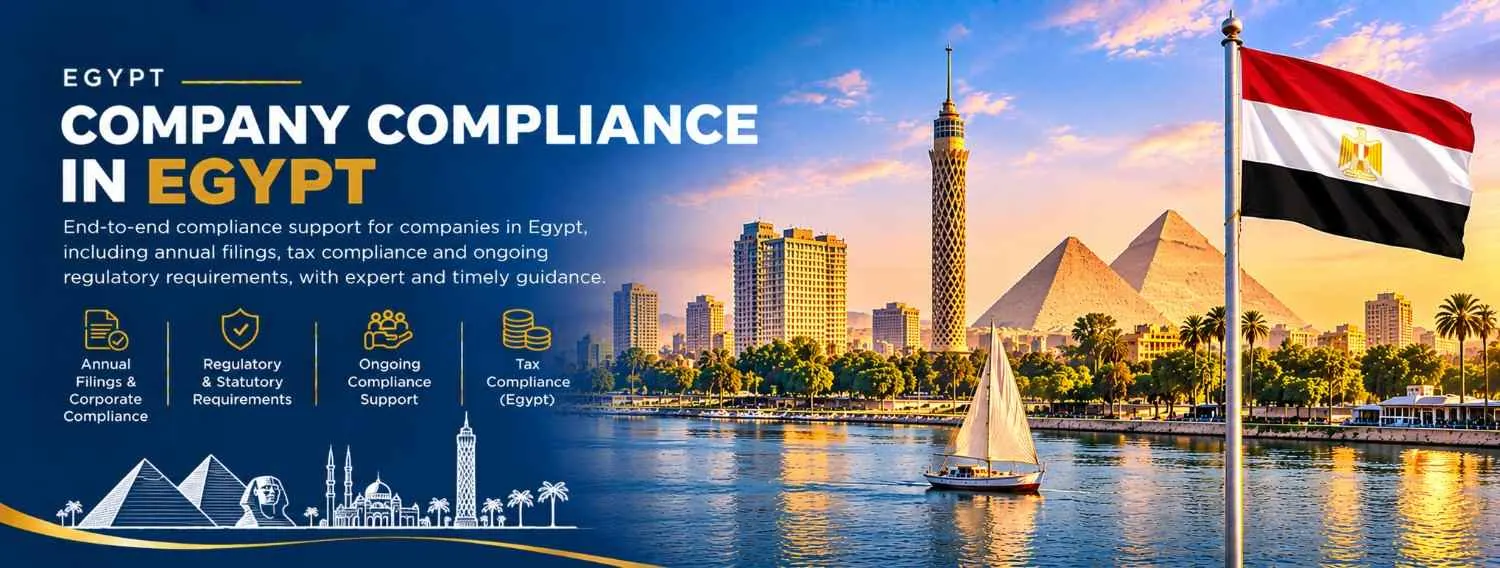
Annual Compliance and Filing Services in Cairo, Egypt
Cairo is Egypt's principal commercial centre, attracting multinational companies, trading businesses, manufacturers and professional service providers. Establishing a business here creates ongoing responsibilities involving corporate governance, financial reporting, taxation and investment disclosures.
Businesses seeking annual compliance services in Cairo must understand the different roles of the General Authority for Investment and Free Zones (GAFI), the Egyptian Tax Authority (ETA) and other regulatory bodies.
Unlike jurisdictions with a single annual company return, Egypt requires businesses to coordinate several statutory processes. These depend on company structure, financial year, ownership and commercial activities.
1. How Corporate Compliance Works in Cairo
Companies operating in Cairo generally follow Egypt's national corporate legislation rather than a separate municipal annual filing system.
1.1 General Authority for Investment and Free Zones
GAFI administers investment-related corporate services, including certain company amendments, general meeting documentation and foreign investment reporting.
1.2 Egyptian Tax Authority
The ETA oversees corporate income tax, Value Added Tax, electronic invoicing and applicable withholding obligations.
1.3 Other Authorities
Depending on the activity, companies may also deal with the Commercial Registry, social insurance authorities and industry-specific regulators.
Effective Cairo company annual filing requirements management begins by identifying the company's legal form and regulatory registrations.
2. General Meetings and GAFI Documentation
Corporate governance is particularly important for Egyptian joint-stock companies and limited liability companies.
2.1 Annual General Meetings
Companies must observe the meeting requirements applicable to their legal structure and governing legislation.
Annual meetings generally address financial performance, management reports, financial statements and auditor-related matters.
2.2 Meeting Documentation
GAFI's 2026 Investor Service Center guidance identifies documents required for ratifying ordinary general meeting minutes.
These may include:
• Signed and stamped meeting minutes.
• Shareholder or director attendance records.
• Evidence of meeting invitations.
• Financial statements and auditor reports, where discussed.
• Recent Commercial Registry extracts.
2.3 Document Ratification
Where required, companies submit meeting documentation through the prescribed GAFI procedure.
Professional GAFI annual compliance services help businesses prepare complete records and coordinate applicable ratification requirements.
3. Annual Financial Statements and Statutory Audit
Egyptian companies must maintain accounting records and prepare financial statements according to applicable legislation and accounting standards.
3.1 Financial Statements
Annual reporting generally involves:
• Balance sheet.
• Income statement.
• Cash flow statement, where applicable.
• Notes to financial statements.
• Supporting accounting schedules.
3.2 Auditor Appointment
Companies subject to statutory audit requirements must appoint an appropriately qualified auditor.
3.3 Audit Documentation
Auditors review accounting records, supporting evidence and financial reporting disclosures.
3.4 Shareholder Approval
Applicable companies present annual financial statements and auditor reports to shareholders or partners through prescribed governance procedures.
Professional statutory audit services Cairo should be coordinated early enough to support tax filings and corporate meetings.
4. Corporate Income Tax Filing
Corporate income tax is a major recurring obligation for companies operating in Cairo.
4.1 Standard Tax Rate
Egypt's general corporate income tax rate is 22.5%, although particular sectors and activities may be subject to different rules.
4.2 Filing Deadline
Corporate income tax returns are generally due within four months after the company's financial year-end.
For calendar-year companies, the ordinary deadline is 30 April of the following year.
4.3 Electronic Submission
Companies submit applicable returns electronically through the ETA's designated tax systems.
4.4 Supporting Records
Tax computations should reconcile accounting profits with taxable income, including allowable expenses, depreciation adjustments and other relevant items.
Reliable corporate tax filing services Cairo involve reviewing accounting records well before the filing deadline.
5. Electronic Invoicing and VAT Compliance
Egypt's digital tax administration makes transaction-level compliance particularly important.
5.1 Electronic Invoicing
Businesses within the applicable electronic invoicing framework must issue compliant invoices using prescribed digital procedures.
5.2 Electronic Receipts
Certain business-to-consumer transactions fall within Egypt's electronic receipt system.
5.3 VAT Obligations
The standard VAT rate is generally 14%, subject to applicable exemptions, special rates and sector-specific treatment.
5.4 VAT Returns
Registered businesses generally submit periodic VAT returns under the prescribed reporting framework.
5.5 Supporting Documentation
Businesses should maintain accurate invoice records, transaction classifications and supporting tax documentation.
Effective Egypt electronic invoicing compliance helps reduce inconsistencies between accounting records and tax declarations.
6. Foreign Investment Reporting and Overseas Ownership
Cairo attracts foreign-owned companies operating in consulting, technology, manufacturing and international trade.
6.1 GAFI Investment Reports
Companies falling within applicable investment reporting requirements may need to provide information concerning foreign ownership and investment activity.
6.2 Share Capital Changes
Capital increases, share transfers and ownership restructuring may require corporate approvals and prescribed regulatory updates.
6.3 Cross-Border Transactions
Management fees, royalties, intercompany loans and related-party services may create transfer pricing or withholding tax considerations.
6.4 Foreign Currency Records
Businesses should maintain supporting documentation for international payments and relevant banking transactions.
Professional foreign owned company compliance Cairo requires coordination between corporate records, accounting and international tax reporting.
7. Payroll, Social Insurance and Withholding Tax
Companies employing personnel must manage responsibilities beyond annual corporate filings.
7.1 Payroll Tax
Employers must assess applicable salary tax withholding and reporting obligations.
7.2 Social Insurance
Eligible employees must be registered under the relevant social insurance framework, with prescribed contributions paid.
7.3 Withholding Obligations
Certain domestic and cross-border payments may attract withholding tax requirements.
7.4 Employee Records
Businesses should maintain employment contracts, payroll calculations and supporting contribution records.
These recurring obligations should be included in the company's compliance calendar.
8. Common Compliance Risks for Cairo Businesses
Several practical issues can increase regulatory exposure.
8.1 Delayed Financial Statements
Late bookkeeping can disrupt audits, shareholder meetings and corporate tax submissions.
8.2 Incomplete Corporate Records
Missing resolutions or outdated shareholder information can complicate GAFI procedures.
8.3 Incorrect Electronic Invoices
Errors in invoice classification or documentation can affect tax reporting and expense substantiation.
8.4 Inactive Companies
A company with limited activity may still have corporate, tax or reporting obligations until formally closed or otherwise exempted.
Regular compliance reviews help identify these issues before deadlines arise.
9. How YKG Global Helps You
YKG Global supports Cairo-based businesses and international investors with coordinated corporate, accounting and taxation compliance services.
9.1 Corporate Compliance
Assisting with GAFI documentation, statutory records and applicable corporate submissions.
9.2 Financial Reporting
Supporting bookkeeping, annual financial statements and statutory audit coordination.
9.3 Tax Compliance
Coordinating corporate tax returns, VAT documentation and electronic invoicing requirements.
9.4 Foreign Investment Support
Assisting overseas-owned companies with investment reporting and cross-border documentation.
9.5 Compliance Monitoring
Maintaining reporting calendars and coordinating filings with appropriately qualified Egyptian professionals.
Call us or fill out our contact form to schedule a consultation today.
📧 Email: Rishi@ykgglobal.com
🌐 Website: www.ykgglobal.com
📱 Call/WhatsApp: +91 76782 77665
📍 Offices: Delhi | Mumbai | Dubai | Singapore