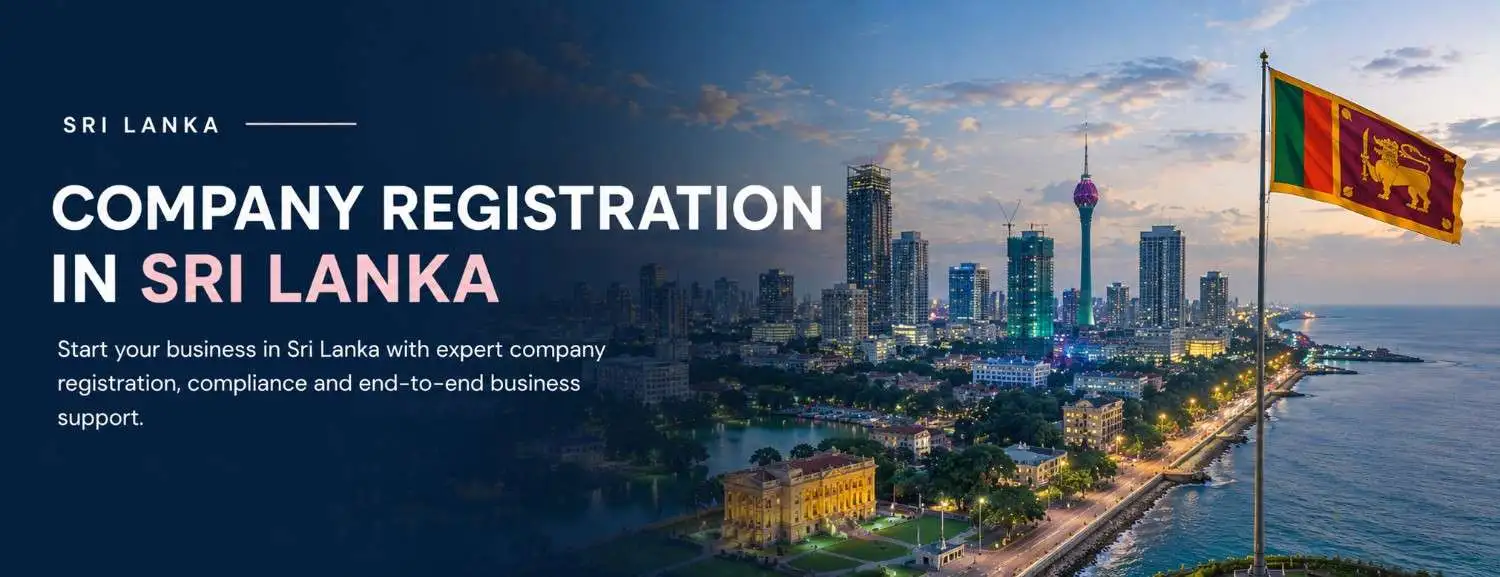
Business Registration Sri Lanka
Sri Lanka offers business opportunities across international trade, tourism, manufacturing, information technology and professional services. Its location along major Indian Ocean shipping routes makes it relevant to entrepreneurs seeking access to South Asian markets and international commercial networks.
For local entrepreneurs and foreign investors, business registration in sri lanka is an important step towards establishing a legally recognised business. The registration procedure depends on the proposed legal structure, ownership arrangements and nature of commercial activities. Understanding these differences helps founders select the appropriate registration route and meet applicable statutory requirements.
1. Understanding Business Registration in Sri Lanka
Sri Lanka has different registration frameworks for incorporated companies and unincorporated businesses.
1.1 Company incorporation
Companies are incorporated under the Companies Act No. 7 of 2007 through the Registrar of Companies (ROC).
Entrepreneurs considering company registration in srilanka commonly choose a private limited company because it provides a separate legal identity and a structured ownership framework.
1.2 Business name registration
Sole proprietorships and certain partnerships generally follow business-name registration procedures administered through the relevant provincial authorities.
Business-name registration does not create a separate corporate legal entity.
1.3 Choosing the appropriate route
Founders should consider:
• Number and nationality of owners.
• Personal liability exposure.
• Capital and financing requirements.
• Intended business activities.
• Taxation and reporting responsibilities.
• Future investment and expansion plans.
2. Business Structures Available in Sri Lanka
The appropriate legal structure depends on whether the entrepreneur intends to operate independently, with partners or through an incorporated entity.
2.1 Private limited company
A private company limited by shares is commonly used for trading, consulting, manufacturing and other commercial activities.
Its characteristics include:
• Separate legal personality.
• Shareholder liability generally limited to unpaid share capital.
• At least one director.
• At least one shareholder.
• A qualified company secretary.
• Statutory accounting and annual filing obligations.
Private companies are subject to restrictions on public share offerings and shareholder numbers under applicable company law.
2.2 Sole proprietorship
A sole proprietorship may suit an eligible individual operating a small business.
However, the proprietor generally remains personally responsible for the business's obligations.
2.3 Partnership
A partnership allows eligible individuals to conduct business together under agreed arrangements.
Partners should assess their legal responsibilities, profit-sharing arrangements and registration requirements before commencing operations.
3. Registrar of Companies and eROC
The sri lanka business registry framework includes the national company registration system and separate arrangements for business names.
3.1 Role of the Registrar of Companies
The Registrar of Companies administers incorporation and statutory company filings.
Its responsibilities include:
• Company name approval.
• Incorporation of companies.
• Maintaining registered company information.
• Receiving prescribed statutory documents.
• Recording relevant corporate changes.
3.2 eROC registration system
The online business registration in sri lanka process for companies is facilitated through the ROC's electronic registration platform, eROC.
The system supports company name applications, incorporation submissions and relevant statutory filing procedures.
3.3 Company registration number
Following successful incorporation, the company receives a registration number and Certificate of Incorporation.
These confirm its incorporation under Sri Lankan company law.
4. Foreign Ownership and Incorporation Requirements
Foreign investors may establish companies in Sri Lanka, subject to restrictions applicable to particular sectors and activities.
4.1 Foreign shareholding
Many business activities permit foreign investment, while others are restricted, prohibited or subject to approval and investment conditions.
Investors should verify sector-specific requirements before finalising ownership arrangements.
4.2 Directors and company secretary
A private limited company must appoint the required director or directors and a qualified company secretary.
Foreign directors may be appointed, subject to applicable legal requirements. Incorporation does not automatically grant immigration or employment authorisation.
4.3 Required incorporation documents
For pvt ltd company registration sri lanka, typical requirements include:
• Proposed company name.
• Shareholder identification and ownership details.
• Director particulars and required consents.
• Registered office address in Sri Lanka.
• Articles of Association.
• Company secretary details and consent.
• Prescribed incorporation forms and declarations.
Additional documents may be required where shareholders are foreign corporate entities.
5. Step-by-Step Business Registration Process
Entrepreneurs planning to register a business in sri lanka should first determine whether company incorporation or business-name registration applies.
5.1 Private limited company registration procedure
• Step 1: Select the appropriate legal structure and proposed business activities.
• Step 2: Check and reserve the proposed company name through the ROC's registration system.
• Step 3: Finalise shareholders, shareholding percentages and initial share arrangements.
• Step 4: Appoint the required director or directors and company secretary.
• Step 5: Arrange a registered office address in Sri Lanka.
• Step 6: Prepare the Articles of Association and prescribed incorporation documents.
• Step 7: Submit the incorporation application through eROC with applicable fees.
• Step 8: Obtain the Certificate of Incorporation and company registration number.
• Step 9: Complete relevant tax registrations, banking arrangements and operational formalities.
5.2 Sole proprietorship and business-name registration
Individuals establishing an unincorporated business generally apply through the relevant provincial business-name registration process.
Requirements may include identity documents, proposed business-name details, business premises information and supporting declarations.
5.3 Incorporation timeline
Processing depends on name approval, document completeness and the ROC's review.
Applications involving foreign corporate shareholders or additional regulatory approvals may require further documentation and processing time.
6. Tax Registration and Banking Requirements
Business incorporation does not automatically complete every tax or banking requirement.
6.1 Taxpayer Identification Number
Businesses should assess their obligations to obtain a Taxpayer Identification Number (TIN) from the Inland Revenue Department.
Additional tax registrations depend on the entity's activities and applicable legislation.
6.2 Corporate income tax and VAT
Companies may be subject to corporate income tax and must evaluate VAT registration requirements based on taxable activities and applicable thresholds.
Employment-related taxes and other statutory obligations may also apply.
6.3 Corporate bank account
Banks generally conduct customer due diligence before opening a business account.
Supporting information may include:
• Certificate of Incorporation.
• Company constitutional documents.
• Director and shareholder identification.
• Beneficial ownership details.
• Business activity and source-of-funds information.
Foreign investment transactions may require appropriate banking arrangements under Sri Lankan foreign exchange regulations.
7. Compliance After Business Registration
For entrepreneurs completing private limited company registration in sri lanka, incorporation creates continuing corporate and financial responsibilities.
7.1 Annual returns and statutory records
Companies must maintain prescribed statutory records and submit annual returns within applicable deadlines.
Changes to directors, registered office details and other registered particulars may require separate notifications.
7.2 Financial statements and accounting
Companies generally must maintain proper accounting records and prepare financial statements under applicable legal and accounting requirements.
Audit and reporting obligations depend on the company's classification and relevant exemptions.
7.3 Employment and operational compliance
Employers may need to comply with:
• Employees' Provident Fund requirements.
• Employees' Trust Fund obligations.
• Payroll and employment legislation.
• Workplace and sector-specific regulations.
Businesses should also verify whether trade licences, environmental approvals or other operating permits are required.
8. How YKG Global Helps You
YKG Global assists international entrepreneurs and businesses planning company establishment and expansion into Sri Lanka.
Our support may include:
• Reviewing proposed business structures and ownership arrangements.
• Coordinating incorporation documentation.
• Assisting with ROC registration requirements.
• Explaining foreign investment and director requirements.
• Supporting tax registration and banking documentation coordination.
• Coordinating with relevant Sri Lankan professionals for statutory and regulatory matters.
Our objective is to help founders establish an appropriate legal structure and prepare for ongoing business operations.
Call us or fill out our contact form to schedule a consultation today.
📧 Email: Rishi@ykgglobal.com
🌐 Website: www.ykgglobal.com
📱 Call/WhatsApp: +91 76782 77665
📍 Offices: Delhi | Mumbai | Dubai | Singapore