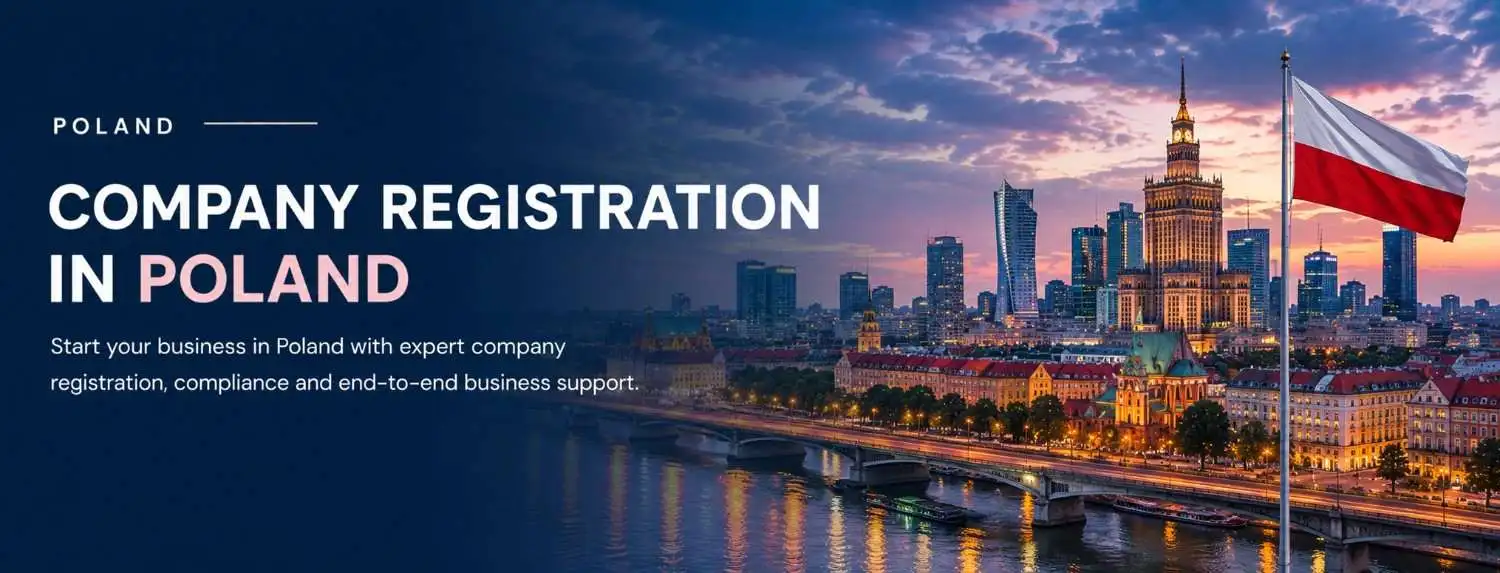
Business Setup in Poland
Poland can be an attractive base for businesses looking to serve European customers, develop regional operations or establish a presence within the European Union. However, choosing the right legal structure is only one part of the decision. Foreign founders should also consider ownership eligibility, registration formalities, taxation, banking and the obligations that begin after incorporation.
YKG Global supports international business setup and corporate compliance planning for businesses exploring new markets. Our approach to company registration in poland starts with understanding your business activities, proposed ownership structure and long-term commercial objectives.
Choose the Right Business Structure
The appropriate structure depends on the scale of your operations, number of owners, liability considerations and eligibility under Polish law.
1. Limited liability company (sp. z o.o.): This is a commonly used structure for businesses seeking a separate legal entity. It can be suitable for subsidiaries, trading businesses, service providers and companies with one or more shareholders. The minimum share capital is generally PLN 5,000.
2. Joint-stock company (S.A.): This structure may be relevant to larger businesses or ventures with more complex capital requirements. Its governance and reporting obligations differ from those of a limited liability company.
3. Sole proprietorship: An individual business may be suitable for certain entrepreneurs, but foreign nationals must check whether their citizenship and legal status allow them to use this route. Eligibility is not identical for all non-EU founders.
For many international investors, setting up a company in poland through a sp. z o.o. is worth evaluating first. However, the right choice should follow a review of the business model, ownership, liability and future investment plans.
Can Foreign Entrepreneurs Establish a Polish Company?
Foreign founders can establish Polish companies, but the available options depend on their nationality, residence status and proposed structure.
EU and EEA nationals generally have broader rights to conduct business under rules comparable to those applying to Polish citizens. For other foreign nationals, eligibility to operate as an individual entrepreneur may depend on residence or another qualifying legal basis. A Polish company structure can offer a different route, but it does not automatically provide immigration or work rights.
When starting a business in poland as a foreigner, consider the following before committing to a structure:
• Whether you will own the company personally or through an existing overseas entity.
• Whether the business requires a Polish registered office or other local arrangements.
• How company documents and identity records will be prepared and signed.
• Whether you need a representative or power of attorney for specific procedures.
• Whether your intended activities require a licence, permit or sector-specific approval.
These decisions should be reviewed before filing, especially when shareholders or directors are based outside Poland.
Registration Requirements and Documents
The documentation depends on the legal form, ownership structure and registration method. For a sp. z o.o., founders typically need to prepare:
• Proposed company name and registered office details.
• Details of shareholders and management board members.
• The company's business activities and relevant Polish classification codes (PKD).
• Articles of association and share capital information.
• Required declarations, consents and identity documents.
• Powers of attorney or supporting corporate records where applicable.
Foreign corporate documents may require additional certification, translation or other formalities. Requirements should be confirmed for the particular document and authority rather than assuming every foreign document needs the same process.
Founders should also consider the signing method. Poland offers electronic registration routes, but the available procedure and signature requirements depend on the company documents and chosen system. The standard S24 route uses model articles; companies requiring customised provisions may need a different registration procedure.
How to Register a Company in Poland
The process to register a company in poland generally involves several connected steps.
1. Define the business structure. Decide whether you need a Polish subsidiary, a locally incorporated company or another suitable arrangement.
2. Select and verify the name. Check that the proposed name meets applicable requirements and is sufficiently distinguishable from existing registered entities.
3. Prepare the company documents. Finalise the articles, share capital, shareholder details, management appointments and registered office information.
4. Submit the registration application. A company such as a sp. z o.o. is entered in the National Court Register (KRS). Depending on the structure and documentation, registration may be completed through S24 or the Court Registers Portal (PRS).
5. Complete tax and identification formalities. After registration, check the company's tax identification number (NIP), statistical number (REGON) and any supplementary information that must be filed.
6. Assess beneficial ownership reporting. Determine whether the company must submit information to the Central Register of Beneficial Owners (CRBR) and meet the applicable deadline.
7. Arrange operational readiness. Review banking, accounting, VAT, employment and licensing needs before commencing the relevant activities.
The polish commercial register is an important part of the process, but entry in the KRS does not automatically complete every tax, licensing or operational requirement.
Tax, Banking and Ongoing Compliance
Registration is the beginning of the company's obligations, not the end. A Polish company may need to maintain accounting records, submit annual financial statements, file corporate tax returns and report changes to its registered information.
VAT registration depends on the company's activities and applicable rules. Some businesses may qualify for an exemption, while others must register before undertaking particular transactions. Cross-border sales, imports, exports and transactions within the EU can create additional tax considerations.
A corporate bank account is another practical consideration. Banks conduct their own due diligence and may request information about shareholders, directors, beneficial owners, business activities and the source of funds. Company registration does not guarantee account approval.
Founders should also assess whether employees, contractors, regulated activities or transactions with related overseas entities create further obligations. Planning for these matters early can reduce disruption after incorporation.
How YKG Global Helps You
YKG Global provides international business setup, corporate compliance and cross-border advisory support, subject to the agreed service scope.
For businesses exploring company formation in poland, we can help clarify the proposed structure, identify registration decisions, organise the information needed for the application and outline relevant post-incorporation considerations.
Our approach focuses on understanding your commercial objective and identifying the next steps required for a more organised market entry. Polish legal, tax, immigration and licensing questions should be confirmed with appropriately qualified local professionals and the relevant authorities wherever specialist advice is required.
Planning to start a business in poland? Contact YKG Global to discuss your intended activities, ownership structure and the assistance you need.
Call us or fill out our contact form to schedule a consultation today.
📧 Email: Rishi@ykgglobal.com
🌐 Website: www.ykgglobal.com
📱 Call/WhatsApp: +91 76782 77665
📍 Offices: Delhi | Mumbai | Dubai | Singapore