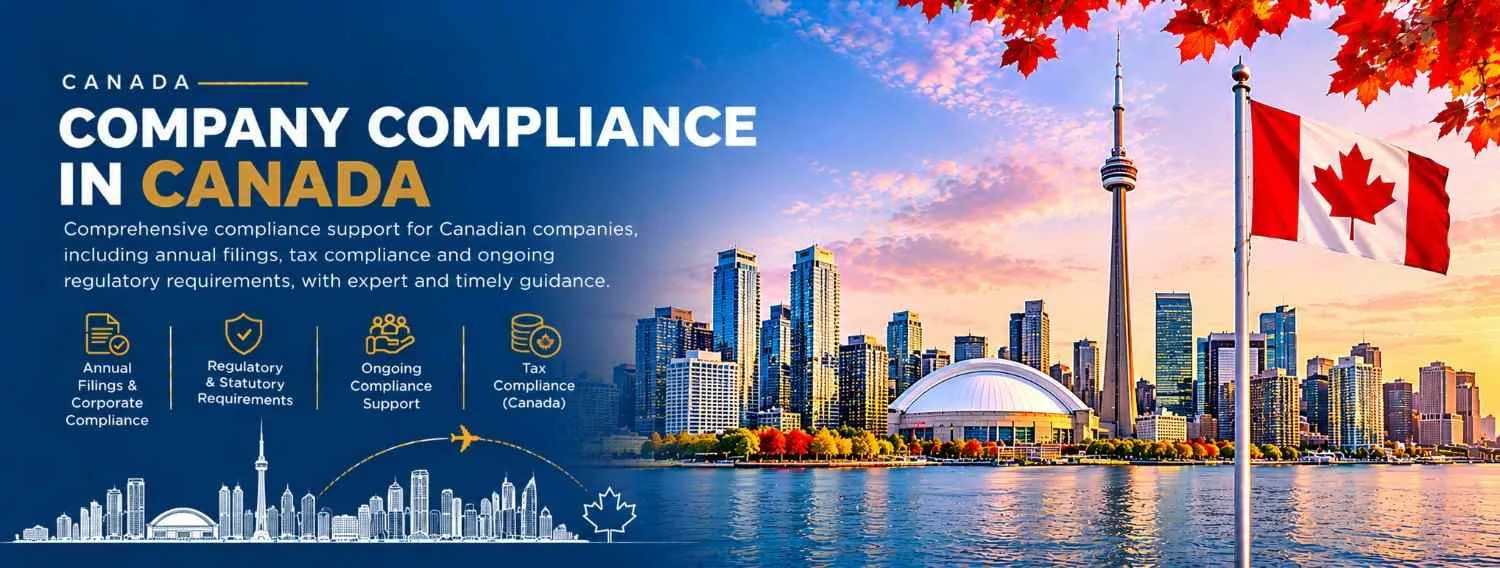
Company Compliance Services in Canada
Operating a company in Canada involves more than completing incorporation formalities. Businesses must maintain corporate records, submit statutory returns, comply with taxation requirements and update information with the relevant authorities.
For domestic businesses and foreign-owned subsidiaries, company compliance services in Canada help address these continuing responsibilities. Canada's regulatory framework includes both federal and provincial legislation, meaning compliance requirements depend on the jurisdiction of incorporation, business activities and operating locations.
Understanding these obligations is essential for maintaining a company's legal standing and avoiding unnecessary penalties.
1. Understanding Canada's Corporate Compliance Framework
Canada has separate federal and provincial corporate registration systems. The applicable requirements depend on where the company is incorporated and conducts business.
1.1 Federal corporations
Companies incorporated under the Canada Business Corporations Act (CBCA) are regulated by Corporations Canada.
Their responsibilities generally include:
• Filing annual returns.
• Maintaining statutory corporate records.
• Reporting prescribed changes in company information.
• Maintaining required beneficial ownership information.
• Complying with applicable director and shareholder obligations.
1.2 Provincial corporations
Provincially incorporated businesses follow the legislation of their incorporation province.
For example, Ontario, British Columbia and Alberta have different corporate filing procedures and reporting requirements.
An effective Canada corporate compliance approach must account for these jurisdiction-specific differences.
2. Annual Returns and Corporate Information Updates
Corporate annual returns are distinct from corporate income tax returns.
2.1 Federal annual returns
A federal CBCA corporation generally must submit its annual return to Corporations Canada within 60 days following its incorporation anniversary.
The filing confirms prescribed corporate information and helps maintain an accurate public register.
2.2 Provincial annual filings
Provincial requirements vary.
Ontario corporations generally file an annual return within six months after their financial year-end. Other provinces may have different deadlines and procedures.
2.3 Changes in registered particulars
Companies may need to report changes involving:
• Registered office addresses.
• Directors and their relevant details.
• Corporate names.
• Other prescribed company information.
Timely Canadian annual return filing and accurate updates help businesses maintain their registration records.
3. Beneficial Ownership and Corporate Governance
Corporate transparency has become an important part of Canada's regulatory framework.
3.1 Individuals with Significant Control
Federal CBCA corporations generally must maintain information about individuals with significant control (ISC).
They must also file prescribed ISC information with Corporations Canada, including through applicable annual and change-reporting procedures.
Provincial beneficial ownership requirements differ and should be assessed separately.
3.2 Director and shareholder records
Companies should maintain records covering:
• Directors and officers.
• Shareholders and share ownership.
• Corporate resolutions.
• Share issuances and transfers.
• Relevant meeting minutes.
3.3 Governance responsibilities
Directors must comply with their statutory duties and the company's governing legislation.
The scope of Canada business compliance requirements may therefore extend beyond annual filing obligations to corporate decision-making, transparency and recordkeeping.
4. Corporate Income Tax and CRA Filings
Canadian corporations must evaluate their tax obligations separately from corporate registry requirements.
4.1 Corporate income tax returns
Resident corporations generally must file a T2 Corporation Income Tax Return with the Canada Revenue Agency (CRA), including where no tax is payable, subject to applicable exceptions.
The T2 filing deadline is generally six months after the corporation's taxation year-end.
4.2 Corporate tax payment deadlines
Corporate income tax balances are generally payable within two months after year-end.
A three-month balance-due deadline may apply to qualifying Canadian-controlled private corporations meeting the relevant conditions.
4.3 GST/HST obligations
Businesses must determine whether registration for Goods and Services Tax or Harmonized Sales Tax is required.
The general small-supplier threshold is CAD 30,000, subject to the applicable calculation rules and exceptions.
4.4 Provincial tax considerations
Businesses may also have provincial income tax, sales tax or other reporting obligations.
For foreign-owned entities, corporate tax compliance Canada may involve additional international reporting and related-party transaction considerations.
5. Maintaining Corporate Records and Financial Information
Proper recordkeeping supports both statutory compliance and effective business management.
5.1 Corporate minute books
Companies should maintain relevant corporate records, including:
• Articles of incorporation and amendments.
• Corporate bylaws.
• Shareholder and director resolutions.
• Securities registers.
• Share certificates or ownership records.
• Prescribed registers and supporting documentation.
5.2 Accounting and financial records
Corporations must maintain accounting information sufficient to support applicable financial and tax reporting obligations.
5.3 Financial statement requirements
Financial reporting obligations depend on the governing corporate statute, company characteristics and applicable exemptions.
Not every privately held Canadian corporation is required to obtain an external audit.
Appropriate Canadian corporate record maintenance helps companies respond to regulatory reviews, financing requests and ownership changes.
6. Compliance When Operating Across Provinces
A company incorporated in one Canadian jurisdiction may have additional obligations when conducting business elsewhere.
6.1 Extra-provincial registration
Businesses may need extra-provincial registration in provinces where their activities meet the relevant registration requirements.
The rules depend on the province and the company's operations.
6.2 Business licences and permits
Additional approvals may be required for:
• Professional and regulated services.
• Retail and commercial premises.
• Manufacturing and industrial operations.
• Food-related businesses.
• Other activities subject to municipal or provincial regulation.
6.3 Employment and payroll
Employers must assess payroll withholding, remittance and reporting obligations.
These may include income tax deductions, Canada Pension Plan contributions, Employment Insurance premiums and applicable provincial requirements.
7. Compliance for Foreign-Owned Canadian Companies
Foreign-owned subsidiaries may face additional considerations arising from their international ownership and transactions.
7.1 International tax reporting
Cross-border payments and transactions may create obligations involving:
• Transfer pricing documentation.
• Related-party reporting.
• Withholding taxes.
• Applicable tax treaty provisions.
• International information returns.
7.2 Changes in foreign ownership
Share transfers, restructuring and changes in control may affect corporate registers, beneficial ownership disclosures and tax reporting.
7.3 Compliance planning
Foreign parent companies should coordinate Canadian reporting with their wider group accounting and governance processes.
A compliance calendar covering federal, provincial and tax obligations can reduce the risk of missed deadlines.
8. How YKG Global Helps You
YKG Global assists international entrepreneurs and businesses with cross-border corporate advisory and compliance coordination.
Our company compliance services Canada support may include:
• Reviewing applicable federal and provincial filing requirements.
• Coordinating annual return preparation and submission.
• Assisting with corporate records and statutory updates.
• Supporting CRA tax compliance coordination.
• Explaining beneficial ownership and governance obligations.
• Coordinating with relevant Canadian professionals for jurisdiction-specific services.
Our objective is to help businesses understand their continuing obligations and maintain an organised compliance framework.
Call us or fill out our contact form to schedule a consultation today.
📧 Email: Rishi@ykgglobal.com
🌐 Website: www.ykgglobal.com
📱 Call/WhatsApp: +91 76782 77665
📍 Offices: Delhi | Mumbai | Dubai | Singapore