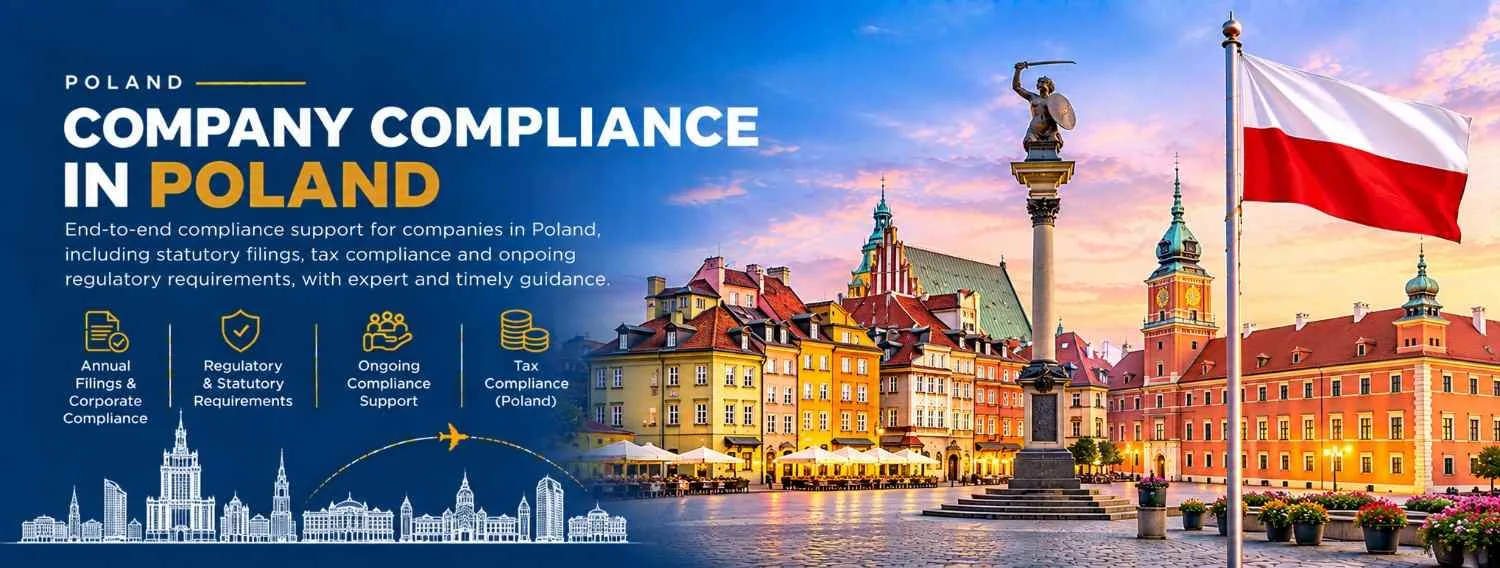
Company Compliance Services Poland
Operating a company in Poland involves ongoing legal, accounting and taxation responsibilities. Businesses must maintain accurate corporate records, prepare annual financial statements, submit tax returns and report prescribed changes to the relevant authorities.
For Polish subsidiaries, foreign-owned businesses and domestic companies, company compliance services Poland help organise these obligations and reduce the risk of missed deadlines. The requirements depend on the company's legal structure, financial activities, employment arrangements and ownership.
Understanding Poland's compliance framework is particularly important for international businesses managing operations across multiple jurisdictions.
1. Corporate Compliance Framework in Poland
Poland regulates corporate reporting through commercial, accounting and taxation legislation.
1.1 Key regulatory authorities
Companies may interact with several institutions:
• National Court Register (KRS) for corporate registration and statutory records.
• Ministry of Finance and tax offices for corporate taxation.
• Central Register of Beneficial Owners (CRBR) for ownership transparency.
• Social Insurance Institution (ZUS) for social security obligations.
• Statistics Poland (GUS) for statistical reporting requirements.
1.2 Management board responsibilities
The management board is responsible for ensuring that the company meets applicable legal and reporting obligations.
Effective Poland corporate compliance involves maintaining reliable information, monitoring deadlines and documenting important corporate decisions.
2. KRS Filings and Corporate Information Updates
The National Court Register, known as Krajowy Rejestr Sądowy, maintains information about registered Polish companies.
2.1 Changes requiring registration
Companies may need to report changes involving:
• Registered office and company address.
• Management board members.
• Company name or legal structure.
• Share capital and relevant ownership particulars.
• Articles of Association.
• Authorised representation arrangements.
2.2 Electronic registration procedures
Corporate changes are generally submitted electronically through the relevant court registration systems.
The applicable KRS filing requirements depend on the nature of the change and the company's legal structure.
2.3 Importance of accurate records
Failure to update prescribed information may result in regulatory action, procedural difficulties or complications during banking and commercial transactions.
3. Annual Financial Statements and Reporting
Polish companies subject to full accounting requirements must prepare annual financial statements under the Accounting Act.
3.1 Preparation of financial statements
Financial statements generally include:
• Balance sheet.
• Profit and loss account.
• Notes and relevant accounting disclosures.
• Additional statements where required.
The financial statements must be prepared electronically in the prescribed format.
3.2 Annual reporting deadlines
For companies with a financial year ending on 31 December, the general timetable is:
• By 31 March: Prepare annual financial statements.
• By 30 June: Obtain approval from the appropriate corporate body.
• Within 15 days after approval: Submit the required financial documents to KRS.
Different dates apply where the financial year does not follow the calendar year.
3.3 Statutory audit requirements
Not every Polish limited liability company requires an annual statutory audit.
Audit obligations depend on the company's classification, applicable financial thresholds and other statutory conditions.
Proper annual compliance for companies in Poland requires reviewing these requirements before the financial year closes.
4. Corporate Income Tax Compliance
Polish companies generally must comply with corporate income tax requirements administered by the tax authorities.
4.1 Annual CIT-8 return
Corporate income tax taxpayers generally submit an annual CIT-8 return by the end of the third month following their tax year.
For a calendar-year taxpayer, the usual deadline is 31 March.
4.2 Corporate tax rates
Poland's standard corporate income tax rate is generally 19%.
A reduced 9% rate may apply to qualifying taxpayers and qualifying income, subject to statutory conditions.
4.3 Tax documentation
Businesses should maintain:
• Accounting ledgers and supporting invoices.
• Tax computation records.
• Fixed asset and depreciation schedules.
• Related-party transaction documentation.
• Supporting records for applicable deductions and reliefs.
For international groups, corporate tax compliance Poland may also involve transfer pricing, withholding taxes and cross-border reporting obligations.
5. VAT and Electronic Tax Reporting
Poland operates an electronic VAT reporting framework involving Standard Audit File requirements.
5.1 JPK_V7 reporting
VAT-registered businesses subject to these requirements generally submit electronic JPK_V7 filings.
The applicable format depends on the settlement method:
• JPK_V7M for monthly VAT settlement.
• JPK_V7K for eligible quarterly VAT settlement.
5.2 VAT reporting deadlines
Monthly VAT reporting is generally due by the 25th day of the following month.
Quarterly settlement is subject to specific eligibility conditions, with monthly records reporting still required.
5.3 KSeF electronic invoicing
Poland is implementing mandatory electronic invoicing through the National e-Invoicing System (KSeF), with phased commencement and applicable exceptions.
Businesses should assess their implementation dates, invoicing systems and transaction requirements.
Effective VAT compliance in Poland requires monitoring both recurring filings and changes to electronic invoicing rules.
6. Beneficial Ownership and Corporate Governance
Ownership transparency is another important part of Polish corporate compliance.
6.1 CRBR reporting
Companies covered by the relevant legislation must report prescribed beneficial ownership information to the Central Register of Beneficial Owners.
Reportable changes generally must be updated within the applicable statutory deadline.
6.2 Shareholder and board records
Companies should maintain:
• Shareholder information and relevant ownership records.
• Management board appointment documents.
• Corporate resolutions.
• Share transfer documentation.
• Articles of Association and amendments.
6.3 Foreign-owned subsidiaries
Foreign-owned Polish companies should also review related-party transactions, management arrangements and reporting obligations involving their overseas parent companies.
7. Payroll and Employment Compliance
Businesses employing personnel in Poland must assess employment, payroll and social security responsibilities.
7.1 Social security contributions
Employers generally register eligible employees with ZUS and calculate applicable social security and health insurance contributions.
7.2 Payroll reporting
Employer responsibilities may include:
• Calculating employee remuneration.
• Withholding applicable personal income tax.
• Submitting payroll-related declarations.
• Remitting social security contributions.
• Maintaining employment and payroll records.
7.3 Foreign employees
Hiring foreign nationals may involve additional immigration, work authorisation and employment documentation requirements.
These obligations should be reviewed before employment commences.
8. Practical Compliance Management Checklist
A structured calendar helps businesses coordinate corporate, financial and tax responsibilities.
8.1 Step-by-step compliance process
• Step 1: Review the company's KRS information and registered particulars.
• Step 2: Verify management board, shareholder and beneficial ownership records.
• Step 3: Identify the company's financial year and reporting deadlines.
• Step 4: Prepare annual financial statements and determine audit requirements.
• Step 5: Complete the annual CIT-8 return and applicable tax payments.
• Step 6: Monitor VAT, JPK_V7 and electronic invoicing obligations.
• Step 7: Review payroll, ZUS and employment reporting requirements.
• Step 8: Submit financial statements and prescribed documents to KRS.
• Step 9: Maintain supporting records and monitor regulatory changes.
8.2 Consequences of non-compliance
Failure to meet applicable requirements may result in penalties, interest, enforcement proceedings or other legal consequences.
Regular monitoring supports effective company compliance in Poland and reduces avoidable administrative risks.
9. How YKG Global Helps You
YKG Global supports international entrepreneurs and businesses with cross-border corporate advisory and compliance coordination.
Our assistance may include:
• Reviewing Polish corporate filing obligations.
• Coordinating annual financial statement preparation.
• Supporting CIT and VAT compliance coordination.
• Assisting with KRS and beneficial ownership documentation.
• Explaining payroll and employment-related obligations.
• Coordinating with relevant Polish accounting, tax and legal professionals.
Our objective is to help businesses maintain organised corporate records, understand their statutory responsibilities and manage recurring compliance requirements.
Call us or fill out our contact form to schedule a consultation today.
📧 Email: Rishi@ykgglobal.com
🌐 Website: www.ykgglobal.com
📱 Call/WhatsApp: +91 76782 77665
📍 Offices: Delhi | Mumbai | Dubai | Singapore