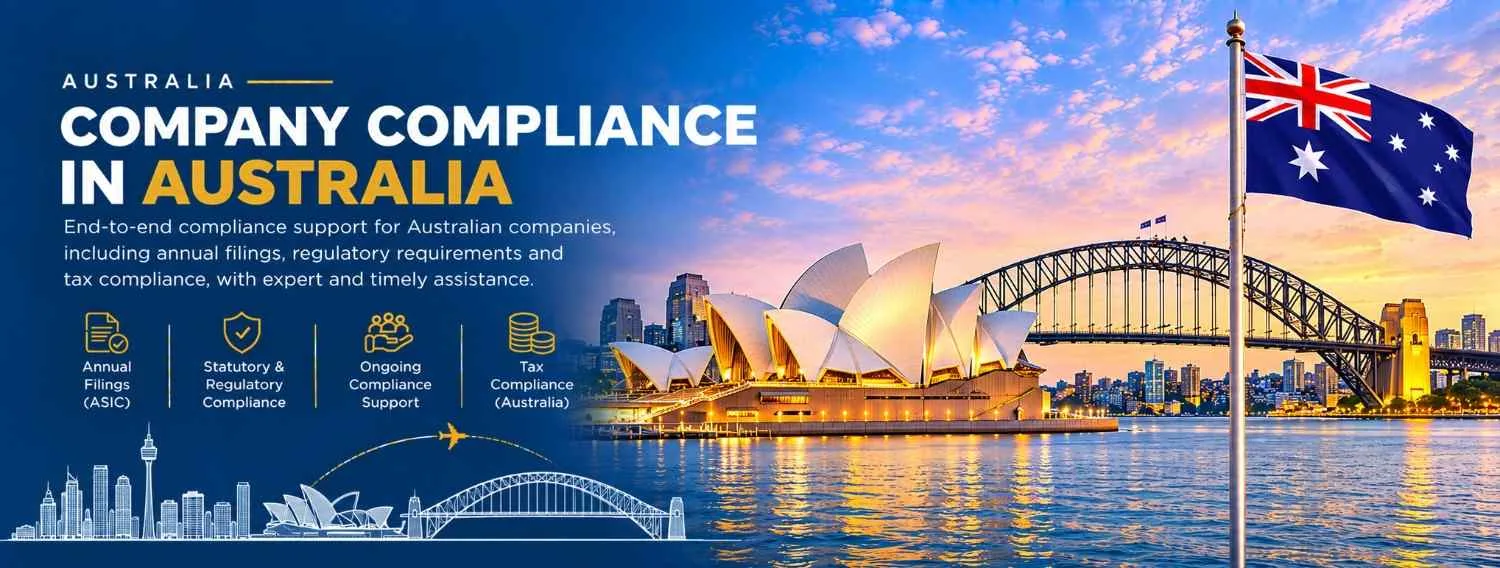
Company Compliance Services in Sydney, Australia
Sydney is Australia's leading financial and commercial centre, home to businesses operating across technology, professional services, international trade, construction and financial services. While Sydney provides access to extensive commercial opportunities, companies must comply with Australian corporate legislation, taxation requirements and relevant New South Wales regulations.
For local businesses and foreign-owned subsidiaries, company compliance services in Sydney support the management of ongoing statutory obligations. These responsibilities extend beyond annual filings and include director duties, corporate records, tax reporting and maintaining accurate information with government authorities.
1. Understanding Corporate Compliance in Sydney
Companies registered in Sydney operate primarily under Australia's national corporate regulatory framework.
1.1 National corporate regulation
The Australian Securities and Investments Commission (ASIC) administers company registration and corporate reporting requirements under the Corporations Act 2001.
Key responsibilities include:
• Maintaining accurate company registration details.
• Completing applicable annual review obligations.
• Updating director and registered office information.
• Maintaining statutory company records.
• Meeting financial reporting requirements where applicable.
1.2 New South Wales obligations
Sydney-based businesses may also need to comply with NSW requirements involving payroll tax, workers compensation, workplace safety and industry-specific licences.
These obligations depend on the company's activities, employees and operational arrangements.
2. ASIC Annual Review Requirements
The ASIC annual review is a central recurring obligation for most Australian proprietary companies.
2.1 Annual review statement
ASIC generally issues an annual statement around the company's annual review date, commonly the anniversary of registration.
The company should verify its recorded information, including:
• Registered office address.
• Principal place of business.
• Directors and secretaries.
• Share structure and shareholders.
• Other relevant company particulars.
2.2 Annual review fee
Companies generally must pay the applicable ASIC annual review fee within two months after their annual review date.
2.3 Solvency resolution
Directors of most proprietary companies must pass a solvency resolution within two months after the annual review date.
A positive solvency resolution generally does not need to be lodged with ASIC, but prescribed notifications may be required where solvency concerns arise.
3. Maintaining Company Records and Director Information
Effective Australian company compliance requires accurate statutory records and timely notification of changes.
3.1 Changes requiring ASIC notification
Companies generally must report prescribed changes, including:
• Appointment or resignation of directors.
• Changes to director details.
• Registered office changes.
• Changes to share structure.
• Changes to relevant shareholder information.
Many changes must be reported within 28 days, although deadlines vary by filing type.
3.2 Director identification numbers
Eligible directors must obtain a director identification number through the Australian Business Registry Services system.
Directors must apply within the timeframe applicable to their circumstances.
3.3 Corporate governance records
Companies should maintain:
• Constitution or replaceable rules information.
• Shareholder and director registers.
• Share issuance and transfer records.
• Relevant company resolutions.
• Financial and supporting accounting records.
4. Financial Reporting and Annual Compliance
The scope of company annual compliance Australia depends on the company's classification, ownership and reporting obligations.
4.1 Financial statements
Companies must maintain financial records that correctly record and explain their transactions and financial position.
Certain companies must prepare and lodge annual financial reports with ASIC.
4.2 Large proprietary companies
Large proprietary companies generally have additional financial reporting and audit obligations.
Classification depends on statutory thresholds relating to revenue, assets and employees.
4.3 Foreign-controlled companies
Small proprietary companies controlled by foreign companies may have additional financial reporting obligations, subject to applicable exemptions and relief.
Foreign-owned subsidiaries should assess their reporting position rather than assuming that all small companies are exempt.
5. Australian Taxation Office Compliance
Sydney companies must evaluate their federal taxation obligations through the Australian Taxation Office (ATO).
5.1 Corporate income tax
Australian resident companies generally must lodge company income tax returns and pay applicable corporate income tax.
The tax rate depends on whether the company qualifies for the lower base rate entity rate or is subject to the general corporate tax rate.
5.2 GST and Business Activity Statements
GST registration is generally required when a business reaches the applicable A$75,000 turnover threshold, subject to specific exceptions.
Registered businesses may need to lodge Business Activity Statements (BAS) and report GST and other relevant tax obligations.
5.3 PAYG withholding
Companies employing staff must assess Pay As You Go withholding obligations.
This generally includes withholding income tax from employee payments and reporting relevant payroll information.
5.4 International transactions
For foreign-owned businesses, corporate tax compliance Australia may also involve transfer pricing, withholding taxes and international dealings reporting.
6. Sydney and NSW Employment Compliance
Businesses employing personnel in Sydney must consider federal employment legislation alongside relevant NSW requirements.
6.1 Payroll tax
NSW payroll tax may apply when taxable wages exceed the applicable threshold.
Employers should assess wages paid across relevant jurisdictions and any grouping rules.
6.2 Superannuation contributions
Employers generally must make superannuation guarantee contributions for eligible employees at the statutory rate.
6.3 Workers compensation and workplace safety
Businesses may need workers compensation insurance and must comply with applicable workplace health and safety requirements.
Additional obligations may apply to construction, manufacturing and other higher-risk activities.
7. Managing Compliance Deadlines
Businesses can reduce filing risks by maintaining a structured compliance calendar.
7.1 Step-by-step compliance management
• Step 1: Identify the company's ASIC annual review date.
• Step 2: Verify directors, shareholders and registered company information.
• Step 3: Complete the annual review fee and solvency requirements.
• Step 4: Determine applicable financial reporting and audit obligations.
• Step 5: Review ATO income tax, GST, BAS and payroll deadlines.
• Step 6: Assess NSW payroll tax, employment and licensing requirements.
• Step 7: Update statutory registers and retain supporting documents.
• Step 8: Monitor changes in legislation and business circumstances.
7.2 Consequences of non-compliance
Failure to meet statutory requirements may result in late fees, penalties, regulatory action or company deregistration in certain circumstances.
Professional ASIC compliance services can assist companies in understanding their filing obligations and maintaining accurate corporate information.
8. How YKG Global Helps You
YKG Global assists entrepreneurs and international businesses with cross-border corporate advisory and ongoing compliance coordination.
Our company compliance services Australia support may include:
• Reviewing ASIC annual review and statutory filing requirements.
• Coordinating corporate information updates.
• Supporting financial reporting and accounting compliance coordination.
• Assisting with ATO tax and GST compliance requirements.
• Explaining director identification and governance obligations.
• Coordinating with appropriately qualified Australian professionals for regulated services.
Our objective is to help Sydney-based businesses maintain organised compliance records and understand their ongoing statutory responsibilities.
Call us or fill out our contact form to schedule a consultation today.
📧 Email: Rishi@ykgglobal.com
🌐 Website: www.ykgglobal.com
📱 Call/WhatsApp: +91 76782 77665
📍 Offices: Delhi | Mumbai | Dubai | Singapore