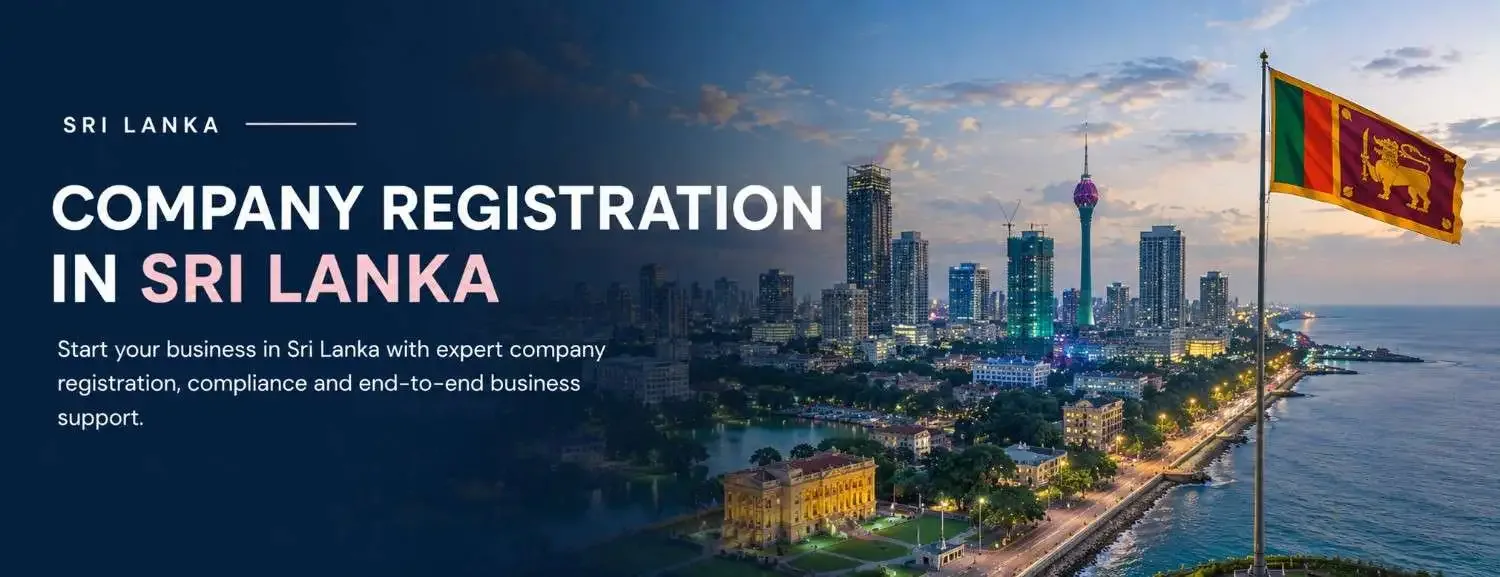
Company Registration in Southern Province (Galle), Sri Lanka
Galle is one of Sri Lanka's important commercial centres outside Colombo, with economic activity connected to tourism, fisheries, trade, hospitality, professional services and coastal businesses. The Galle Municipal Council describes tourism, fisheries and trade as major sources of income for the city.
For entrepreneurs planning Company Registration in Southern Province, it is important to understand that incorporation itself is handled through Sri Lanka's national company-registration system. There is no separate Southern Province company registry for incorporating a company.
The Department of the Registrar of Companies (DRC) administers company incorporation and provides eROC as its web-based single-window system for business-registration facilities.
A company operating in Galle may therefore have two layers of requirements:
• National incorporation and corporate compliance through the DRC.
• Local, environmental or sector-specific approvals connected with the company's actual premises and activities.
1. Why Galle Can Be Suitable for a New Company
Galle offers a different business environment from Colombo and the country's main industrial centres.
The city's economic profile is particularly relevant to:
• Tourism and hospitality.
• Restaurants and accommodation.
• Fisheries and seafood-related businesses.
• Retail and trading.
• Professional services.
• Travel and tourism services.
• Coastal and marine-related activities.
• Digital and remote service businesses.
• Property and supporting services.
This makes Galle Business Registration relevant to both locally focused entrepreneurs and businesses using Galle as a Southern Province operating base.
The appropriate company structure should nevertheless be selected according to ownership, liability, investment and activity rather than simply the location.
2. Company or Individual Business?
Before Company Formation Galle, decide whether you actually need a separate company.
A founder may consider:
• Individual business activity.
• Private company limited by shares.
• Public company.
• Company limited by guarantee.
• Overseas company structure where applicable.
A private company can be appropriate where the founders want a separate legal entity, formal shareholding and limited liability.
For smaller owner-operated activities, an individual business structure may be more appropriate.
The choice affects registration, accounting, governance and continuing compliance.
3. How DRC Handles Company Registration
The legal incorporation process is administered by the DRC rather than Galle Municipal Council.
For a private company, the DRC identifies incorporation documents including:
• Articles of Association / Company Profile.
• Form 01 – Application of Incorporation.
• Form 18 – Consent of Directors.
• Form 19 – Consent of Secretary.
The DRC's current guidance provides these requirements for private-company incorporation.
The company information should accurately reflect its proposed business activities, ownership, directors, secretary and registered office.
4. eROC Registration for a Galle Company
eROC Company Registration Galle is essentially the same national eROC incorporation process used elsewhere in Sri Lanka.
The electronic workflow can involve:
- Creating or accessing an eROC account.
- Checking the proposed company name.
- Entering company and shareholder information.
- Providing director and secretary details.
- Preparing the incorporation documents.
- Submitting the application.
- Completing the applicable payment process.
- Downloading the incorporation certificate after successful registration.
The DRC states that certificates of incorporation for newly incorporated companies are now issued in soft form, with downloadable verification through the certificate link or QR code.
5. Registered Office and Galle Business Address
A company establishing operations in Galle needs appropriate registered-office information.
The registered office is a formal corporate requirement and should not simply be treated as a marketing address.
Depending on the business, the company may also have:
• A separate operating premises.
• Retail or hospitality premises.
• Warehouse or storage location.
• Factory or processing site.
• Tourism-related property.
• Branch locations.
The address selected during incorporation should be accurate and capable of supporting the company's statutory communications.
6. Galle Municipal Approvals After Incorporation
This is where a Galle company can have requirements that are different from a purely national incorporation process.
Where a business operates within Galle Municipal Council limits, certain trades or industries may require a municipal licence.
Published Galle Municipal Council notices confirm that premises carrying on trades covered by applicable by-laws require the relevant licence from the Municipal Commissioner.
Therefore, incorporation does not automatically mean that a restaurant, hotel, industrial premises or other regulated operation can immediately begin trading.
The local authority requirements should be checked according to the actual premises and activity.
7. Tourism and Hospitality Businesses in Galle
Galle's tourism economy makes local licensing particularly important for businesses such as:
• Hotels.
• Guesthouses.
• Restaurants.
• Tourism services.
• Travel-related businesses.
• Hospitality establishments.
A company may first need to be legally incorporated and then satisfy the additional regulatory requirements applicable to its operating activity.
This is especially important where the business involves food, accommodation, public health, building compliance or other regulated operations.
8. Environmental Requirements for Galle Businesses
Not every company requires an Environmental Protection Licence (EPL).
However, prescribed industrial activities may require one.
The Central Environmental Authority states that an EPL application can require evidence such as business registration, legal permission to use the land, survey information and approvals relating to establishment of the activity.
For certain lower-polluting prescribed industries, EPL functions have been delegated to local authorities.
This makes environmental assessment an important consideration for manufacturing, processing and other activities operating in or around Galle.
9. 2026 Beneficial Ownership Requirement
A major recent development for Sri Lanka Company Registration is the new beneficial-ownership requirement.
From 30 March 2026, newly incorporated companies must submit beneficial-ownership and authorised-person information after incorporation and payment of incorporation fees.
The DRC requires Forms BO1 and BO5, and states that failure to complete the submission will result in the incorporation being resubmitted.
This means beneficial-ownership information should now be planned during the incorporation process rather than treated as an afterthought.
10. Compliance After Company Registration
Once the Galle company is incorporated, ongoing obligations can include:
• Annual returns.
• Accounting and financial records.
• Tax compliance.
• Director and secretary updates.
• Registered-office changes.
• Beneficial-ownership information.
• Local trade-licence renewals where applicable.
• Environmental approvals where applicable.
The DRC also published a 2026 notice identifying companies that had not filed annual returns up to 2025, highlighting the importance of continuing corporate compliance.
11. Foreign Entrepreneurs Setting Up in Galle
Foreign investors can explore establishing a company in Sri Lanka, but the ownership and investment structure should be reviewed before incorporation.
A foreign founder may need to consider:
• Passport and identification documents.
• Shareholding structure.
• Director information.
• Foreign investment restrictions where applicable.
• Source-of-funds documentation.
• Banking requirements.
• Sector-specific approvals.
• Tax obligations.
The company-registration process and immigration rights should also be treated as separate matters.
12. Why Choose YKG Global?
YKG Global assists entrepreneurs and international investors with Galle Business Setup, including:
• Company structure selection.
• DRC and eROC incorporation coordination.
• Private-company registration.
• Registered-office guidance.
• Director and secretary documentation.
• Beneficial-ownership filing.
• Tax-registration coordination.
• Galle local-licence assistance.
• Environmental-approval coordination where applicable.
• Ongoing corporate compliance.
Our approach combines national company registration with the practical local requirements that can arise from operating a business in Galle.
Company Registration in Southern Province for a business based in Galle involves more than obtaining a certificate of incorporation.
The company is incorporated through Sri Lanka's national DRC/eROC framework, while businesses operating from Galle may also need municipal, environmental or sector-specific approvals depending on their activities.
Galle's tourism, fisheries, trade and service economy creates opportunities for entrepreneurs, but the correct legal structure and operating permissions should be established before commencing commercial activity.
The 2026 beneficial-ownership requirement is also now part of the incorporation workflow and should be completed correctly for new companies.
Call us or fill out our contact form to schedule a consultation today.
📧 Email: Rishi@ykgglobal.com
🌐 Website: www.ykgglobal.com
📱 Call/WhatsApp: +91 76782 77665
📍 Offices: Delhi | Mumbai | Dubai | Singapore