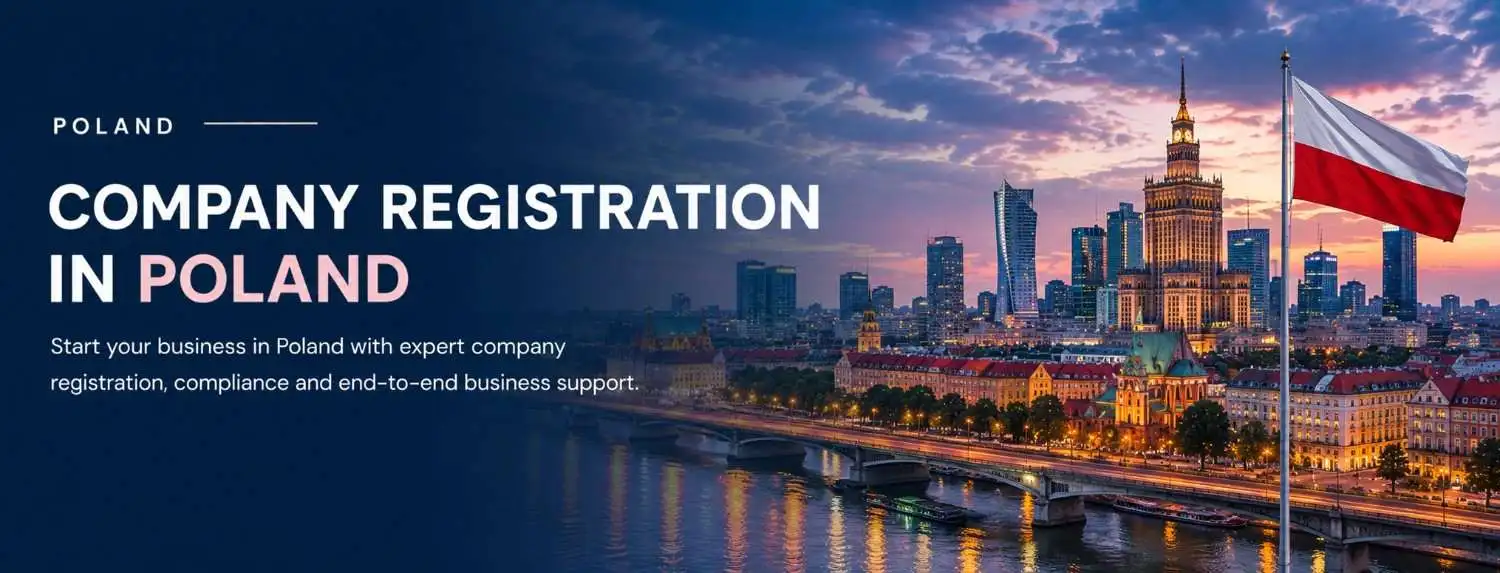
Company Incorporation in Poland
Poland offers businesses a base within the European Union, access to a substantial domestic market and connections to Central and Eastern European supply chains. For international entrepreneurs, establishing a Polish entity can support local sales, distribution, manufacturing, technology services or wider European expansion.
However, the right structure depends on ownership, commercial objectives, residency status and the activities planned. Company incorporation in Poland should therefore begin with a clear understanding of the available legal forms, registration route and ongoing responsibilities.
YKG Global assists businesses exploring international expansion with company formation planning and related compliance coordination, subject to the agreed scope of engagement.
Choosing the Right Business Structure
Before beginning company registration in Poland, decide how the business will operate and who will own it. Common options include the following.
1. Limited Liability Company — Sp. z o.o.
The Polish spółka z ograniczoną odpowiedzialnością, commonly called Sp. z o.o., is a frequently used structure for businesses seeking a separate legal entity. It may suit small and medium-sized businesses, subsidiaries and international ventures.
The company has its own legal identity, while shareholder liability is generally limited, subject to applicable law and specific circumstances. The structure has formal governance, accounting and reporting obligations that founders should understand before incorporation.
International founders searching for llc poland should know that Sp. z o.o. is a local limited-liability company, not the same legal form as a US LLC.
2. Joint-Stock and Partnership Structures
A joint-stock company may be relevant to larger businesses or ventures with particular capital-raising plans. Polish law also provides for several partnership forms, each with its own rules on liability, management and taxation.
A sole proprietorship may be appropriate for an eligible individual operating independently. Its availability to foreign nationals depends on their legal status and applicable rules.
The best structure is the one that matches the business model, ownership arrangements and long-term plans—not simply the one that appears easiest to register.
Starting a Business in Poland as a Foreigner
Starting a business in Poland as a foreigner requires an eligibility review before documents are prepared. The business forms available to an individual can depend on citizenship, residence status and applicable international agreements.
Citizens of EU and EEA countries generally have broader rights to operate under the same rules as Polish citizens. Certain other foreign nationals may also qualify for equivalent treatment, while others may be restricted to specific company structures, such as a limited liability company or joint-stock company. These rules should be checked against the founder’s individual circumstances.
For this reason, setting up a company in Poland as a non-resident should include an early review of ownership, management, identity documents, signing arrangements and any requirements for electronic signatures or representation.
Understanding the Polish Company Register
Poland uses different official registration systems for different forms of business.
The poland company register search often refers to the National Court Register, known as the Krajowy Rejestr Sądowy or KRS. Companies and many partnerships register through the KRS. Sole proprietors and certain civil-law partnership participants use CEIDG, the Central Registration and Information on Business register.
The poland business registry is therefore not a single interchangeable register for every business type. Selecting the correct route is an important part of the incorporation process.
The KRS is also commonly described in English as the polish commercial register. Registration records identify the entity and provide information required for business verification and official dealings. Founders should ensure that the company’s name, registered office, business activities and management details are consistent across their documents and filings.
How to Register a Company in Poland
The process to register a company in Poland will depend on the selected legal form and the method used to prepare the company’s constitutional documents. A typical incorporation project involves the following stages.
1. Confirm the Structure and Ownership
Decide who will hold the shares, who will manage the company and how the entity will be funded. For international shareholders, identify any documents that may require translation, notarisation, legalisation or an apostille.
2. Select and Check the Company Name
Choose a name that complies with Polish requirements and does not create confusion with an existing entity. A name search is an important preliminary check, although it should not be treated as a guarantee that every proposed name will be accepted.
3. Prepare the Incorporation Documents
Prepare the articles of association or other required founding documents, shareholder information, management appointments and registered-office details. The exact documents depend on the company type and the chosen registration method.
4. Submit the Registration Application
Companies are registered with the KRS through the relevant electronic system. The S24 system may be used for eligible entities formed using standardised templates, while the Court Registers Portal is used for other filings, including those requiring documents prepared in a different form.
The application must contain accurate information and the required supporting documents. Incomplete or inconsistent submissions can delay the process.
5. Complete Tax and Statistical Formalities
Following registration, confirm the company’s tax identification number (NIP), statistical number (REGON) and any supplementary notifications that apply. VAT registration may also be necessary depending on the company’s activities and circumstances.
6. Prepare for Operations
Before trading, review accounting arrangements, corporate records, tax obligations, employment responsibilities and any sector-specific permits. Opening a corporate bank account is a separate process, subject to the bank’s own verification and onboarding requirements.
Businesses setting up a business Poland should plan for these operational requirements alongside incorporation, rather than treating registration as the final step.
Should You Open a Shelf Company in Poland?
A shelf company in Poland is an already incorporated entity offered for transfer to a new owner. It may appear to provide a quicker route to obtaining a registered company, but it requires careful due diligence.
Before acquiring one, review its KRS records, ownership history, financial statements, tax position, existing contracts, liabilities and outstanding filing obligations. Confirm how the transfer of shares and changes to management will be documented and registered.
A shelf company is not automatically faster, safer or more suitable than a newly incorporated entity. The decision should be based on verified records, the intended use of the company and the risks associated with its past activities.
Key Compliance Considerations After Incorporation
Once you open company in Poland, ongoing responsibilities may include maintaining accounting records, preparing annual financial statements, submitting required filings and keeping company details current with the relevant authorities.
Tax obligations depend on the entity, its activities and applicable rules. VAT, corporate income tax, payroll and social-security matters should be assessed individually. Businesses employing staff or operating in regulated sectors may have additional requirements.
Foreign-owned companies should also consider how decisions will be documented, how records will be maintained across borders and whether local accounting and reporting support is required.
How YKG Global Helps You
YKG Global supports businesses evaluating international incorporation and cross-border operations. Depending on the agreed engagement, support may include:
- Initial discussions about the appropriate Polish business structure.
- Coordination of incorporation documentation and registration steps.
- Assistance identifying tax, accounting and post-registration requirements.
- Guidance on documentation and compliance planning for foreign shareholders.
Coordination of related international business advisory requirements.
Our approach is to help founders understand the steps involved, identify issues that need specialist review and plan for obligations beyond the initial registration. Legal, tax, banking and regulatory outcomes remain subject to the relevant authorities, professional requirements and third-party approval.
Call us or fill out our contact form to schedule a consultation today.
📧 Email: Rishi@ykgglobal.com
🌐 Website: www.ykgglobal.com
📱 Call/WhatsApp: +91 76782 77665
📍 Offices: Delhi | Mumbai | Dubai | Singapore