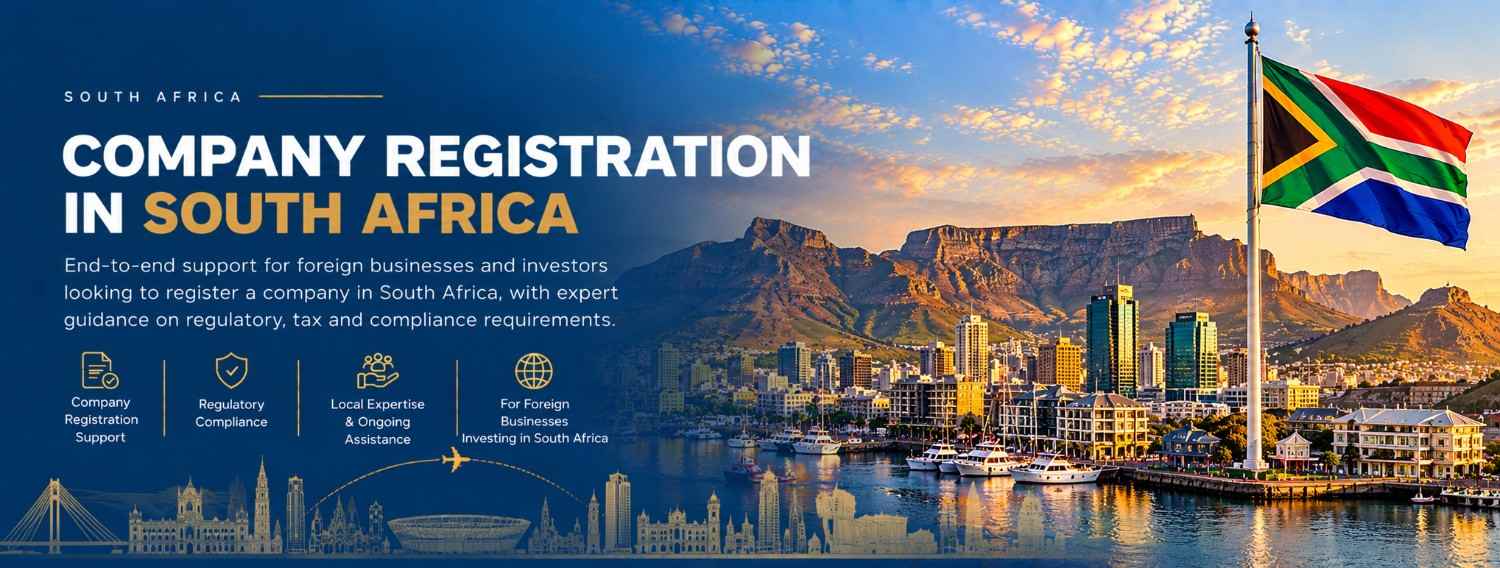
Establishing a Business in the Western Cape
The Western Cape is an important business region in South Africa, with commercial activity spanning Cape Town's financial and technology sectors, agricultural production, food processing, tourism, logistics, manufacturing and international trade. Entrepreneurs entering the region may establish a local operating business, launch a new venture or create a South African subsidiary of an overseas company.
The first step is understanding how South African company law applies to the proposed business. The Western Cape does not operate a separate company incorporation system. Companies are registered nationally through the Companies and Intellectual Property Commission (CIPC), while tax matters are administered by the South African Revenue Service (SARS). Municipalities and other authorities may impose additional requirements relating to premises, land use, trading activities and licences.
For international founders, business registration south africa involves more than obtaining a registration certificate. The legal structure, ownership arrangements, tax obligations and permissions required for actual operations should all be considered before trading begins.
Which Business Structure Should You Choose?
The right structure depends on the scale of the business, its liability exposure, ownership plans and the nature of its activities.
1. Private Company (Pty) Ltd
A private company is a common structure for businesses seeking a separate legal identity. It can enter into contracts, own assets and conduct business in its own name. Shareholder liability is generally limited, subject to applicable law and circumstances.
This structure may suit technology companies in Cape Town, agricultural exporters, consulting firms, trading businesses and companies supplying commercial customers.
A private company must have at least one director and an appropriate Memorandum of Incorporation (MOI). The MOI governs important aspects of company management and shareholder rights.
2. Sole Proprietorship
A sole proprietorship may suit an individual running a small business. It is not a separate legal entity, and the proprietor is generally personally responsible for business liabilities.
Not every sole proprietor needs to incorporate through CIPC. However, tax registration, municipal permissions and other obligations may still apply depending on the business.
3. Non-Profit Company
A non-profit company may be appropriate for qualifying organisations established for public-benefit or other non-profit purposes. Its governance and use of income differ from those of a conventional commercial company.
4. Foreign Company or South African Subsidiary
An overseas business planning to enter the Western Cape should distinguish between incorporating a new South African subsidiary and registering an existing foreign company as an external company. These routes have different legal implications, and the appropriate choice depends on the intended operating model.
How CIPC Company Registration Works
The cipc company registration process is administered nationally. Entrepreneurs can use CIPC's electronic services or the government-supported BizPortal platform for eligible registration types.
Step 1: Define the proposed business
Identify the company's activities, ownership structure and intended location. A company operating a software consultancy in Cape Town may face different practical requirements from a food manufacturer, hospitality business or agricultural exporter.
If the company will be owned by a foreign parent, determine how capital will be introduced and how the South African operation will interact with related entities.
Step 2: Choose and check the company name
Decide whether to reserve a company name before incorporation. CIPC permits certain profit companies to be registered without a reserved name; in such cases, the registration number becomes the company's name, with the prescribed South African suffix.
A name can be added later through the relevant name reservation and company-name amendment process. If a distinctive commercial identity is important, check name availability and consider trademark protection separately.
Step 3: Prepare the incorporation information
For a standard private company, the application requires the relevant company details, incorporator information and director particulars. The company's MOI establishes its governance framework.
A standard MOI may suit a straightforward business. A customised MOI may be more appropriate where shareholders need specific governance arrangements or share-related provisions.
Step 4: Submit the application
Applicants can use cipc registration online through the official CIPC e-Services platform or BizPortal, depending on the type of application.
BizPortal offers an electronic registration route for standard private companies and non-profit companies. Applications involving customised documents or other company types may require a different filing process.
The official BizPortal platform currently lists registration fees of R125 for a private company without a reserved name and R175 where a name is included, subject to the platform's terms and current fee schedule. Additional professional services or compliance arrangements may involve separate charges.
Step 5: Receive the registration details
Once the application is approved, the company receives its registration documentation and company number. Keep these records accessible for tax administration, banking applications, supplier onboarding and future statutory filings.
The process for online company registration south africa can be straightforward for eligible standard applications, but processing times depend on the application type, completeness of information and payment.
Tax Registration and Business Administration
After incorporation, the company must establish its tax and administrative arrangements.
1. Corporate income tax: SARS states that companies registered with CIPC are generally issued an income tax reference number automatically. The company should verify its tax details and register on SARS eFiling to manage applicable tax obligations electronically.
2. VAT: Registration depends on the business's taxable supplies and the prevailing statutory rules. SARS should be consulted to determine whether compulsory or voluntary registration applies.
3. Payroll obligations: Businesses employing staff may need to register for PAYE and other relevant employment-related contributions or funds, depending on their circumstances.
4. Accounting and annual filings: Companies must maintain proper accounting records, file annual returns with CIPC and comply with applicable financial reporting and tax requirements.
5. Beneficial ownership: Companies must comply with CIPC's beneficial ownership disclosure requirements. The applicable beneficial ownership information and supporting securities or beneficial interest records must be kept up to date and submitted as required, including in connection with annual returns.
Completing register a business in south africa requirements at incorporation is therefore only the beginning of the company's compliance responsibilities.
Local Requirements in the Western Cape
Although company incorporation is national, the company's physical activities may trigger additional local requirements.
Businesses operating from Cape Town or other Western Cape municipalities should determine whether their premises require zoning or land-use approval, building approval, a business licence or other permission. Requirements depend on the activity and location; they do not apply identically to every company.
Food businesses, liquor establishments, accommodation providers and certain regulated activities may face additional licensing or inspection requirements. Importers and exporters should also consider customs registration and any product-specific controls relevant to their goods.
Entrepreneurs planning to start a company in south africa should confirm these requirements before signing a long-term lease or committing to premises. Incorporation does not automatically authorise a business to conduct regulated activities.
How YKG Global Helps You
YKG Global supports international entrepreneurs and businesses planning to establish operations in South Africa, including the Western Cape. Our team helps clients understand the national registration process and identify additional requirements relevant to their intended activities.
Our support can include:
• Guidance on selecting an appropriate South African business structure.
• Coordination of incorporation documentation and CIPC filing requirements.
• Assistance with understanding tax registration, accounting and annual compliance obligations.
• Guidance on beneficial ownership disclosure and company record-keeping.
• Cross-border tax and regulatory coordination for businesses operating between India and South Africa.
• Assistance in identifying local licensing and premises-related considerations, subject to the relevant authority's requirements.
• Support in preparing documents for business banking applications, subject to the bank's independent due diligence and approval.
Whether you plan to establish a Cape Town-based service business or a regional trading operation, YKG Global can help you plan the registration and compliance process.
Call us or fill out our contact form to schedule a consultation today.
📧 Email: Rishi@ykgglobal.com
🌐 Website: www.ykgglobal.com
📱 Call/WhatsApp: +91 76782 77665
📍 Offices: Delhi | Mumbai | Dubai | Singapore