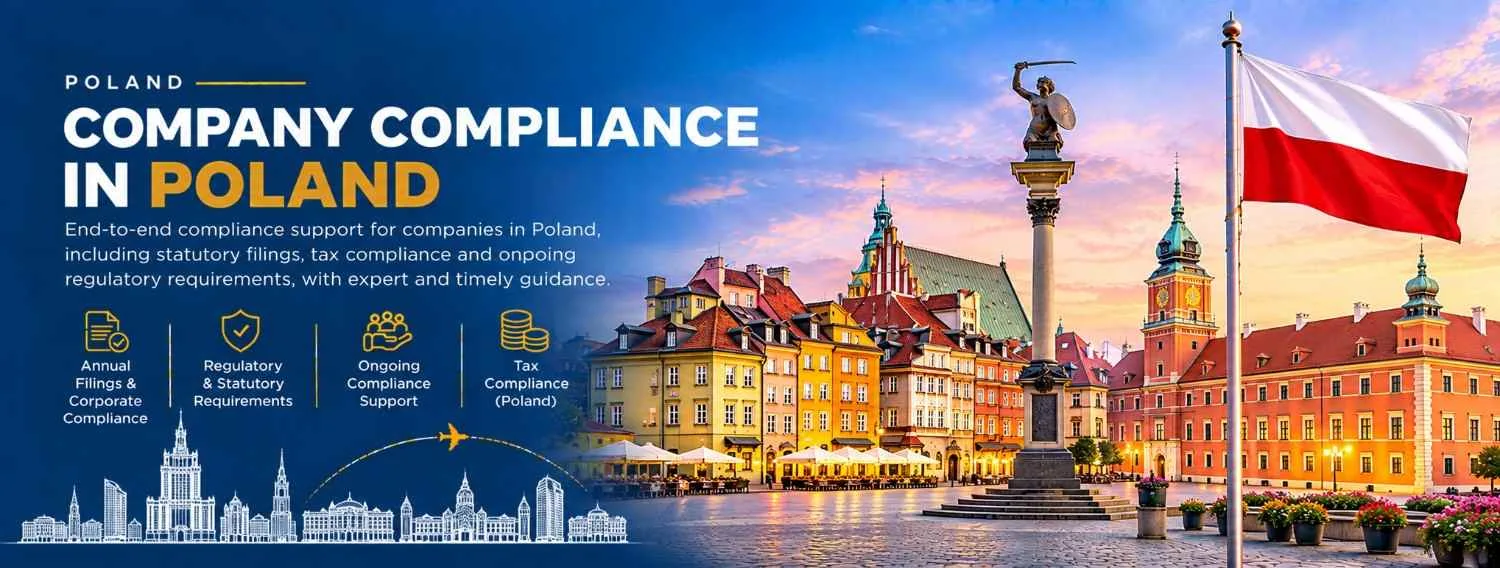
Annual Compliance for Foreign Company in Poland
Poland is an important European market for international manufacturers, technology companies, logistics providers and trading groups. Establishing a business presence is only the beginning; maintaining it requires coordinated accounting, tax and corporate reporting.
The obligations differ significantly between a foreign company's Polish branch and a locally incorporated subsidiary.
Effective Poland foreign company compliance requires understanding the National Court Register (KRS), Polish accounting standards, corporate income tax, VAT and cross-border transactions.
1. Foreign Branch or Polish Subsidiary?
1.1 Polish Branch
A branch (oddział) operates as part of its overseas parent company and does not have separate legal personality.
It must be registered in the KRS and appoint a person authorised to represent the foreign entrepreneur.
1.2 Foreign-Owned Subsidiary
A Polish limited liability company (Sp. z o.o.) is a separate legal entity, even when all shares belong to an overseas corporation.
Its management board is responsible for statutory corporate obligations.
1.3 Different Reporting Responsibilities
A branch generally maintains separate Polish accounting records for its activities. A subsidiary prepares accounts for its own legal entity.
This distinction affects financial reporting, governance and tax administration.
2. The Polish Financial Year-End Process
2.1 Preparing Annual Accounts
Entities subject to Polish accounting requirements generally prepare annual financial statements within three months after their financial year-end.
For a calendar-year entity, this ordinarily means 31 March.
2.2 Financial Statement Components
Depending on the entity and applicable reporting framework, statements may include:
• Balance sheet.
• Profit and loss account.
• Notes and accounting policies.
• Additional statements required by law.
2.3 Approval of Accounts
For a typical Sp. z o.o., shareholders generally approve annual financial statements within six months after year-end.
2.4 Electronic Format
Polish financial statements must be prepared electronically in the prescribed format and signed using accepted electronic signatures.
3. KRS Filing and Corporate Governance
3.1 Financial Document Submission
Entities registered in the KRS entrepreneurs register generally submit approved financial statements electronically within 15 days after approval.
3.2 Supporting Documents
Depending on the entity, the filing may include:
• Annual financial statements.
• Approval resolution.
• Resolution concerning profit distribution or loss coverage.
• Audit report, where required.
3.3 Changes During the Year
Changes involving management board members, registered addresses or constitutional documents may require separate KRS notifications.
3.4 Foreign Shareholder Coordination
International groups should schedule approval meetings and signatures early to avoid delays in KRS annual reporting.
4. Corporate Income Tax and Foreign Ownership
4.1 Applicable Rates
Poland's standard corporate income tax rate is 19%.
A reduced 9% rate may apply to qualifying entities and eligible income, subject to statutory conditions.
4.2 Annual CIT-8 Return
Companies generally submit CIT-8 electronically by the end of the third month following their tax year-end.
Tax balances are ordinarily payable by the same deadline.
4.3 Branch Taxation
A foreign company's Polish branch may create a permanent establishment for tax purposes.
The allocation of taxable profits requires consideration of Polish law and relevant tax treaties.
4.4 Related-Party Transactions
Management charges, financing arrangements and other transactions with overseas group companies may require transfer pricing analysis.
Accurate corporate tax Poland reporting therefore involves more than calculating local revenue.
5. VAT, JPK and Electronic Invoicing
5.1 VAT Registration
Businesses carrying out taxable activities must assess Polish VAT registration requirements.
The standard VAT rate is 23%, with reduced rates applying to qualifying supplies.
5.2 JPK_V7 Reporting
VAT-registered businesses generally submit electronic VAT records and declarations through the JPK_V7 framework.
5.3 KSeF Electronic Invoices
Poland's National e-Invoicing System (KSeF) is being implemented through phased mandatory requirements in 2026.
Businesses must evaluate the applicable commencement dates and transaction exemptions.
5.4 Intra-EU Transactions
Companies trading within the European Union may have additional VAT-UE and Intrastat reporting obligations.
These requirements are particularly relevant to foreign-owned distributors and manufacturers.
6. Beneficial Ownership and Corporate Transparency
6.1 CRBR Reporting
Qualifying Polish entities must disclose beneficial ownership information to the Central Register of Beneficial Owners (CRBR).
6.2 Ownership Changes
Changes to reportable beneficial ownership information must be submitted within applicable statutory deadlines.
6.3 Foreign Parent Companies
Multi-layered international ownership structures may require documentation identifying individuals who ultimately control the Polish entity.
6.4 Branch Distinction
A foreign branch should not automatically be treated as having the same CRBR obligations as a Polish subsidiary.
The applicable entity classification must be assessed.
7. Employment and Cross-Border Operational Duties
7.1 ZUS Social Insurance
Employers must register eligible employees and manage applicable social insurance contributions through ZUS.
7.2 Payroll Tax
Employee income tax withholding and annual employer declarations may apply.
7.3 Foreign Employees
Non-EU nationals may require work and residence authorisations depending on their circumstances.
7.4 Regulatory Permits
Transport, financial services, food production and certain other activities may require additional permits.
7.5 Branch-Specific Records
A Polish branch should maintain accounting documentation that distinguishes its Polish activities from those of the overseas headquarters.
These operational responsibilities form an important part of Poland branch compliance.
8. Building a Practical Compliance Calendar
8.1 Monthly Obligations
Depending on registration and activities, companies may need to manage VAT reporting, payroll contributions and tax advances.
8.2 Annual Obligations
Typical year-end responsibilities include:
• CIT-8 submission.
• Financial statement preparation.
• Shareholder approval, where applicable.
• KRS financial document filing.
• Statutory audit, where required.
8.3 Event-Based Filings
Management changes, ownership changes and amendments to corporate particulars may trigger additional reporting.
8.4 International Coordination
Foreign parent companies should align their group reporting schedules with Polish statutory deadlines.
This approach makes Poland annual filings more manageable across multiple jurisdictions.
9. How YKG Global Helps You
YKG Global assists international businesses with managing corporate, accounting and tax obligations in Poland.
Our Poland statutory compliance support focuses on practical coordination between overseas headquarters and Polish professionals.
9.1 Corporate Filing Support
Assistance with KRS documentation, financial statement submissions and corporate information updates.
9.2 Accounting Coordination
Helping organise annual accounts, supporting records and relevant audit requirements.
9.3 Tax Compliance Assistance
Supporting CIT-8 preparation, VAT reporting and cross-border tax documentation.
9.4 Beneficial Ownership Reporting
Guidance on applicable CRBR requirements and ownership disclosures.
9.5 Ongoing Compliance Monitoring
Coordinating recurring deadlines, statutory records and changes affecting the Polish business.
YKG Global helps foreign companies maintain structured compliance processes while focusing on their commercial operations.
Call us or fill out our contact form to schedule a consultation today.
📧 Email: Rishi@ykgglobal.com
🌐 Website: www.ykgglobal.com
📱 Call/WhatsApp: +91 76782 77665
📍 Offices: Delhi | Mumbai | Dubai | Singapore