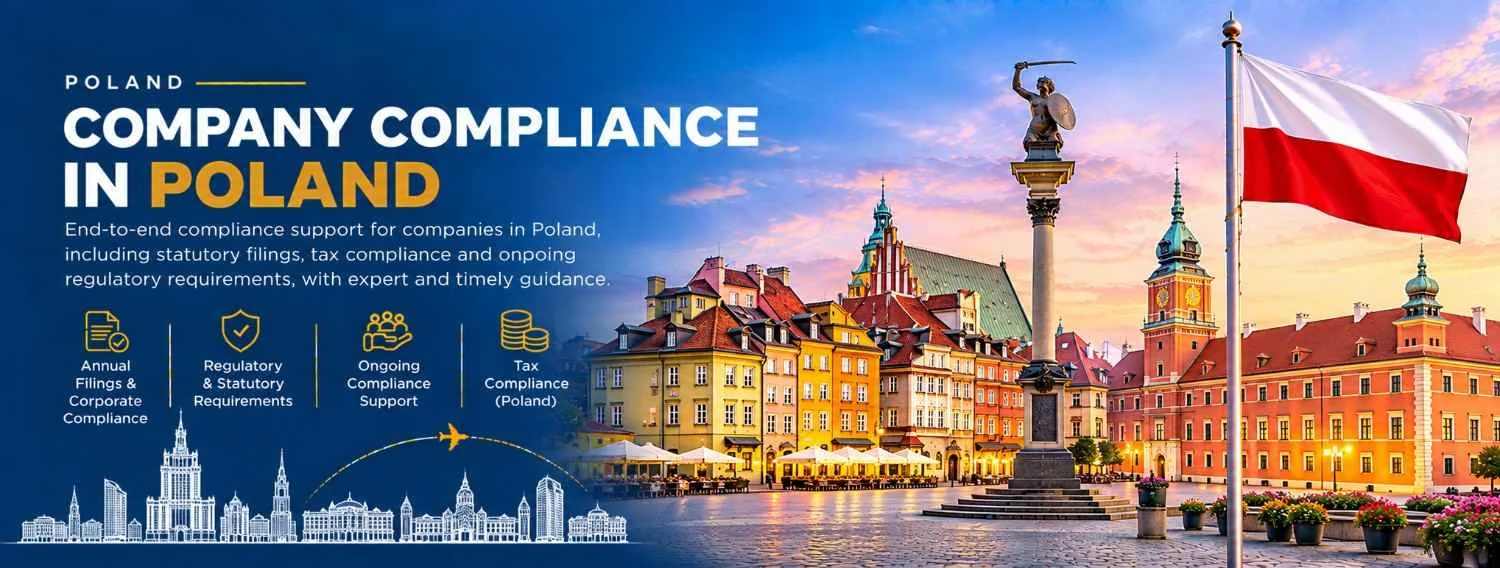
Annual Compliance for Foreign Company in Poland
Operating in Poland gives international businesses access to the European Union's single market, established manufacturing networks and a growing services sector. However, foreign-owned businesses must satisfy Polish accounting, taxation and corporate reporting requirements.
These obligations depend on how the foreign investor operates. A Polish subsidiary, a registered branch and an overseas company with a Polish permanent establishment may face different compliance responsibilities.
Understanding Poland foreign company compliance helps international businesses coordinate their local records with group reporting and avoid missed statutory deadlines.
1. Identify Your Foreign Business Structure
1.1 Polish Subsidiary
A Polish limited liability company, or spółka z ograniczoną odpowiedzialnością (sp. z o.o.), is a separate legal entity, even when wholly owned by an overseas parent.
It generally maintains its own accounts, files corporate tax returns and submits annual financial statements.
1.2 Registered Foreign Branch
An oddział przedsiębiorcy zagranicznego is an extension of its overseas parent rather than a separate company.
Its accounting and tax obligations reflect the activities carried out in Poland.
1.3 Foreign Company Without a Branch
An overseas business may have Polish VAT or permanent establishment obligations without incorporating a subsidiary.
The existence and extent of these obligations require individual assessment.
2. Financial Statements and Year-End Deadlines
2.1 Preparation of Accounts
Entities subject to Polish accounting requirements generally prepare annual financial statements within three months after the financial year ends.
2.2 Approval of Statements
A Polish subsidiary generally obtains approval of its annual financial statements within six months after year-end.
2.3 Electronic Filing
Approved statements and prescribed accompanying documents are generally submitted electronically to the National Court Register within 15 days of approval.
2.4 Unapproved Accounts
Where approval is delayed beyond the statutory deadline, additional filing obligations can arise.
For a calendar-year Polish subsidiary, Poland annual filings commonly involve preparation by 31 March, approval by 30 June and subsequent registry submission.
3. National Court Register and Corporate Changes
3.1 Understanding KRS
The Krajowy Rejestr Sądowy (KRS) is Poland's National Court Register.
It maintains information about registered companies and foreign branches.
3.2 Financial Document Repository
Annual financial documents are submitted through the appropriate electronic filing system.
3.3 Corporate Information Updates
Changes involving management boards, registered addresses, representation arrangements or constitutional documents may require KRS notifications.
3.4 Overseas Management
Foreign directors should confirm that appropriate electronic signatures or authorised filing representatives are available.
Effective KRS annual reporting requires coordination between local accountants, management and the overseas parent.
4. Corporate Income Tax and CIT-8 Returns
4.1 Standard Corporate Tax
Poland's standard corporate income tax rate is 19%.
A 9% rate may apply to qualifying taxpayers and eligible income, subject to statutory conditions.
4.2 Annual CIT-8
Taxpayers generally submit their CIT-8 return electronically by the end of the third month following the tax year.
4.3 Tax Payment
Outstanding corporate income tax is generally payable by the same deadline.
4.4 Foreign Branches
Where a foreign company operates through a Polish permanent establishment, Poland may tax the profits attributable to that establishment, subject to applicable treaties.
4.5 Related-Party Transactions
International group transactions may trigger transfer pricing documentation and reporting obligations.
Businesses assessing corporate tax Poland should consider these requirements alongside the annual tax return.
5. VAT Reporting and Electronic Invoicing
5.1 VAT Registration
Businesses conducting taxable transactions must determine whether Polish VAT registration is required.
5.2 JPK_V7 Reporting
Registered taxpayers generally submit electronic VAT records and declarations through the applicable JPK_V7 format.
5.3 KSeF Requirements
Poland introduced mandatory structured electronic invoicing through the National e-Invoice System (KSeF) in stages during 2026.
5.4 January 2027 Expansion
From 1 January 2027, the remaining eligible small businesses covered by the transitional arrangements are scheduled to enter the mandatory system.
5.5 Foreign Business Implications
Foreign entities must assess whether KSeF applies to their transactions, taking account of establishment status and relevant exceptions.
Accounting systems and invoicing processes should be reviewed before the applicable deadline.
6. Compliance Requirements for Foreign Branches
6.1 Separate Accounting Records
A registered foreign branch generally maintains Polish accounting records reflecting its local operations.
6.2 Financial Statements
Branches subject to Polish accounting legislation generally prepare financial statements and meet applicable registry filing requirements.
6.3 Parent Company Relationship
The branch's financial information must be coordinated with the overseas head office.
6.4 Taxpayer Identity
The foreign parent, rather than the branch as a separate legal person, may be the relevant corporate taxpayer.
6.5 Local Representation
Changes to authorised branch representatives and registered information may require formal notifications.
Proper Poland branch compliance therefore involves both local reporting and coordination with the foreign parent.
7. Payroll, Social Security and Beneficial Ownership
7.1 Employee Payroll
Companies employing staff must comply with Polish payroll tax withholding and reporting requirements.
7.2 ZUS Contributions
Employers generally register and report relevant employees to the Social Insurance Institution (ZUS) and pay applicable contributions.
7.3 Beneficial Ownership Register
Entities covered by Poland's Central Register of Beneficial Owners (CRBR) must maintain accurate beneficial ownership information.
7.4 Foreign Directors
Overseas management arrangements may require additional analysis of employment, social security and tax residency matters.
7.5 Employment Documentation
Businesses should maintain appropriate employment contracts, payroll records and legally required personnel documentation.
8. Annual Audit and Group Reporting
8.1 Statutory Audit
An audit may be mandatory depending on the company's legal form, financial thresholds and other statutory criteria.
8.2 Group Accounting
Foreign-owned subsidiaries often need to reconcile Polish statutory accounts with parent-company reporting standards.
8.3 Intercompany Balances
Loans, management fees, royalties and other related-party transactions should be reconciled before year-end.
8.4 Supporting Documentation
Businesses should maintain invoices, agreements, accounting records and relevant transfer pricing support.
Accurate Polish financial statements depend on consistent accounting throughout the year, not only year-end adjustments.
9. How YKG Global Helps You
YKG Global supports international businesses with Polish corporate administration, tax coordination and statutory reporting.
9.1 Compliance Assessment
Reviewing the obligations applicable to subsidiaries, registered branches and other foreign business structures.
9.2 Accounting Coordination
Assisting with bookkeeping arrangements, year-end schedules and financial reporting documentation.
9.3 Corporate Filing Support
Coordinating KRS submissions, corporate information changes and relevant statutory records.
9.4 Tax Compliance
Supporting CIT, VAT and cross-border tax reporting through appropriate Polish professionals.
9.5 Payroll and Ownership Reporting
Helping businesses organise payroll documentation, beneficial ownership information and related compliance records.
9.6 International Group Coordination
Connecting Polish reporting requirements with the overseas parent company's financial and governance processes.
YKG Global helps foreign-owned businesses manage Poland statutory compliance through organised reporting schedules and coordination with qualified local advisers.
Call us or fill out our contact form to schedule a consultation today.
📧 Email: Rishi@ykgglobal.com
🌐 Website: www.ykgglobal.com
📱 Call/WhatsApp: +91 76782 77665
📍 Offices: Delhi | Mumbai | Dubai | Singapore