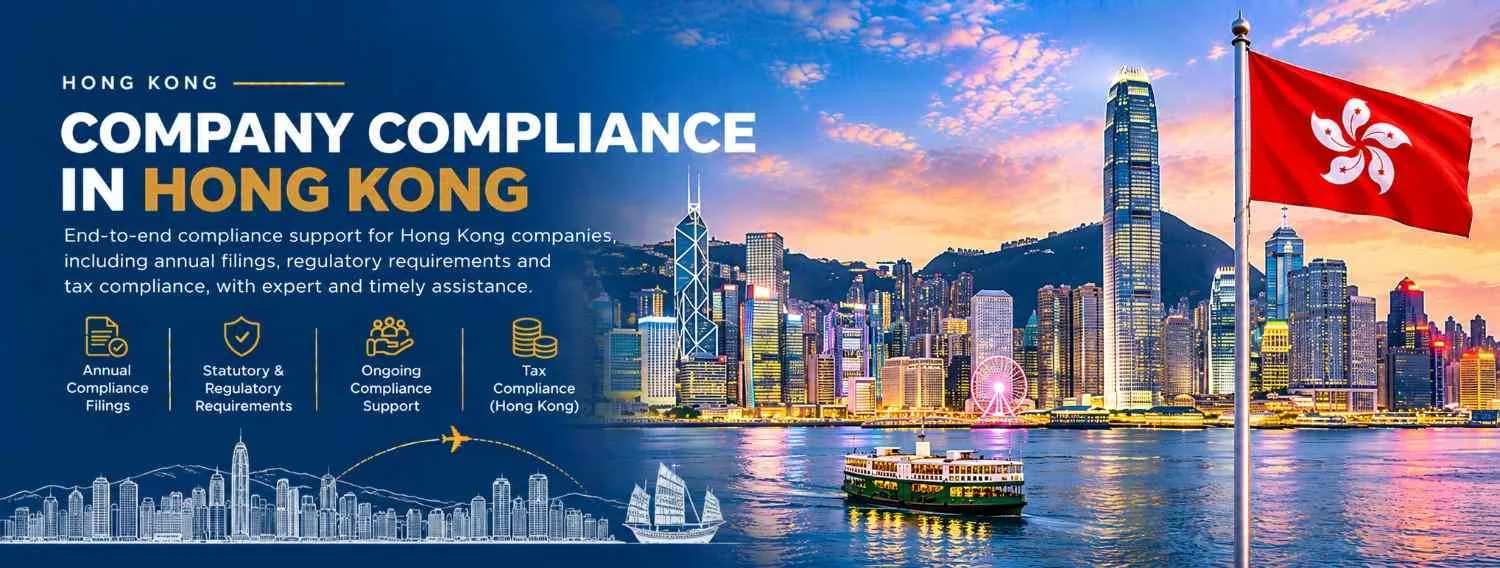
Hong Kong Company Annual Filing Services
Hong Kong remains an important business centre for international trading, financial services, technology and cross-border investment. However, maintaining a company involves recurring statutory obligations that continue after incorporation, even when commercial activity is limited.
Companies must coordinate filings with the Companies Registry and Inland Revenue Department (IRD), alongside accounting, auditing and corporate recordkeeping responsibilities.
Professional Hong Kong company annual filing services help businesses monitor statutory deadlines, prepare accurate documentation and maintain their legal standing.
For overseas shareholders, understanding the distinction between annual returns, business registration and tax reporting is particularly important because each obligation follows a different procedure.
1. Understanding Hong Kong's Annual Filing Framework
Hong Kong companies operate under the Companies Ordinance and applicable taxation legislation.
Two principal authorities administer recurring obligations.
1.1 Companies Registry
The Companies Registry receives annual returns and prescribed notifications concerning directors, shareholders, registered offices and company secretaries.
1.2 Inland Revenue Department
The IRD administers business registration, profits tax returns, employer reporting and relevant taxation matters.
1.3 Different Filing Dates
Companies Registry deadlines generally depend on incorporation anniversaries, whereas tax filing obligations follow assessment periods and notices issued by the IRD.
Businesses should maintain separate calendars for these requirements instead of treating them as a single annual submission.
2. Annual Return Filing with the Companies Registry
Every local private company generally submits an annual return, except during its year of incorporation.
2.1 Form NAR1
The annual return records prescribed information about the company's directors, secretary, shareholders, registered office and share capital.
2.2 Filing Deadline
A private company must generally submit its annual return within 42 days after its incorporation anniversary.
2.3 Government Fee
The standard registration fee is HK$105 when the return is delivered within the prescribed period.
2.4 Electronic Submission
Companies may submit returns through the Companies Registry's e-Services Portal or use permitted paper filing methods.
2.5 Dormant Companies
Companies with no trading activity generally remain subject to annual return requirements unless they have obtained the relevant statutory dormant status.
Timely Hong Kong annual return filing requires checking company information before submission and confirming successful registration.
3. Documents and Information Required for NAR1
Preparing an annual return requires information reflecting the company's position on its return date.
3.1 Corporate Particulars
• Company name and registration number
• Registered office address
• Principal business details, where applicable
3.2 Directors and Secretary
Details of directors and the appointed company secretary must be accurately recorded.
3.3 Shareholder Information
The company must provide prescribed shareholder and shareholding particulars.
3.4 Share Capital
Relevant issued share capital information must reflect the company's records.
3.5 Signature Requirements
The return must be properly signed or authenticated according to the selected filing method.
Accurate NAR1 filing Hong Kong depends on reconciling statutory registers with information already recorded by the Companies Registry.
4. Late Filing Fees and Consequences
Missing an annual return deadline can substantially increase statutory costs.
4.1 Late Registration Fees
For local private companies, the prescribed fees are:
• Within 42 days: HK$105
• After 42 days but within three months: HK$870
• After three months but within six months: HK$1,740
• After six months but within nine months: HK$2,610
• After nine months: HK$3,480
4.2 Enforcement Risks
Failure to deliver annual returns may expose the company and responsible officers to prosecution and statutory fines.
4.3 Deadline Extensions
The Registrar cannot extend the statutory filing period merely because a company missed its deadline.
4.4 Preventive Measures
Businesses should begin reviewing their corporate records before the incorporation anniversary rather than waiting until the filing window closes.
5. Business Registration Certificate Renewal
Business registration is administered separately from annual returns.
5.1 Renewal Requirements
Companies must maintain a valid Business Registration Certificate under the applicable registration arrangements.
5.2 Certificate Duration
Businesses may hold one-year or three-year certificates, depending on their election and eligibility.
5.3 Renewal Notices
The IRD generally issues renewal demands before the existing certificate expires.
5.4 Government Charges
Registration fees and levies may change according to the applicable government fee schedule.
5.5 Business Particulars
Changes in business information must be notified where required.
Proper Hong Kong business registration renewal ensures that companies do not confuse the Business Registration Certificate with the Certificate of Incorporation.
6. Accounting, Auditing and Financial Statements
Annual corporate filings must be distinguished from financial reporting responsibilities.
6.1 Accounting Records
Companies must maintain sufficient records of revenue, expenses, assets, liabilities and business transactions.
6.2 Financial Statements
Applicable companies prepare annual financial statements in accordance with relevant accounting requirements.
6.3 Statutory Audit
Hong Kong companies generally require audited financial statements, subject to statutory exceptions, including qualifying dormant companies.
6.4 Private Company Filings
Ordinary private companies generally do not submit audited financial statements with Form NAR1.
6.5 Audit Preparation
Bank statements, invoices, contracts and transaction schedules should be organised before the annual audit.
These records also support tax reporting and financial information requested by banks or investors.
7. Profits Tax Returns and Employer Reporting
Tax compliance follows a separate process from Companies Registry filings.
7.1 Profits Tax Returns
Companies must submit profits tax returns when issued by the IRD, within the applicable deadline or authorised extension.
7.2 Tax Rates
Corporations generally face an 8.25% rate on the first HK$2 million of assessable profits and 16.5% thereafter, subject to the two-tiered regime's conditions.
7.3 Supporting Accounts
Applicable profits tax submissions require relevant financial statements, tax computations and supporting schedules.
7.4 Employer Returns
Companies employing staff must assess annual employer reporting and other applicable employment-related tax obligations.
7.5 International Transactions
Cross-border payments and related-party dealings may require additional tax analysis.
Accurate Hong Kong profits tax return filing requires reconciling audited financial information with taxable income calculations.
8. Statutory Registers and Corporate Changes
Annual filing preparation provides an opportunity to review corporate governance records.
8.1 Significant Controllers Register
Applicable companies must maintain a Significant Controllers Register identifying relevant beneficial ownership and control information.
8.2 Director Changes
Appointments, resignations and changes in directors' particulars require prescribed notifications.
8.3 Share Transfers
Shareholder changes must be documented and reflected in applicable statutory records.
8.4 Registered Office
Changes in the registered office must be reported through the relevant procedure.
8.5 Company Secretary
Companies must maintain an eligible company secretary and update appointment details when required.
These obligations form part of Hong Kong company annual compliance, although many notifications arise when changes occur rather than annually.
9. Annual Filing for Overseas-Owned Companies
Foreign shareholders frequently manage Hong Kong companies without residing in the jurisdiction.
9.1 Remote Documentation
Directors and shareholders should provide updated corporate information sufficiently before filing deadlines.
9.2 International Ownership
Changes in overseas holding structures may affect beneficial ownership records.
9.3 Registered Non-Hong Kong Companies
Registered non-Hong Kong companies generally file Form NN3 within 42 days after their Hong Kong registration anniversary.
9.4 Different Statutory Fees
The on-time annual return registration fee for a registered non-Hong Kong company is HK$180.
9.5 Centralised Monitoring
International groups should maintain jurisdiction-specific calendars rather than assuming that all subsidiaries share identical filing dates.
10. How YKG Global Helps You
YKG Global supports businesses with annual filing coordination and corporate documentation through appropriately qualified Hong Kong professionals.
10.1 Annual Return Preparation
Assisting with Form NAR1 information, supporting documents and submission coordination.
10.2 Deadline Monitoring
Maintaining calendars for annual returns, registration renewals and tax reporting.
10.3 Accounting and Audit Coordination
Helping organise financial records and coordinate with qualified Hong Kong auditors.
10.4 Tax Documentation
Supporting profits tax return preparation and relevant IRD reporting coordination.
10.5 Corporate Records
Providing Hong Kong company secretarial services coordination for statutory registers, resolutions and prescribed company changes.
10.6 Foreign Shareholder Assistance
Helping international owners manage documentation and communicate with local professional advisers.
YKG Global assists companies in maintaining organised annual compliance processes while supporting their continuing business operations.
Call us or fill out our contact form to schedule a consultation today.
📧 Email: Rishi@ykgglobal.com
🌐 Website: www.ykgglobal.com
📱 Call/WhatsApp: +91 76782 77665
📍 Offices: Delhi | Mumbai | Dubai | Singapore