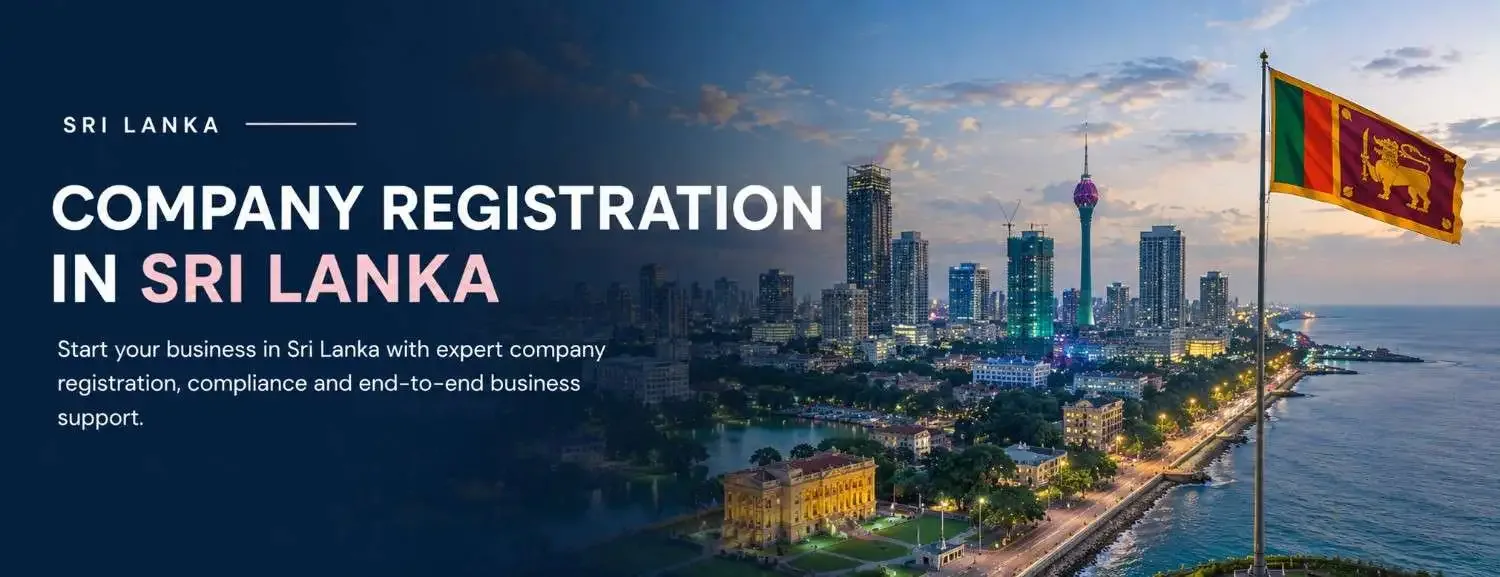
Private Limited Company Registration Sri Lanka
A Private Limited Company Registration Sri Lanka creates a separate corporate entity for carrying on business under Sri Lanka's Companies Act No. 7 of 2007.
Unlike an individual business, a private company separates the company's legal identity from its shareholders. This can make the structure suitable for entrepreneurs who want formal ownership through shares, limited liability and a business structure that can accommodate multiple investors.
The incorporation process is administered by the Department of the Registrar of Companies (DRC) through its eROC platform. The DRC identifies Articles of Association or a Company Profile, Form 01, Form 18 and Form 19 among the core documents for private-company incorporation.
There is also an important 2026 development: new companies must complete beneficial-ownership and authorised-person submissions after incorporation and payment of incorporation fees.
1. What Makes a Sri Lankan Private Company Different?
A private limited company is not simply a business name registered to an individual.
It has its own:
• Legal identity.
• Shareholders.
• Directors.
• Company secretary.
• Constitutional documents.
• Registered office.
• Corporate records.
• Statutory filing responsibilities.
The Companies Act also permits a company to have a single shareholder in specified circumstances, including where the shareholder is an individual or body corporate; the Act's general provision otherwise states that a company shall have not less than two shareholders.
This makes the structure more flexible than assuming every company must have multiple individual founders.
2. Who Should Consider a Private Limited Company?
The structure can be appropriate for:
• Entrepreneurs launching a formal operating business.
• Family-owned businesses.
• Startups planning to bring in investors.
• Professional and service businesses where a company structure is appropriate.
• Trading businesses.
• Technology companies.
• Businesses expanding from an individual operation.
• Foreign investors establishing a Sri Lankan corporate presence.
The key question is not simply whether you can incorporate a company, but whether a company is the right legal and commercial structure for the activity.
3. Shareholders, Directors and Secretary
A private company operates through several distinct corporate roles.
Shareholders own shares in the company.
Directors manage and govern the company according to the Companies Act and its articles.
The company secretary performs important statutory and administrative functions.
During incorporation, the DRC requires consent from the initial directors through Form 18 and consent from the initial secretary through Form 19.
Keeping these roles clearly documented helps establish proper corporate governance from the beginning.
4. Decide the Ownership Before Filing
Before Register a Private Limited Company Sri Lanka, founders should settle the ownership structure.
Important decisions include:
• Who will hold shares?
• What percentage will each shareholder own?
• Who will become directors?
• Who will act as secretary?
• What business activities will the company undertake?
• What will the articles of association provide?
• Where will the company maintain its registered office?
For foreign participation, ownership and investment arrangements should be reviewed before incorporation rather than changing the structure after registration.
5. Prepare the Company's Constitutional Documents
A private company requires appropriate constitutional documentation.
The DRC lists the Articles of Association / Company Profile as part of the private-company incorporation requirements.
The constitutional framework can address matters relating to:
• Share rights.
• Transfer of shares.
• Decision-making.
• Directors.
• Meetings.
• Company administration.
For a straightforward company, model documentation may be useful. Where shareholders have more complex arrangements, the constitutional documents should be prepared carefully around the actual ownership and governance model.
6. eROC: The Digital Incorporation Route
The DRC operates eROC, its web-based single-window platform for business-registration facilities.
The DRC's current instructions state that Form 01 and Form 05 should be system-generated through eROC, while Form 18 and Form 19 should be generated through the system when initially incorporating a company.
A typical digital workflow involves:
- Creating or accessing the eROC account.
- Selecting and checking the proposed company name.
- Entering company and shareholder information.
- Providing director and secretary details.
- Preparing the required documents.
- Uploading the required signed documents.
- Completing payment.
- Responding to any Registrar request for corrections or resubmission.
- Receiving the incorporation documentation after approval.
The DRC has also stated that incorporation certificates are issued electronically, allowing users to download them from the relevant dashboard.
7. Documents Required for Private Company Registration
The core DRC requirements include:
• Articles of Association / Company Profile.
• Form 01 – Application of Incorporation.
• Form 18 – Consent of Directors.
• Form 19 – Consent of Secretary.
The exact supporting information depends on the shareholders, directors, business activity and circumstances of the company.
Applicants should also ensure that uploaded documents comply with DRC technical requirements. The DRC has warned that documents without physically placed signatures or documents that have been improperly merged, edited or scanned can be rejected without refund.
8. Registered Office and Business Activity
A private company should establish its registered-office arrangements as part of the incorporation planning.
The proposed business activity should also be described accurately.
This is particularly important where the company will later require:
• Industry licences.
• Import/export registrations.
• Food or health approvals.
• Environmental permissions.
• Professional or sector-specific authorisations.
Company incorporation creates the entity, but it does not automatically authorise every regulated business activity.
9. The 2026 Beneficial Ownership Step
One of the most important changes for Pvt Ltd Company Registration Sri Lanka is the mandatory beneficial-ownership submission introduced in 2026.
The DRC states that, effective 30 March 2026, new companies must submit information concerning:
• Beneficial owners.
• The company's authorised person.
The process uses BO1 and BO5 after incorporation and payment of the incorporation fees. The DRC specifically states that failure to complete the requirement will result in the incorporation being resubmitted.
This means beneficial ownership should be prepared alongside the incorporation information instead of being treated as an unrelated future filing.
10. What Happens After Incorporation?
Registration is only the beginning of the company's compliance lifecycle.
A private company may subsequently need to manage:
• Annual returns.
• Accounting records.
• Tax obligations.
• Director and secretary changes.
• Share-related changes.
• Registered-office changes.
• Beneficial-ownership updates.
• Regulatory licences.
• Corporate resolutions and records.
The DRC provides separate forms and processes for changes to company information and ongoing filings.
A properly organised corporate record system makes future changes easier to manage.
11. Why Choose YKG Global?
YKG Global supports entrepreneurs with Sri Lanka Private Company Formation and related corporate requirements.
Our support can include:
• Private-company structure planning.
• Company-name and incorporation coordination.
• eROC registration assistance.
• Articles and incorporation-document coordination.
• Director and shareholder documentation.
• Secretary appointment support.
• BO1 and BO5 filing coordination.
• Tax-registration coordination.
• Corporate compliance support.
• Ongoing company-secretarial assistance.
For founders searching for Online Private Company Registration Sri Lanka, our role is to coordinate the process while ensuring that the company's ownership, documentation and compliance requirements are addressed together.
Private Limited Company Registration Sri Lanka is suitable for entrepreneurs seeking a formal corporate structure with shareholders, directors, a company secretary and a separate legal identity.
The process is administered through the DRC and eROC, with Form 01, Form 18, Form 19 and the company's constitutional documentation forming part of the incorporation framework.
For companies incorporated from 30 March 2026, beneficial-ownership submissions through BO1 and BO5 have become an important additional incorporation requirement.
A well-planned incorporation should therefore consider not only the initial registration but also ownership, governance, business activity, documentation and continuing compliance from the outset.
Call us or fill out our contact form to schedule a consultation today.
📧 Email: Rishi@ykgglobal.com
🌐 Website: www.ykgglobal.com
📱 Call/WhatsApp: +91 76782 77665
📍 Offices: Delhi | Mumbai | Dubai | Singapore