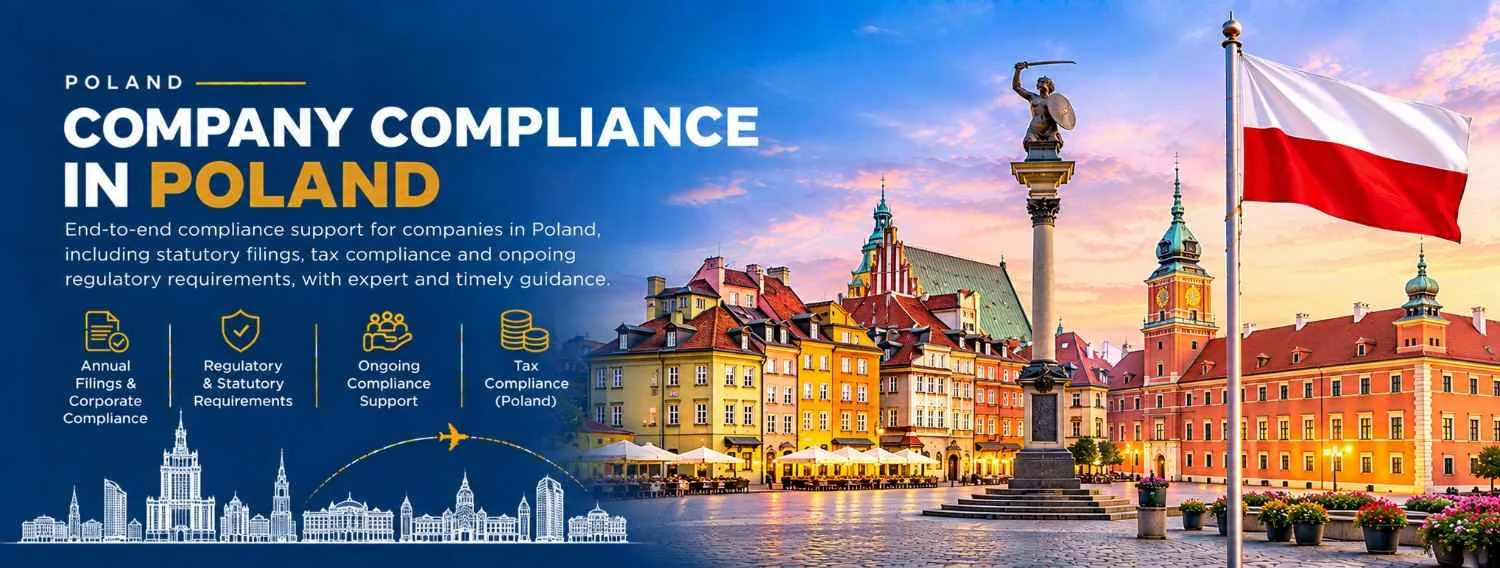
Register a Company in Poland
Poland offers international entrepreneurs access to a substantial European market, established manufacturing networks and opportunities in technology, logistics, trading and professional services. However, establishing a Polish company involves decisions that extend beyond submitting an incorporation application.
Foreign investors must select a suitable legal structure, determine how shareholders will sign incorporation documents and prepare for banking, taxation and beneficial ownership reporting.
For entrepreneurs planning to register a company in poland, understanding the distinction between Poland's online S24 system and its traditional notarial incorporation process is especially important.
1. Why the Incorporation Route Matters
Poland provides two principal registration routes for a limited liability company.
1.1 S24 Electronic Incorporation
S24 allows eligible companies to use standardised constitutional documents and submit their registration applications electronically.
It may suit straightforward ownership arrangements.
1.2 Notarial Incorporation
The traditional route involves executing customised articles of association before a notary and submitting the registration application through the Court Registers Portal.
1.3 Choosing Between Them
S24 may offer lower filing costs, while notarial incorporation allows greater flexibility for shareholder agreements and governance provisions.
The appropriate method depends on the company's intended ownership and management structure.
2. Understanding the Polish Limited Liability Company
The Spółka z ograniczoną odpowiedzialnością, abbreviated as Sp. z o.o., is a commonly used corporate structure.
2.1 Separate Legal Personality
The company becomes a separate legal entity upon registration in the National Court Register.
2.2 Shareholder Liability
Shareholders generally have limited liability, although management board members can face liability in specified circumstances.
2.3 Minimum Share Capital
The statutory minimum share capital is PLN 5,000, with a minimum nominal share value of PLN 50.
2.4 Shareholders
A company may generally have one or more shareholders, subject to restrictions involving formation by another single-shareholder limited liability company.
2.5 Management Board
The company must appoint a management board responsible for its representation and management.
An llc poland structure may suit foreign investors establishing a subsidiary, trading entity or regional operating business.
3. Can Foreigners Own a Polish Company?
3.1 Foreign Individuals
Foreign nationals may generally establish Polish limited liability companies, subject to applicable legal restrictions.
3.2 Overseas Corporate Shareholders
An international company may establish a Polish subsidiary through a corporate shareholding arrangement.
3.3 Director Residency
Polish limited liability companies do not generally require management board members to be Polish residents.
3.4 Immigration Considerations
Company ownership does not automatically provide permission to reside or work in Poland.
3.5 Foreign Documentation
Overseas corporate shareholders may need registration extracts, authorisations, translations and other supporting documents.
For investors considering starting a business in poland as a foreigner, these requirements should be reviewed before selecting the incorporation method.
4. Documents and Decisions Required Before Registration
4.1 Company Name
The proposed name must comply with Polish naming requirements and include the appropriate legal designation.
4.2 Registered Office
A registered office must be established in Poland.
4.3 Business Activities
The company must identify its intended activities using the applicable Polish Classification of Activities, known as PKD.
4.4 Articles of Association
The articles specify the company's ownership, share capital, governance and representation arrangements.
4.5 Management Board Details
Information concerning the appointed management board members must be prepared.
4.6 Electronic Signatures
Online incorporation requires acceptable electronic signatures for relevant documents and applications.
Accurate documentation helps avoid registration delays and subsequent corporate amendments.
5. How to Register Through S24
5.1 Create an Account
Applicants establish an account in the Ministry of Justice's S24 system.
5.2 Select the Entity
Choose the limited liability company structure.
5.3 Complete the Standard Articles
Enter shareholder details, share capital, registered office information and management arrangements.
5.4 Sign Electronically
Relevant parties must sign the documents using accepted electronic signature methods.
5.5 Submit the Application
The completed application is submitted electronically to the appropriate registry court.
5.6 Pay the Registration Fee
The standard S24 court registration fee is PLN 250.
S24 is useful for straightforward company registration in poland, but its standardised documents may not suit complex shareholder arrangements.
6. When Traditional Incorporation Is Preferable
6.1 Customised Shareholder Rights
Investors may need special provisions concerning share transfers, management powers or shareholder decisions.
6.2 Corporate Groups
International groups may require governance provisions aligned with their internal structures.
6.3 Non-Cash Contributions
Certain capital contributions may require a notarial incorporation arrangement.
6.4 Registration Procedure
Following execution of the notarial deed, the application is submitted electronically through the Court Registers Portal.
6.5 Government Fee
The standard court registration fee for the notarial route is PLN 500, excluding applicable notarial and professional costs.
Investors considering company formation in poland should evaluate governance flexibility alongside initial registration expenses.
7. What Is the National Court Register?
Poland's National Court Register, known as Krajowy Rejestr Sądowy (KRS), maintains official records of registered commercial entities.
7.1 Company Identification
Registered companies receive a KRS registration number.
7.2 Public Verification
The register provides access to prescribed company information, including legal status and representation details.
7.3 Corporate Changes
Relevant changes to registered particulars must be reported through applicable procedures.
7.4 Registry Extracts
Official company information can support banking, contracting and commercial due diligence.
The poland company register is therefore important throughout a company's existence, not only during incorporation.
8. Registrations Required After Incorporation
8.1 Tax Identification
Companies generally receive NIP and REGON identification numbers through the applicable registration arrangements.
8.2 Beneficial Ownership
Qualifying companies must report their beneficial owners to the Central Register of Beneficial Owners, generally within 14 days after KRS registration, excluding Saturdays and public holidays.
8.3 VAT Registration
Businesses must assess whether VAT registration is required before undertaking relevant taxable activities.
8.4 Corporate Banking
Banks may request identification, ownership information, incorporation records and evidence of business activities.
8.5 Capital Contributions
Share capital must be contributed according to the applicable incorporation requirements.
These steps should be planned alongside the initial registration application.
9. Tax and Continuing Corporate Responsibilities
9.1 Corporate Income Tax
The standard Polish corporate income tax rate is 19%, while qualifying taxpayers may benefit from a 9% rate on eligible income, subject to conditions.
9.2 VAT
Poland's standard VAT rate is 23%, with reduced rates and exemptions for qualifying transactions.
9.3 Accounting Records
Limited liability companies generally maintain full accounting books.
9.4 Financial Statements
Annual financial statements must be prepared and submitted according to applicable requirements.
9.5 Employment and Social Insurance
Companies employing staff must assess payroll, social insurance and employment law obligations.
9.6 Electronic Reporting
Businesses must consider applicable electronic tax reporting and invoicing requirements.
The polish commercial register also requires prescribed updates when corporate information changes.
10. How YKG Global Helps You
YKG Global assists international entrepreneurs with Polish incorporation planning and related regulatory coordination.
10.1 Entity Structure Assessment
Helping evaluate limited liability companies, branches and other appropriate structures.
10.2 Incorporation Route Selection
Assisting with the choice between S24 and notarial incorporation.
10.3 Shareholder Documentation
Coordinating foreign shareholder records, identification documents and corporate authorisations.
10.4 Registration Support
Helping organise company documentation and registration procedures through qualified Polish professionals.
10.5 Banking and Tax Preparation
Supporting documentation for corporate banking, tax identification and VAT assessment.
10.6 Continuing Compliance
Coordinating accounting, financial reporting, beneficial ownership disclosures and corporate updates.
YKG Global helps international businesses establish Polish entities with attention to legal structure, documentation and operational readiness.
Call us or fill out our contact form to schedule a consultation today.
📧 Email: Rishi@ykgglobal.com
🌐 Website: www.ykgglobal.com
📱 Call/WhatsApp: +91 76782 77665
📍 Offices: Delhi | Mumbai | Dubai | Singapore