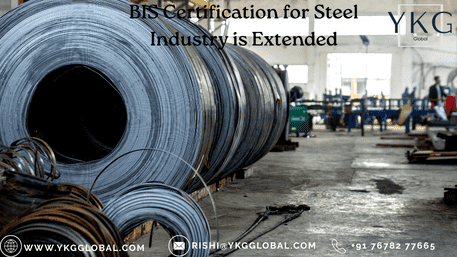
BIS Certification for Steel Industry Is Extended – What Manufacturers Must Know
The Bureau of Indian Standards (BIS) plays a crucial role in maintaining product quality and safety across industries in India. Recently, the Indian government announced an extension of BIS certification for the steel industry, expanding its scope to include more categories of steel and related products. This extension aims to ensure uniform quality, protect consumers, and strengthen India’s position in the global steel market.
For steel manufacturers, importers, and suppliers, understanding the new BIS certification requirements is essential to remain compliant and competitive in 2025.
What Is BIS Certification and Why It Matters
BIS certification ensures that a product meets the Indian standards for quality, safety, and reliability. In the steel industry, this certification is especially vital because steel forms the foundation of construction, infrastructure, automotive, and manufacturing sectors.
Holding a BIS license allows companies to:
1. Ensure consistent product quality
2. Gain customer trust and credibility
3. Participate in government tenders
4. Comply with the Quality Control Orders (QCOs) issued by the Ministry of Steel
With the latest extension, the BIS certification regime now covers additional grades and types of steel products, making it more comprehensive than ever.
Recent Update: Extension of BIS Certification for Steel
In 2025, the Ministry of Steel announced that several new categories of steel products will now fall under mandatory BIS certification. This decision was taken to enhance product quality and eliminate substandard imports.
The extension includes:
1. Alloy and non-alloy steel products
2. Steel wire rods and bars
3. Hot-rolled and cold-rolled steel sheets
4. Galvanized steel products
5. Stainless steel items
6. Carbon steel for structural applications
This move ensures that both domestic and imported steel products meet Indian standards, maintaining consistency in strength, durability, and performance.
Who Needs to Apply for BIS Certification
The following entities are required to obtain BIS certification under the new rules:
1. Indian steel manufacturers and fabricators producing regulated products
2. Importers and traders bringing steel products from other countries into India
3. Exporters who wish to sell BIS-marked steel to Indian markets
4. OEMs (Original Equipment Manufacturers) who use BIS-certified steel in production
If your business deals with steel in any form — whether as a raw material or finished product — BIS certification is now mandatory.
Step-by-Step Process for Obtaining BIS Certification for Steel
Getting BIS certification involves several detailed steps. Here’s a simplified breakdown:
Step 1: Identify Applicable IS Standard
Each steel product falls under a specific Indian Standard (IS). You must first determine which IS standard applies to your product category.
Step 2: Product Testing
Send your steel samples to a BIS-recognized laboratory for testing as per the applicable standards. Testing ensures your product meets all chemical and mechanical specifications.
Step 3: Document Preparation
Prepare and submit the required documents such as:
1. Factory license
2. Manufacturing process details
3. Test reports
4. Product specification sheet
5. Quality control system records
Step 4: Application Submission
Submit your online application through the BIS portal along with necessary fees and test results.
Step 5: Factory Inspection
BIS officials may visit your manufacturing facility to inspect the production process, testing equipment, and quality management system.
Step 6: Grant of License
If all standards are met, the BIS license is issued, allowing you to use the ISI Mark on your products.
Step 7: Renewal
BIS certification must be renewed periodically to maintain compliance and validity.
Validity and Renewal Period
BIS certification is typically valid for two years and can be renewed thereafter. Renewal requires submitting updated documentation, test reports, and compliance records. Manufacturers must ensure continued adherence to BIS standards during the entire license period.
Penalties for Non-Compliance
Failure to comply with BIS certification norms can result in:
1. Monetary fines
2. Product seizure or recall
3. Cancellation of license
4. Legal action under the BIS Act, 2016
Therefore, timely compliance and renewal are crucial for uninterrupted business operations.
Benefits of BIS Certification for Steel Manufacturers
1. Enhanced Product Credibility: BIS certification demonstrates adherence to national standards.
2. Consumer Confidence: Ensures customers receive high-quality, durable steel products.
3. Legal Protection: Complying with BIS protects manufacturers from penalties and disputes.
4. Export Advantage: BIS-marked products enjoy better acceptance in international markets.
5. Increased Profitability: Quality assurance helps attract high-value contracts and long-term clients.
Challenges in Obtaining BIS Certification
While beneficial, the certification process can be complex. Manufacturers often face challenges like:
1. Difficulty identifying correct IS standards
2. Delays in product testing and inspection
3. Incomplete or incorrect documentation
4. Lack of clarity on renewal procedures
This is where professional assistance from compliance experts becomes invaluable.
How YKG Global Helps with BIS Certification
At YKG Global, we specialize in BIS certification services for steel manufacturers and exporters. Our team provides end-to-end support — from identifying applicable standards to documentation, testing, and license approval.
Why Choose YKG Global for BIS Certification Support
1. Over 40 years of industry experience
2. Expert guidance on Quality Control Orders (QCOs)
3. End-to-end assistance with documentation and testing
4. Fast and hassle-free approval process
5. Support for both domestic and international manufacturers
With YKG Global, you can ensure smooth certification and focus on growing your business while we handle your compliance needs.
The extension of BIS certification for the steel industry marks a significant step toward quality assurance and consumer protection. For manufacturers and importers, compliance is no longer optional — it’s a mandatory requirement that ensures competitiveness, reliability, and trust.
If your business operates in the steel sector, now is the right time to act. Obtain or renew your BIS certification today with expert guidance from YKG Global and stay ahead of the regulatory curve in 2025.