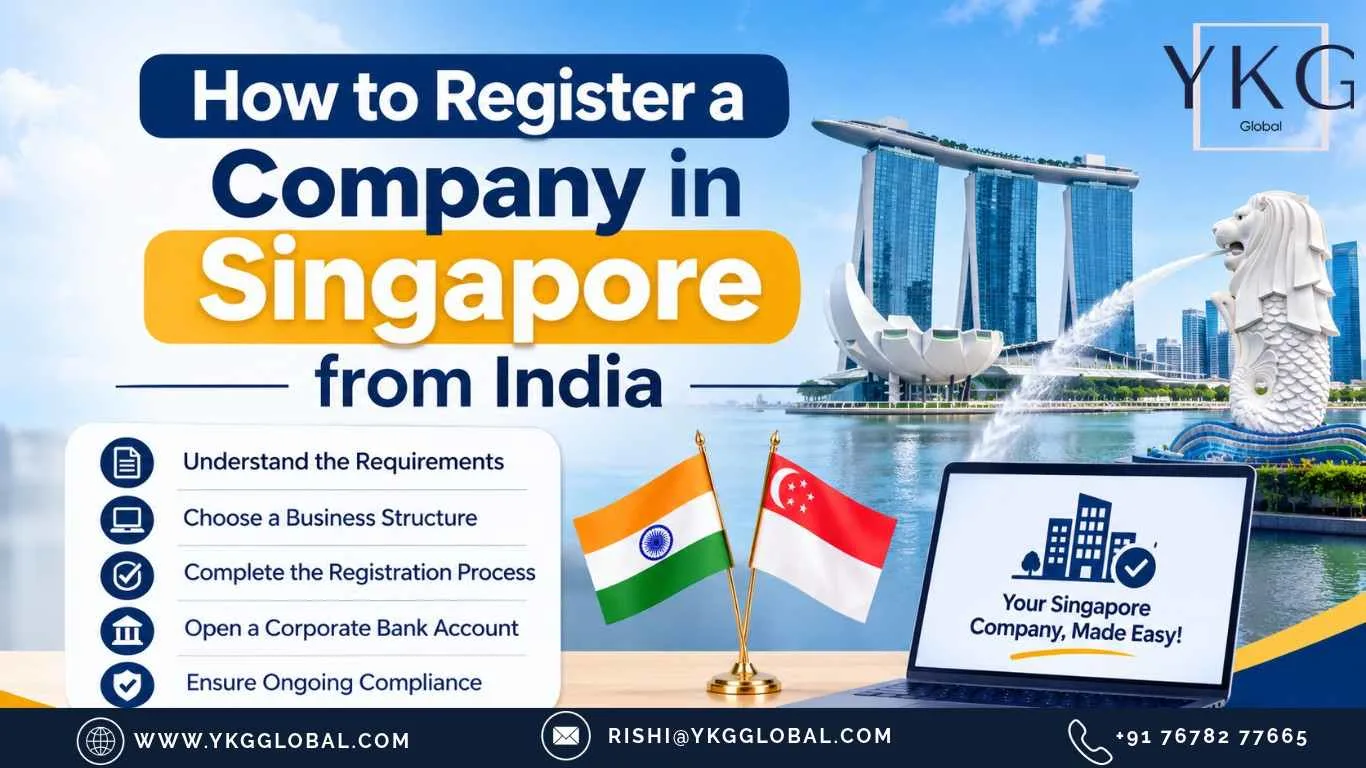
How to Register a Company in Singapore from India
Singapore has become an important destination for Indian entrepreneurs looking to expand internationally. Its established financial sector, transparent regulatory framework, strategic location and access to Southeast Asian markets make it attractive for businesses planning cross-border operations.
Whether you are an Indian startup founder, an established business owner or an investor planning overseas expansion, understanding singapore company registration from india is essential before entering the market.
The good news is that Indian citizens and companies can legally establish a business in Singapore without necessarily travelling there for incorporation. However, foreign entrepreneurs must comply with Singapore's corporate regulations, including resident director, registered office and statutory filing requirements.
Indian residents must also consider applicable foreign exchange regulations before investing in an overseas entity.
This guide explains how to register a company in Singapore from India, the available business structures, documentation, incorporation process, banking requirements and ongoing compliance obligations.
1. Can an Indian Citizen Register a Company in Singapore?
Yes. Indian citizens can own shares in Singapore companies, subject to applicable laws and regulations.
Singapore generally permits 100% foreign ownership of private companies in many sectors, meaning an Indian entrepreneur does not ordinarily need a Singaporean shareholder merely to establish a company.
However, foreign ownership and local management requirements are different.
Every Singapore company must have at least one director who is ordinarily resident in Singapore.
The company must also maintain a registered office address in Singapore and comply with the requirements of the Accounting and Corporate Regulatory Authority (ACRA).
Entrepreneurs planning to register a company in singapore from india can generally complete incorporation remotely through an authorised Singapore corporate service provider.
However, corporate bank account opening, licensing and immigration procedures may involve additional verification.
2. Why Do Indian Businesses Choose Singapore?
Singapore offers several commercial advantages for businesses pursuing international expansion.
2.1 Access to Southeast Asian Markets
Singapore provides a strategic base for businesses seeking opportunities across ASEAN markets.
Companies engaged in international trade, technology, consulting and regional distribution may benefit from its connectivity.
2.2 Established Corporate Framework
Singapore's Companies Act and ACRA registration system provide a structured legal environment for business establishment.
2.3 International Banking Infrastructure
Singapore has an established banking sector supporting international transactions and multiple currencies.
Banking services remain subject to customer due diligence and individual bank policies.
2.4 Corporate Tax Environment
Singapore's headline corporate income tax rate is 17%, with applicable exemptions and incentives available to qualifying companies.
However, tax benefits depend on eligibility, residence and actual business circumstances.
2.5 International Business Credibility
A Singapore company may support relationships with international customers, investors and commercial partners.
These advantages explain why entrepreneurs increasingly consider company registration in singapore as part of their international business strategy.
3. Which Business Structure Should Indian Entrepreneurs Choose?
Selecting the appropriate legal structure is an important decision before incorporation.
3.1 Private Limited Company
A Private Limited Company is a separate legal entity with limited liability for its shareholders.
It is commonly used for startups, trading businesses, consulting firms and foreign-owned subsidiaries.
For many Indian entrepreneurs, this structure provides a practical foundation for international operations.
3.2 Singapore Subsidiary of an Indian Company
An existing Indian company may establish a Singapore subsidiary.
The subsidiary is incorporated as a separate Singapore legal entity, with the Indian parent holding some or all of its shares.
This arrangement requires consideration of Indian overseas investment regulations and related reporting obligations.
3.3 Singapore Branch Office
An Indian company may register a branch in Singapore.
Unlike a subsidiary, the branch is an extension of the foreign parent company rather than a separate legal entity.
The parent company remains responsible for the branch's obligations.
3.4 Limited Liability Partnership
An LLP may suit certain professional or collaborative business arrangements.
However, its ownership, management and regulatory requirements differ from those of a private company.
The appropriate structure depends on the proposed business activities, ownership arrangements, liability considerations and long-term expansion objectives.
4. What Are the Requirements for Company Incorporation in Singapore?
Before starting singapore company registration, Indian entrepreneurs should understand the principal statutory requirements.
4.1 At Least One Shareholder
A private company must have at least one shareholder.
The shareholder may be an individual or a corporate entity, subject to applicable restrictions.
4.2 At Least One Resident Director
Every Singapore company must have at least one director who is ordinarily resident in Singapore.
An Indian shareholder who is not ordinarily resident in Singapore cannot independently satisfy this requirement.
4.3 Company Secretary
A company must appoint a qualified company secretary within six months of incorporation.
A sole director cannot simultaneously act as the company's secretary.
4.4 Registered Office Address
The company must maintain a registered office in Singapore.
The address must satisfy ACRA requirements, including accessibility during the prescribed hours.
4.5 Share Capital
Singapore generally does not impose a substantial minimum paid-up capital requirement for an ordinary private limited company.
However, regulated activities and immigration applications may have additional requirements.
4.6 Company Constitution
The company must adopt a constitution setting out its governance framework and relevant corporate rules.
5. Step-by-Step Process to Register a Company in Singapore from India
The process of company incorporation singapore generally involves the following stages.
Step 1: Finalise the Business Structure
Determine whether to establish a new Singapore private company, a subsidiary of an Indian company or another permitted business structure.
Step 2: Choose the Company Name
Select a proposed name and submit it for approval through ACRA's Bizfile system.
Names that are identical to existing registered names, undesirable or subject to regulatory restrictions may not be approved.
Step 3: Appoint the Resident Director
Identify an eligible director who satisfies Singapore's ordinary residence requirement.
Professional resident director arrangements may be considered, subject to proper governance and legal compliance.
Step 4: Arrange the Registered Office
Establish a suitable registered office address in Singapore.
A professional serviced office may be considered where it satisfies the applicable requirements.
Step 5: Prepare Incorporation Documents
Collect shareholder and director identification details, ownership information, registered office particulars and the proposed company constitution.
Additional documentation may be required for corporate shareholders.
Step 6: Submit the Incorporation Application
The application is filed electronically through ACRA's Bizfile system, generally through a registered corporate service provider where the foreign applicant does not have direct filing access.
Step 7: Obtain the Unique Entity Number
Once incorporation is approved, the company receives its Unique Entity Number (UEN).
The UEN is used for government transactions and various corporate processes.
Step 8: Complete Operational Registrations
The company may then proceed with corporate banking, tax matters, licensing and other operational requirements.
6. What Documents Do Indian Shareholders Need?
The documentation for company formation singapore depends on whether the shareholders are individuals or corporate entities.
6.1 For Individual Indian Shareholders
Common requirements include passport identification, residential address information, contact details and ownership particulars.
The service provider may request additional documents for customer due diligence.
6.2 For an Indian Corporate Shareholder
Documents may include the Indian company's Certificate of Incorporation, constitutional documents, ownership information and an appropriate board resolution authorising the proposed investment.
The corporate service provider may also require details of ultimate beneficial owners and authorised representatives.
6.3 For Proposed Directors
Identification, residential address details, consent to act and relevant eligibility declarations are generally required.
Documents may need certification or additional authentication depending on the circumstances and the service provider's verification procedures.
7. Can an Indian Company Invest in a Singapore Subsidiary?
Yes, subject to India's applicable overseas investment framework.
Indian companies considering overseas expansion must evaluate the Foreign Exchange Management Act, 1999, and the relevant Overseas Investment Rules, Regulations and Directions.
The applicable requirements depend on the investor, investment structure, financial commitment and proposed overseas business activities.
Where an investment qualifies as Overseas Direct Investment (ODI), the Indian investor may need to undertake the relevant reporting through its authorised dealer bank.
The reporting process may involve Form FC and other applicable submissions.
Indian resident individuals investing abroad must separately consider the rules applicable to their investment, including the Liberalised Remittance Scheme where relevant.
An overseas company should not be established on the assumption that Singapore incorporation approval automatically satisfies Indian FEMA requirements.
For Indian businesses, the investment structure and remittance process should be reviewed before funds are transferred.
8. How to Open a Corporate Bank Account in Singapore
Opening a business bank account is an important step after incorporation.
Singapore has established financial institutions such as DBS, OCBC and UOB, alongside other international banking providers.
Banks generally review the company's ownership, business activities, anticipated transactions and source of funds.
Commonly requested documents include the incorporation records, company constitution, director and shareholder identification, business information and relevant supporting documents.
For Indian-owned companies, the bank may also seek information about the relationship between the Singapore entity and any Indian parent company.
Remote account opening may be available in certain cases, but approval and any requirement for physical verification depend on the financial institution.
A newly incorporated company is not automatically entitled to a bank account.
9. Do Indian Entrepreneurs Need a Singapore Work Visa?
Owning shares in a Singapore company does not automatically provide the right to live or work in Singapore.
Indian entrepreneurs who intend to relocate or work in Singapore must consider the appropriate immigration route.
9.1 Employment Pass
An Employment Pass may be relevant to eligible foreign professionals, managers and executives, subject to Ministry of Manpower requirements.
9.2 EntrePass
EntrePass may be relevant to qualifying foreign entrepreneurs establishing eligible innovative or venture-backed businesses.
Eligibility is subject to specific criteria.
9.3 Managing the Company Remotely
An Indian shareholder may own a Singapore company without necessarily relocating.
However, the company must continue to satisfy its resident director and other statutory requirements.
10. Taxation and Compliance After Incorporation
Completing singapore company setup is only the beginning of the company's regulatory responsibilities.
10.1 Corporate Income Tax
Singapore's headline corporate income tax rate is 17%.
Tax exemptions and incentives may apply to qualifying companies.
Tax residency and the location of management and control can affect the company's tax position.
10.2 Goods and Services Tax
Singapore's standard GST rate is 9%.
GST registration depends on the applicable turnover tests and other statutory requirements.
10.3 Annual Returns
Companies must file annual returns with ACRA within the applicable deadlines.
10.4 Corporate Tax Filings
Companies may need to submit Estimated Chargeable Income and annual corporate income tax returns to IRAS, subject to the relevant rules and exemptions.
10.5 Accounting Records
Companies must maintain proper accounting records and prepare financial statements in accordance with applicable requirements.
10.6 Audit Requirements
Certain private companies may qualify for audit exemption, while others must appoint an auditor and comply with statutory audit requirements.
10.7 India–Singapore Tax Considerations
Cross-border transactions may raise questions involving the India–Singapore Double Taxation Avoidance Agreement, transfer pricing, withholding taxes and permanent establishment exposure.
These matters should be evaluated based on actual operations rather than incorporation location alone.
11. Common Challenges Indian Entrepreneurs Should Anticipate
Although incorporation can largely be completed remotely, several practical challenges deserve attention.
11.1 Resident Director Arrangements
Appointing a resident director requires careful consideration of statutory duties and corporate governance.
11.2 Banking Due Diligence
Banks may require detailed explanations of business activities, ownership and anticipated international transactions.
11.3 Indian Overseas Investment Compliance
Failure to assess ODI or other FEMA obligations before investing may create regulatory difficulties.
11.4 Tax Residency Assumptions
A company incorporated in Singapore is not automatically entitled to every Singapore tax benefit or treaty advantage.
11.5 Licensing Requirements
Businesses operating in regulated industries may need approvals before commencing activities.
11.6 Ongoing Corporate Administration
Companies must maintain statutory records, accounting information and timely filings even where business activity is limited.
Addressing these matters during the planning stage can help avoid unnecessary delays after incorporation.
How YKG Global Helps You
YKG Global supports Indian entrepreneurs and established businesses planning to enter the Singapore market.
Our services include:
1. Business Structure Advisory: Evaluating suitable incorporation structures for individual entrepreneurs, Indian parent companies and international investors.
2. Company Incorporation Coordination: Assisting with company name approval, incorporation documentation and ACRA filing coordination.
3. Resident Director and Registered Office Support: Coordinating suitable arrangements through relevant Singapore service providers.
4. Documentation Assistance: Supporting the preparation and review of shareholder documents, corporate authorisations and incorporation records.
5. FEMA and ODI Advisory: Assisting Indian investors with applicable overseas investment considerations and reporting requirements.
6. Corporate Banking Coordination: Supporting the preparation of company and ownership documentation for bank account applications, subject to bank approval.
7. Tax and Accounting Support: Coordinating corporate tax, GST, accounting and applicable cross-border tax compliance requirements.
8. Post-Incorporation Compliance: Assisting with company secretarial coordination, annual filings and ongoing corporate administration.
YKG Global helps businesses approach international expansion with a focus on appropriate structures, regulatory compliance and practical cross-border coordination.