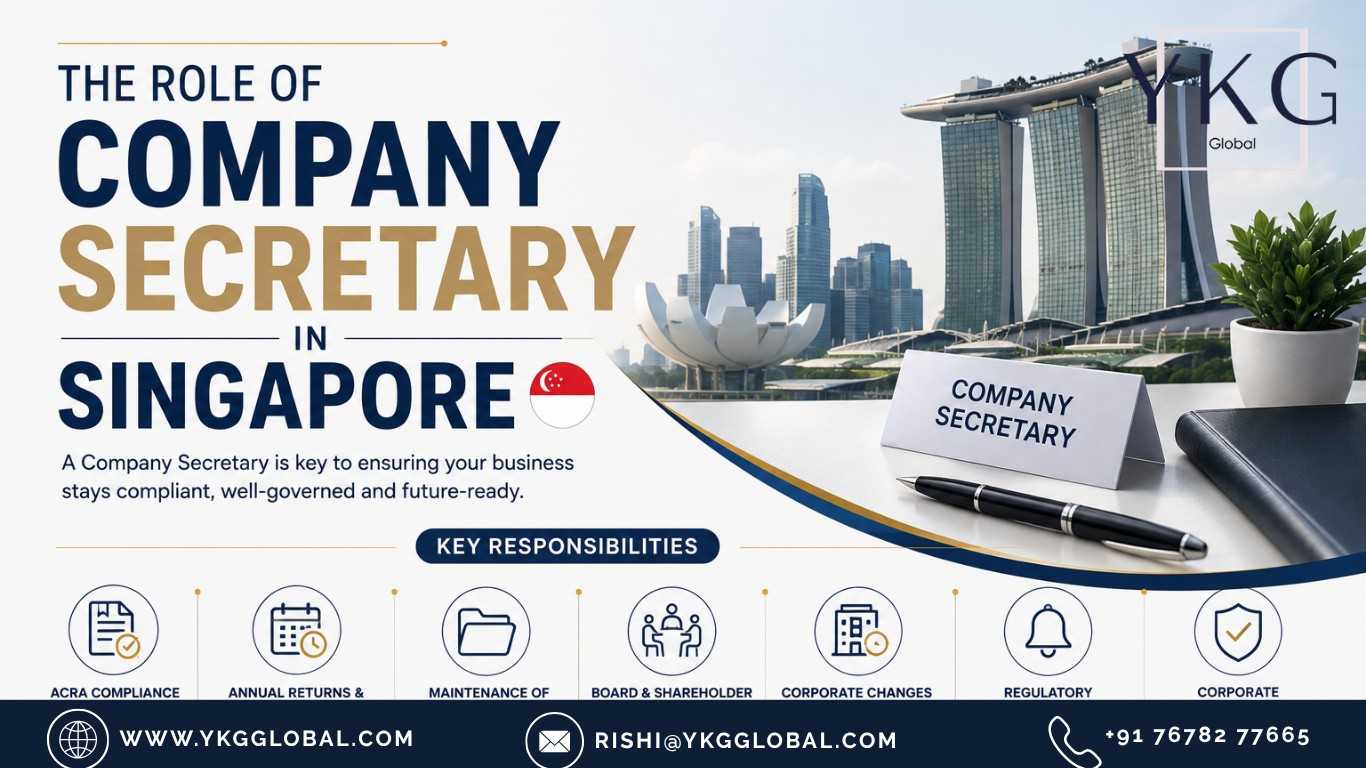
Role of a Company Secretary in Singapore
A company secretary plays an important role in maintaining the legal, administrative, and compliance framework of a Singapore company. While directors are responsible for managing the company's business and making strategic decisions, the company secretary helps ensure that statutory obligations and corporate records are properly maintained.
For businesses operating in Singapore, company secretarial compliance is more than filing documents. It involves maintaining company information, managing statutory registers, monitoring deadlines, supporting annual returns, preparing corporate resolutions, and assisting with governance procedures.
Under Singapore's Companies Act framework, every company must appoint at least one company secretary within six months of incorporation. The position cannot remain vacant for more than six months, and the secretary must meet applicable residency requirements. Where a company has only one director, that director cannot also act as the company secretary.
For startups, SMEs, subsidiaries, and foreign-owned companies, understanding the role of a company secretary in Singapore is essential for maintaining ongoing corporate compliance.
What Does a Company Secretary Do?
The main responsibility of a company secretary is to support the company in meeting its statutory and administrative obligations.
Typical responsibilities include:
1. Maintaining corporate records
2. Managing statutory registers
3. Supporting annual return filings
4. Monitoring compliance deadlines
5. Preparing corporate resolutions
6. Coordinating company meetings
7. Updating company information
8. Supporting beneficial ownership compliance
9. Maintaining records of company officers
10. Assisting directors with procedural requirements
The company secretary helps create an organised corporate administration system so that important compliance obligations are not overlooked.
1. Maintaining Statutory Company Records
One of the most important Singapore company secretary duties is maintaining accurate corporate records.
Companies are required to maintain relevant information relating to directors, secretaries, shareholders, and other corporate matters.
A company secretary can ensure that these records remain accurate and consistent with information submitted to the relevant authorities.
This becomes particularly important when a company changes:
1. Directors
2. Shareholders
3. Company secretary
4. Registered office details
5. Shareholdings
6. Company officers
7. Beneficial ownership information
Keeping corporate records updated helps reduce inconsistencies and supports effective company administration.
2. Annual Return Filing
Annual return compliance is a key responsibility associated with company secretarial work in Singapore.
Companies are required to file annual returns containing updated corporate information within the applicable deadlines.
A company secretary can assist by:
1. Monitoring annual filing deadlines
2. Reviewing company information
3. Coordinating with directors
4. Preparing required information
5. Supporting regulatory submission
6. Maintaining filing records
This is particularly useful for companies with overseas shareholders or directors who may not be familiar with Singapore's compliance requirements.
Annual return filing should be treated as an ongoing compliance responsibility rather than a once-a-year administrative task.
3. Beneficial Ownership Compliance
Beneficial ownership transparency is another important part of corporate compliance in Singapore.
Companies that fall within the applicable requirements generally need to maintain a Register of Registrable Controllers.
The register identifies individuals or entities that ultimately own or control the company.
A company secretary can help with:
1. Identifying registrable controllers
2. Maintaining the relevant register
3. Monitoring changes in ownership
4. Coordinating required notifications
5. Supporting applicable regulatory filings
This becomes especially important for companies with foreign shareholders, holding companies, multiple ownership layers, or complex corporate structures.
4. Supporting Board and Shareholder Meetings
Company secretaries often support the administrative side of board and shareholder meetings.
Their responsibilities may include preparing:
1. Meeting notices
2. Agendas
3. Board resolutions
4. Shareholder resolutions
5. Meeting minutes
6. Attendance records
Proper documentation creates a clear record of important corporate decisions.
This can be particularly important when companies make decisions involving directors, shareholdings, corporate restructuring, banking arrangements, or other significant matters.
5. Preparing Corporate Resolutions
Companies may require formal resolutions when making important corporate decisions.
A company secretary can prepare and maintain documentation relating to matters such as:
1. Appointment or resignation of directors
2. Appointment of company secretary
3. Changes in shareholding
4. Share allotments
5. Changes to company information
6. Corporate banking arrangements
7. Other significant corporate actions
Properly documented resolutions help demonstrate that decisions were approved through appropriate corporate procedures.
6. Updating Company Information
Singapore companies need to keep their registered information accurate.
Changes involving directors, shareholders, company officers, addresses, or other corporate information may need to be updated with the relevant authority within the prescribed timeframe.
A company secretary can monitor these changes and coordinate the necessary updates.
This is particularly useful for growing businesses where corporate information may change frequently.
7. Supporting Directors With Compliance
A company secretary does not replace the legal responsibilities of directors.
Directors remain responsible for managing the company's affairs and fulfilling their statutory duties.
However, the company secretary can provide important administrative and procedural support.
For example, the secretary can remind directors about filing deadlines, maintain corporate documentation, prepare resolutions, and help organise meetings.
This allows directors to focus on strategic and operational matters while maintaining greater visibility over corporate compliance.
8. Supporting Corporate Governance
Corporate governance is an important part of running a well-organised Singapore company.
A company secretary can support good governance through:
1. Accurate documentation
2. Proper meeting procedures
3. Timely regulatory filings
4. Transparent ownership records
5. Organised statutory registers
6. Clear decision-making records
Strong corporate governance can improve transparency and make the company's internal administration more effective.
For growing companies, good governance also becomes increasingly important when dealing with investors, banks, shareholders, and international business partners.
9. Monitoring Regulatory Changes
Singapore's corporate regulatory environment can evolve over time.
A company secretary can monitor relevant changes and help directors understand how new requirements may affect the company.
This is especially useful for foreign-owned businesses whose directors may be located outside Singapore.
A local company secretary can help maintain continuity by monitoring compliance requirements and keeping corporate administration aligned with applicable regulations.
10. Supporting Foreign-Owned Singapore Companies
The company secretary role can be particularly valuable for international businesses.
Foreign-owned Singapore companies may have:
1. Overseas directors
2. Foreign shareholders
3. Parent companies
4. Cross-border transactions
5. International ownership structures
Managing Singapore compliance remotely can create administrative challenges.
A company secretary can provide local support by monitoring filing deadlines, maintaining statutory records, coordinating corporate documentation, and assisting management teams with Singapore-specific requirements.
This can make ongoing Singapore company compliance more structured and manageable.
Company Secretary vs Company Director
Although both positions are important, their responsibilities are different.
1. Company Director
The director is responsible for managing the company, making strategic decisions, overseeing operations, and fulfilling statutory duties.
2. Company Secretary
The company secretary primarily supports corporate administration, statutory compliance, records, filings, meetings, and governance procedures.
The two roles work together. Directors make business decisions, while the company secretary helps ensure that the company's administrative and statutory processes properly support those decisions.
When Must a Singapore Company Appoint a Secretary?
A Singapore company must appoint a company secretary within six months of incorporation.
The position cannot remain vacant for more than six months.
The secretary must meet the applicable local residency requirements, and where there is only one director, that director cannot also act as the company secretary.
This makes appointing a qualified secretary an important part of post-incorporation compliance.
Common Company Secretarial Mistakes
Businesses can face compliance issues when they:
1. Miss annual filing deadlines
2. Maintain outdated director information
3. Fail to update shareholder records
4. Neglect beneficial ownership requirements
5. Keep incomplete meeting records
6. Delay changes to company information
7. Assume incorporation completes all compliance obligations
8. Treat company secretarial work as a one-time task
These mistakes can become more difficult to manage as the business grows.
Why Company Secretarial Compliance Matters
Effective company secretarial administration can help businesses:
1. Maintain accurate corporate information
2. Meet statutory deadlines
3. Keep ownership records updated
4. Support corporate governance
5. Reduce administrative errors
6. Maintain proper decision records
7. Improve corporate transparency
8. Support banking and investor due diligence
9. Respond more efficiently to regulatory changes
For this reason, company secretarial compliance should be viewed as an ongoing part of running a Singapore company.
Why Choose YKG Global?
Managing corporate compliance requires consistent attention to statutory records, filings, deadlines, and governance procedures.
YKG Global supports businesses with:
1. Singapore company incorporation
2. Company secretarial support
3. Corporate compliance
4. Annual return assistance
5. Statutory register maintenance
6. Beneficial ownership compliance
7. Corporate governance support
8. Accounting and tax coordination
9. Corporate banking assistance
10. International business advisory
Our support helps businesses maintain an organised corporate structure while allowing management teams to focus on operations and growth.
The role of a company secretary in Singapore goes far beyond filing documents. A company secretary supports statutory compliance, maintains corporate records, monitors deadlines, assists with meetings and resolutions, manages beneficial ownership requirements, and supports good corporate governance.
For startups, established businesses, and foreign companies, an effective company secretary can provide an important compliance framework for ongoing operations.
By keeping records accurate, filings timely, and corporate administration organised, businesses can build a stronger foundation for sustainable growth in Singapore.