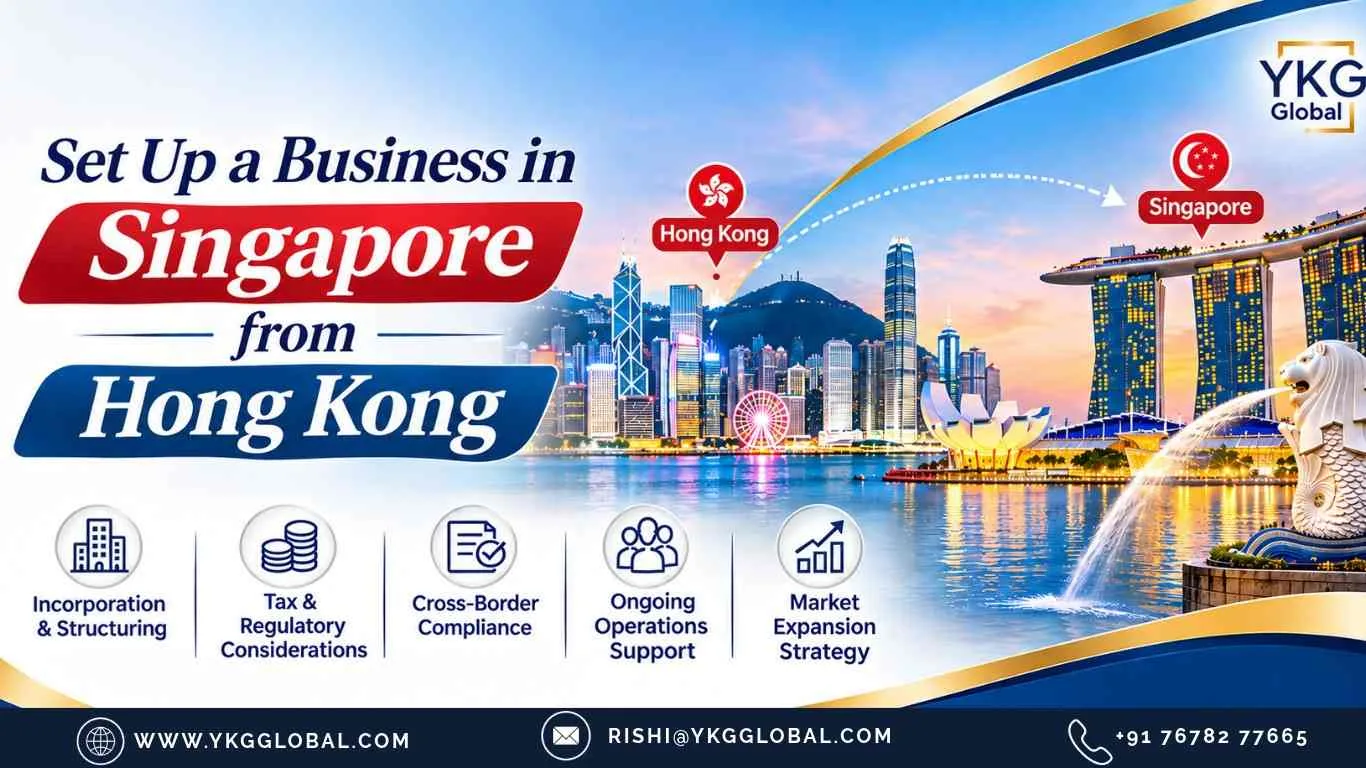
Set up a Business in Singapore from Hong Kong
Singapore has become a strategic destination for Hong Kong entrepreneurs and companies looking to expand their operations across Southeast Asia. Its transparent regulatory environment, international financial infrastructure, skilled workforce and access to ASEAN markets make it an attractive location for cross-border business expansion.
For Hong Kong companies considering regional diversification, establishing a Singapore entity can provide opportunities to serve new customers, build regional partnerships and develop an international operating presence.
Can a Hong Kong company establish a business in Singapore?
Yes. Hong Kong companies and residents can generally establish and own 100% of a Singapore private limited company, subject to applicable industry-specific restrictions. However, the company must meet Singapore's incorporation requirements, including appointing at least one ordinarily resident director and maintaining a registered office address.
Entrepreneurs planning to set up a business in singapore from hong kong should understand the available business structures, incorporation procedures, taxation and regulatory obligations before proceeding.
This guide explains how Hong Kong entrepreneurs can establish a Singapore company, the documents required, banking considerations and the compliance responsibilities involved in operating across both jurisdictions.
1. Can a Hong Kong Company Register a Business in Singapore?
Yes. Singapore generally permits foreign individuals and corporate entities to establish and own private limited companies.
A Hong Kong company can incorporate a wholly owned Singapore subsidiary, while individual Hong Kong residents can establish companies in their personal capacity.
Singapore does not generally require a local shareholder for an ordinary private limited company.
However, the company must comply with the Singapore Companies Act 1967 and the requirements administered by the Accounting and Corporate Regulatory Authority (ACRA).
The principal requirements include:
A. At least one shareholder.
B. At least one director ordinarily resident in Singapore.
C. A registered office address in Singapore.
D. A company secretary appointed within six months of incorporation.
E. An appropriate share capital structure.
F. Compliance with applicable incorporation and beneficial ownership requirements.
Foreign businesses must also evaluate whether their intended activities require sector-specific licences or regulatory approvals.
2. Why Are Hong Kong Businesses Expanding into Singapore?
Hong Kong and Singapore are established international financial and commercial centres, but they provide access to different regional markets and business ecosystems.
2.1 Access to Southeast Asian Markets
Singapore offers a strategic location for companies targeting customers and business partners across ASEAN.
A Singapore subsidiary may support regional distribution, commercial contracts and local operations.
2.2 Established Financial Infrastructure
Singapore has an international banking sector and financial services ecosystem that supports domestic and cross-border business activities.
2.3 Business-Friendly Regulatory Environment
ACRA provides an electronic incorporation system, while other government agencies administer taxation, employment and industry-specific regulation.
2.4 Regional Diversification
A Singapore entity may help Hong Kong companies diversify their operational presence and customer base.
2.5 International Trade Opportunities
Singapore maintains extensive trade relationships and participates in various international trade agreements.
However, eligibility for preferential treatment depends on the relevant agreement and applicable conditions.
These factors make Singapore relevant to trading companies, technology businesses, consulting firms, logistics providers and international service companies.
3. Which Business Structure Should a Hong Kong Company Choose?
Before beginning company registration in singapore, Hong Kong entrepreneurs should determine the most appropriate legal structure.
3.1 Singapore Private Limited Company
A private company limited by shares is a separate legal entity from its shareholders.
It can enter contracts, employ staff, own assets and conduct business independently.
Shareholders generally benefit from limited liability, subject to applicable exceptions.
This is commonly considered by businesses planning long-term commercial operations in Singapore.
3.2 Singapore Subsidiary of a Hong Kong Company
An existing Hong Kong company may incorporate a Singapore subsidiary and hold 100% of its shares.
The subsidiary operates as a separate Singapore legal entity.
This structure may be appropriate for businesses seeking local contracts, employees, banking facilities and regional operations.
3.3 Singapore Branch Office
A Hong Kong company may register a Singapore branch as a foreign company.
Unlike a subsidiary, the branch is not a separate legal entity from the Hong Kong head office.
The foreign company remains responsible for the branch's obligations.
A registered branch must comply with Singapore's foreign company registration and authorised representative requirements.
3.4 Representative Office
A qualifying foreign company may apply to establish a representative office for permitted market research and liaison activities.
Representative offices are subject to eligibility conditions and generally cannot undertake revenue-generating commercial activities.
This option may suit businesses exploring the Singapore market before establishing a permanent operating entity.
4. Singapore Subsidiary vs Branch Office: Which Is Better?
The choice depends on the company's commercial objectives, liability preferences and operating model.
4.1 Singapore Subsidiary
A subsidiary provides a separate Singapore corporate identity.
It may be suitable for businesses intending to establish local operations, hire employees and enter commercial agreements directly.
4.2 Singapore Branch
A branch operates as an extension of the Hong Kong company.
It may be relevant where the business prefers to operate through the existing foreign legal entity.
However, the Hong Kong parent remains legally responsible for the branch's obligations.
4.3 Representative Office
A representative office may support initial market research but is not appropriate for ordinary revenue-generating operations.
For many Hong Kong businesses seeking an independent and scalable Singapore presence, a private limited subsidiary is a commonly considered structure.
However, tax treatment and compliance obligations should be assessed before making the final decision.
5. Requirements for Singapore Company Incorporation
Entrepreneurs planning singapore company registration must satisfy the following principal requirements.
5.1 Shareholders
A Singapore private limited company must have at least one shareholder.
The shareholder may generally be an individual or corporate entity.
A Hong Kong company can ordinarily hold all the shares in a Singapore subsidiary.
5.2 Resident Director
Every Singapore company must have at least one director ordinarily resident in Singapore.
A foreign director may also be appointed, provided the company satisfies its statutory requirements.
5.3 Company Secretary
A company secretary must be appointed within six months after incorporation.
The secretary must satisfy the statutory eligibility requirements and ordinarily reside in Singapore.
A sole director cannot also act as the company secretary.
5.4 Registered Office
The company must maintain a registered office address in Singapore.
The address must meet applicable statutory requirements, including the prescribed accessibility requirements.
5.5 Share Capital
Singapore does not impose a general high minimum paid-up capital requirement for an ordinary private limited company.
Companies may commonly begin with a nominal amount of issued share capital, subject to their business and licensing needs.
5.6 Company Constitution
The company must adopt a constitution setting out its governance framework.
6. Step-by-Step Process to Register a Singapore Company from Hong Kong
The process to register business in singapore from hong kong generally involves the following stages.
Step 1: Select the Business Structure
Decide whether to establish a subsidiary, register a foreign company branch or explore another appropriate structure.
Step 2: Choose a Company Name
Select a proposed company name and submit the name application through ACRA's Bizfile system.
The name must comply with applicable naming rules.
Certain names may require additional review or referral to another government agency.
Step 3: Finalise Shareholders and Directors
Identify the proposed shareholders and directors.
Where the shareholder is a Hong Kong corporation, collect its relevant corporate documents and ownership information.
Step 4: Arrange a Resident Director
Ensure that at least one proposed director satisfies Singapore's ordinary residence requirement.
Step 5: Establish a Registered Office
Arrange a valid Singapore registered office address.
Step 6: Prepare Incorporation Documents
Prepare the company constitution, shareholding particulars, director information and other required incorporation details.
Step 7: Submit the Incorporation Application
The incorporation application is submitted through ACRA's Bizfile system, typically through an appropriate corporate service provider where foreign founders cannot directly complete the required filing.
Step 8: Receive the Company Registration Details
Following approval, the company receives its Unique Entity Number (UEN) and electronic incorporation confirmation.
Step 9: Complete Post-Incorporation Formalities
Arrange the company secretary, statutory registers, banking documentation, tax registrations and applicable business licences.
7. What Documents Are Required from a Hong Kong Company?
The documentation required for company incorporation singapore depends on the ownership structure and the corporate service provider's due diligence requirements.
7.1 Hong Kong Certificate of Incorporation
This establishes the legal existence of the Hong Kong parent company.
7.2 Business Registration Certificate
The Hong Kong company's Business Registration Certificate may be requested to verify its registration details.
7.3 Articles of Association
The parent company's constitutional documents may be required.
7.4 Corporate Ownership Information
Details of the shareholders, ultimate beneficial owners and controlling individuals may be requested.
7.5 Board Resolution
A resolution authorising the Singapore investment and incorporation may be required for the Hong Kong corporate shareholder.
7.6 Director Identification
Identification and address information for proposed directors and relevant individuals may be necessary.
7.7 Singapore Registered Office Details
A valid registered office address must be provided for the new Singapore entity.
7.8 Proposed Business Activities
The company must identify its intended activities using the applicable Singapore Standard Industrial Classification codes.
Additional documents may be required depending on the ownership structure and verification procedures.
8. Can a Hong Kong Resident Incorporate a Singapore Company Remotely?
Yes. Hong Kong residents can generally establish Singapore companies without relocating.
The incorporation process is electronic, and a professional corporate service provider may coordinate the required filings and documentation.
However, remote incorporation does not eliminate the resident director requirement.
Foreign founders should also distinguish company ownership from immigration authorisation.
Owning shares in a Singapore company does not automatically provide permission to work or reside in Singapore.
Entrepreneurs who intend to manage the company while physically present in Singapore should evaluate applicable work pass requirements.
9. How Long Does Singapore Company Registration Take?
Singapore offers an efficient electronic incorporation process.
Straightforward company applications may be approved relatively quickly once the necessary information is submitted.
However, ACRA states that applications requiring referral to another government agency can take significantly longer.
The overall timeline also depends on preparation of documents, verification of the Hong Kong parent company, appointment of the resident director and completion of service provider due diligence.
Corporate banking, employment passes and business licensing are separate processes.
Therefore, entrepreneurs should not assume that incorporation approval means the business is immediately ready to conduct every proposed activity.
10. How to Open a Corporate Bank Account in Singapore
Following singapore company setup, the company may apply for a corporate bank account.
Singapore banks generally conduct customer due diligence before approving an application.
Documents commonly requested include:
A. Singapore incorporation details and UEN.
B. Company constitution.
C. Director and shareholder identification.
D. Hong Kong parent company documents, where applicable.
E. Ultimate beneficial ownership information.
F. Business activity and transaction details.
G. Information about expected customers, suppliers and source of funds.
H. Banks may also request additional documents or interviews.
Some institutions support remote onboarding for eligible applicants, while others require physical verification.
Bank account approval remains subject to the financial institution's independent assessment.
11. How Are Singapore Companies Owned by Hong Kong Businesses Taxed?
A Singapore subsidiary owned by a Hong Kong company is generally subject to Singapore's corporate tax framework.
11.1 Corporate Income Tax
Singapore's headline corporate income tax rate is 17%.
Eligible companies may qualify for applicable tax exemptions or reliefs, depending on statutory conditions.
Foreign ownership alone does not determine whether a company qualifies for every available tax incentive.
11.2 GST Registration
Singapore's Goods and Services Tax rate is 9%.
Businesses generally must register for GST when their taxable turnover exceeds the applicable S$1 million threshold, subject to the relevant retrospective and prospective tests.
Certain businesses may register voluntarily if eligible.
11.3 Tax Residence
A company's Singapore tax residence generally depends on where its control and management are exercised.
Incorporation in Singapore does not automatically establish tax residence for every purpose.
11.4 Dividends
Singapore generally does not impose withholding tax on dividends paid by Singapore resident companies under its one-tier corporate tax system.
However, the Hong Kong shareholder should separately assess the applicable tax treatment in Hong Kong.
11.5 Transfer Pricing
Transactions between a Hong Kong parent and its Singapore subsidiary must be considered under applicable related-party pricing rules.
Relevant transactions should be supported by arm's-length pricing and appropriate documentation.
12. What Are the Tax Implications in Hong Kong?
A Hong Kong company investing in Singapore must consider the tax and reporting implications in both jurisdictions.
12.1 Singapore Subsidiary Ownership
The Hong Kong parent may receive dividends or other payments from its Singapore subsidiary.
The tax treatment depends on the nature of the income and applicable legislation.
12.2 Hong Kong Foreign-Sourced Income Rules
Hong Kong's foreign-sourced income exemption regime may apply to specified foreign-sourced income received in Hong Kong by certain multinational enterprise entities.
Whether income is taxable depends on the applicable statutory conditions and exemptions.
12.3 Intercompany Transactions
Management fees, service charges, royalties and financing arrangements may create cross-border tax and transfer pricing considerations.
12.4 Double Taxation Agreement
Singapore and Hong Kong have an agreement for the avoidance of double taxation.
Its provisions may affect the treatment of relevant income, subject to eligibility and treaty conditions.
Businesses should evaluate the complete tax position rather than assuming that establishing a subsidiary automatically produces tax savings.
13. Does the Hong Kong Company Need to Make Additional Filings?
Establishing a Singapore subsidiary does not ordinarily replace the Hong Kong company's existing corporate obligations.
The Hong Kong parent must continue to comply with applicable Companies Registry and Inland Revenue Department requirements.
These may include annual returns, business registration renewal, accounting records and profits tax filings.
The parent should also maintain appropriate records of its investment in the Singapore subsidiary.
Where the transaction involves related-party arrangements, appropriate supporting documentation should be maintained.
If the Hong Kong company instead registers a Singapore branch, the applicable reporting and filing requirements will differ from those of a separately incorporated subsidiary.
14. What Compliance Is Required After Singapore Incorporation?
A Singapore company must maintain ongoing statutory and regulatory compliance.
14.1 Annual Returns
Companies must file annual returns with ACRA according to the applicable statutory deadlines.
14.2 Annual General Meeting
Companies must comply with the relevant AGM requirements unless an exemption or applicable alternative is available.
14.3 Corporate Income Tax Returns
Companies generally must comply with the Inland Revenue Authority of Singapore's Estimated Chargeable Income and annual corporate income tax return requirements, subject to applicable exemptions.
14.4 GST Returns
GST-registered businesses must submit returns according to their prescribed reporting periods.
14.5 Statutory Registers
Companies must maintain required corporate registers, including relevant ownership and controller information.
14.6 Company Secretary
The company must maintain an appropriately qualified company secretary.
14.7 Registered Office
The registered office must continue to satisfy Singapore's statutory requirements.
14.8 Accounting Records
Companies must maintain proper accounting records and prepare financial statements as required.
14.9 Employment and Licensing
Businesses hiring employees or conducting regulated activities must satisfy the relevant employment, work pass and licensing requirements.
Effective compliance planning should begin before the company commences operations.
Common Challenges When Expanding from Hong Kong to Singapore
Although Singapore provides an efficient incorporation framework, cross-border expansion can involve practical challenges.
1. Choosing the Wrong Structure
A subsidiary and branch have different legal, tax and reporting consequences.
2. Resident Director Arrangements
Foreign founders must ensure that the company satisfies Singapore's resident director requirement.
3. Banking Delays
Banks may request detailed information about the Hong Kong parent company and proposed business activities.
4. Cross-Border Taxation
Related-party transactions, dividends and management arrangements can create tax considerations in both jurisdictions.
5. Regulatory Licensing
Certain industries require approvals before business activities can commence.
6. Ongoing Compliance
Maintaining two corporate entities requires coordination of filing deadlines, accounting records and statutory obligations.
Businesses should establish a clear compliance and operational framework before expansion.
How YKG Global Helps You
YKG Global assists Hong Kong entrepreneurs, corporate groups and international investors planning business expansion into Singapore.
Our company incorporation services in singapore include:
1. Business Structure Advisory: Assisting Hong Kong businesses in evaluating Singapore subsidiaries, branch offices and other appropriate establishment options.
2. Company Incorporation Coordination: Supporting ACRA registration procedures, company name applications and incorporation documentation.
3. Corporate Shareholder Documentation: Assisting with Hong Kong parent company records, ownership information and relevant corporate authorisations.
4. Resident Director and Registered Office Coordination: Supporting appropriate arrangements through qualified Singapore service providers.
5. Corporate Banking Support: Coordinating the preparation of documentation for Singapore bank account applications, subject to bank approval.
6. Tax and Cross-Border Advisory: Supporting Singapore–Hong Kong tax considerations, related-party transactions and relevant reporting requirements.
7. Accounting and Regulatory Compliance: Assisting with applicable accounting, GST, corporate income tax and statutory filing requirements.
8. Post-Incorporation Business Support: Coordinating company secretary services, annual compliance and ongoing corporate administration.
YKG Global helps businesses establish an appropriate Singapore presence while managing incorporation requirements and cross-border compliance considerations.