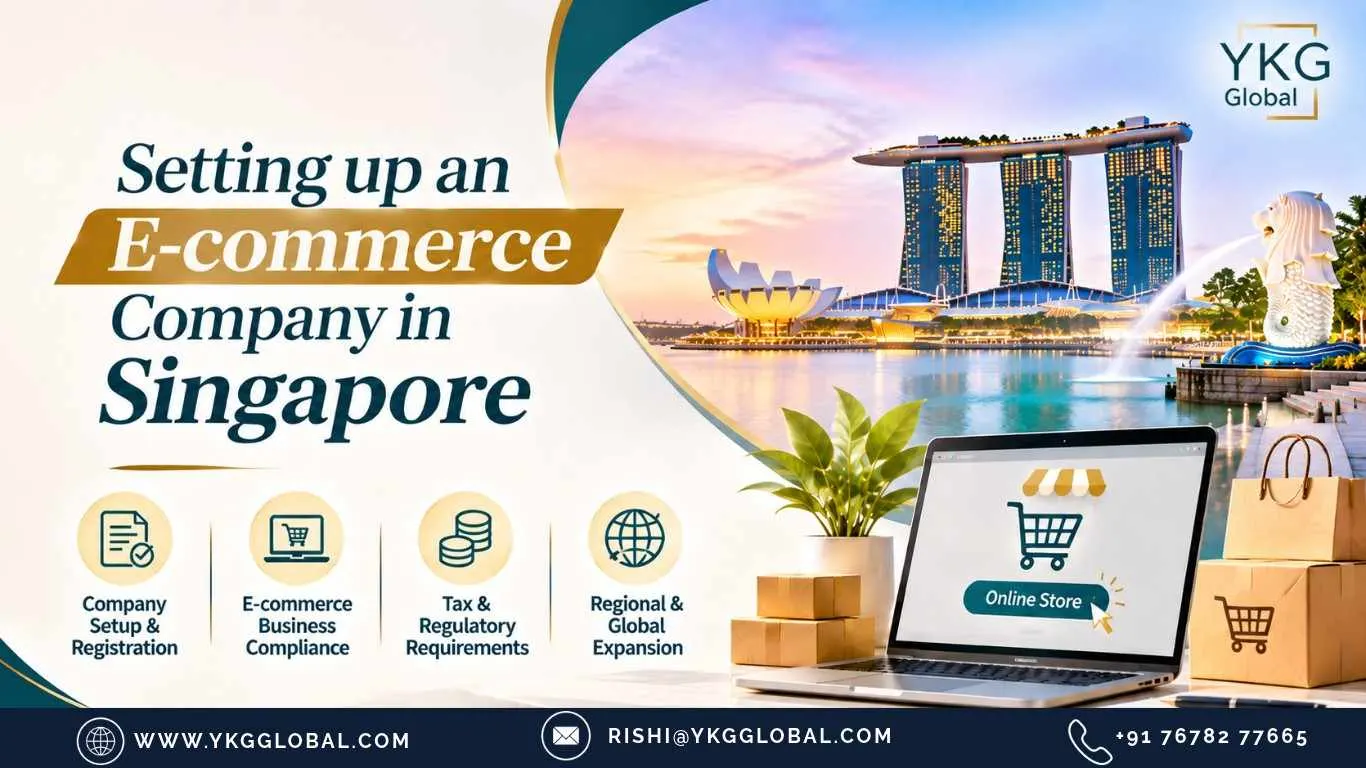
Setting up an E-commerce company in Singapore
Singapore has become an attractive destination for entrepreneurs looking to establish online businesses and expand into Southeast Asian markets. With its digital infrastructure, international trade connections, established banking system and transparent corporate regulations, the country provides a structured environment for e-commerce operations.
However, launching an online store involves more than creating a website and listing products. Entrepreneurs must consider company incorporation, payment processing, inventory management, consumer protection, taxation and cross-border shipping requirements.
Establishing an e commerce company in singapore requires a clear understanding of both corporate registration procedures and the operational obligations associated with selling products or services online.
Whether you plan to operate a direct-to-consumer website, sell through international marketplaces or establish a regional distribution business, this guide explains the essential steps for setting up an e-commerce company in Singapore.
1. Why Singapore Is an Attractive Location for E-commerce Businesses
Singapore offers several advantages for businesses operating in the digital economy.
1.1 Access to Southeast Asian Markets
Singapore's geographical position and international trade connections make it a practical base for companies serving customers across Southeast Asia.
Businesses can coordinate regional suppliers, logistics providers and distribution arrangements through a Singapore entity.
1.2 Digital Business Infrastructure
Singapore has an established digital payments ecosystem, reliable telecommunications infrastructure and access to technology service providers.
These facilities support businesses that rely on online transactions and remote customer engagement.
1.3 Foreign Ownership
Singapore generally permits 100% foreign ownership of private limited companies, subject to applicable sector-specific restrictions.
This allows international entrepreneurs to establish a local subsidiary without necessarily requiring a Singaporean shareholder.
1.4 Corporate Legal Framework
Companies operate under an established regulatory system administered by the Accounting and Corporate Regulatory Authority (ACRA).
For an e commerce business in singapore, this framework provides a foundation for commercial contracts, corporate governance and ongoing compliance.
2. Choosing the Right Business Structure
Before starting an online business, entrepreneurs must determine the most appropriate legal structure.
2.1 Private Limited Company
A private limited company is commonly selected for e-commerce businesses intending to scale operations, appoint employees or attract investment.
It has a separate legal identity from its shareholders, and shareholder liability is generally limited to their investment, subject to applicable legal exceptions.
A private limited company can also enter into contracts, maintain business accounts and own assets in its own name.
2.2 Sole Proprietorship
A sole proprietorship may be suitable for certain small businesses operated by eligible individuals.
However, the proprietor and the business are not separate legal entities, meaning the proprietor bears personal responsibility for business liabilities.
2.3 Limited Liability Partnership
An LLP combines elements of partnership management with a separate legal identity.
It may suit certain collaborative business arrangements, although it is less commonly selected for conventional online retail operations.
2.4 Foreign Company Subsidiary
An overseas business can establish a Singapore subsidiary to manage local or regional e-commerce activities.
The appropriate structure depends on ownership, investment plans, commercial operations and tax considerations.
3. How to Register an E-commerce Company in Singapore
The process for company registration in singapore is administered through ACRA's Bizfile system.
Step 1: Select a Company Name
Choose a proposed business name and check its availability.
The name must comply with ACRA's requirements and should not be identical to an existing registered name or otherwise prohibited.
Step 2: Identify Business Activities
The company must select the appropriate Singapore Standard Industrial Classification (SSIC) codes.
For e-commerce businesses, the classification should reflect the actual activities, such as online retail, wholesale distribution or other relevant commercial operations.
Step 3: Appoint Directors
A Singapore private limited company must have at least one director who is ordinarily resident in Singapore.
Foreign entrepreneurs who do not have an eligible resident director must arrange for a suitable appointment before incorporation.
Step 4: Determine Shareholding and Capital
Singapore generally allows complete foreign ownership of private limited companies.
A company can ordinarily be incorporated with a minimum issued share capital of S$1, although additional capital may be commercially necessary.
Step 5: Arrange a Registered Office
The company must maintain a registered office address in Singapore that meets the statutory requirements.
A P.O. Box alone is not sufficient.
Step 6: Prepare Incorporation Documents
Relevant information includes shareholder and director particulars, identification documents, registered office details, share capital information and the company's constitution.
Step 7: Submit the Application
The incorporation application is submitted through ACRA's Bizfile system.
Foreign applicants generally engage a registered corporate service provider to handle incorporation.
Once approved, the company receives its Unique Entity Number (UEN) and official registration confirmation.
4. Documents Required for E-commerce Company Incorporation
The documents required for singapore company registration depend on whether the shareholders are individuals or corporate entities.
Individual shareholders and directors generally provide identification documents, residential address information and other details required for verification.
Where a foreign company is the shareholder, supporting documents may include its certificate of incorporation, constitutional documents and information about its authorised representatives.
The incorporation process also requires details of the proposed company name, business activities, registered office, directors, shareholders and share capital.
Foreign-language documents may require suitable translations.
Corporate service providers may request additional information to satisfy customer due diligence and beneficial ownership requirements.
Preparing accurate documentation in advance can help avoid unnecessary incorporation delays.
5. Building the E-commerce Infrastructure
Company incorporation establishes the legal entity, but the business also needs an operational platform for receiving and fulfilling customer orders.
5.1 Domain Name and Online Store
The company should select a suitable domain name and develop a website that reflects its products, services and brand identity.
Online stores can be built using dedicated e-commerce platforms or custom-developed systems.
5.2 Payment Gateway Integration
Payment providers enable customers to pay through supported cards, digital wallets and other electronic payment methods.
Businesses should evaluate transaction settlement arrangements, supported currencies, fraud prevention tools and eligibility requirements.
5.3 Inventory Management
Businesses selling physical goods need systems for monitoring stock levels, purchase orders and fulfilment.
Inventory records should be coordinated with accounting systems to support accurate financial reporting.
5.4 Customer Service
A reliable customer support process should address delivery enquiries, refunds, returns and complaints.
5.5 Website Security
E-commerce businesses should implement appropriate security measures to protect customer information and online transactions.
Entrepreneurs planning to start ecommerce business in singapore should develop these operational arrangements alongside the incorporation process rather than treating them as separate considerations.
6. Online Marketplaces vs Independent E-commerce Websites
Singapore companies may sell through their own websites, third-party marketplaces or a combination of both.
6.1 Independent Websites
A company-operated website provides greater control over branding, customer experience and marketing activities.
However, the business must independently manage customer acquisition, website maintenance and payment integrations.
6.2 Online Marketplaces
Marketplaces provide access to established selling infrastructure and existing customer traffic.
Businesses must comply with marketplace onboarding requirements, product policies and seller obligations.
6.3 Combining Both Channels
Many businesses use marketplaces for product discovery while developing their own websites for customer retention and brand recognition.
The appropriate approach depends on the product category, target market and operating model.
7. Licences and Regulatory Requirements for Online Sellers
Not every e-commerce business requires a special licence simply because it sells online.
However, licensing obligations depend on the nature of the products and services.
Businesses dealing in regulated products such as food, healthcare products, cosmetics, telecommunications equipment or certain controlled goods may require additional approvals.
Importers and exporters may also need customs registrations, permits or product-specific authorisations.
Companies should verify the requirements applicable to their actual products before beginning sales.
In addition, online businesses must comply with relevant consumer protection and advertising rules.
Singapore's Consumer Protection (Fair Trading) Act addresses unfair practices in consumer transactions.
Businesses should provide accurate product descriptions, transparent transaction terms and appropriate information concerning refunds and delivery.
8. GST Requirements for Singapore E-commerce Companies
Goods and Services Tax (GST) is an important consideration for businesses selling goods or services in Singapore.
8.1 Singapore's prevailing GST rate is 9%.
Businesses generally must register for GST when their taxable turnover exceeds S$1 million under the applicable retrospective or prospective registration rules.
Voluntary GST registration may also be available, subject to Inland Revenue Authority of Singapore (IRAS) requirements.
8.2 Domestic Online Sales
GST-registered businesses generally must account for GST on taxable local supplies unless a specific treatment applies.
8.3 Overseas Sales
Exports of goods may qualify for zero-rating when the relevant conditions and documentary requirements are satisfied.
8.4 Imported Goods
GST treatment depends on the nature of the goods, import arrangements and applicable rules.
8.5 Cross-Border Digital Services
Specific GST rules apply to certain imported services and low-value goods transactions.
E-commerce businesses should evaluate their sales channels and customer locations to determine the appropriate tax treatment.
9. Personal Data Protection and Customer Privacy
Online retailers frequently collect customer names, contact details, delivery addresses and transaction information.
Singapore's Personal Data Protection Act (PDPA) establishes obligations concerning the collection, use, disclosure and protection of personal data.
Businesses should establish appropriate privacy notices, consent procedures where required and safeguards against unauthorised access.
They should also appoint a Data Protection Officer, as required under the PDPA.
Where customer information is transferred outside Singapore, applicable data transfer requirements must be considered.
For company incorporation singapore projects involving online retail, privacy compliance should be addressed during the website development stage rather than after customer data has already been collected.
10. Logistics, Warehousing and Cross-Border Fulfilment
The fulfilment model is one of the most important operational decisions for an e-commerce company.
10.1 Local Warehousing
Businesses serving Singapore customers may store inventory in local warehouses and arrange domestic delivery.
10.2 Third-Party Logistics
Third-party logistics providers can manage storage, packing, shipping and certain returns processes.
10.3 Dropshipping
Under a dropshipping model, products are generally dispatched by suppliers after customers place orders.
However, the seller remains responsible for complying with applicable contractual, consumer protection and product requirements.
10.4 International Fulfilment
Companies selling internationally must consider customs documentation, import duties, destination-country taxes and delivery responsibilities.
The choice of fulfilment model can also affect inventory accounting, tax exposure and customer service obligations.
11. Banking, Accounting and Financial Management
Once incorporated, the company should establish appropriate financial arrangements.
A Singapore corporate bank account or suitable business payment account may be necessary to receive customer payments and settle supplier invoices.
Banks and payment institutions generally conduct identity verification and assess the company's ownership, activities and expected transactions.
E-commerce companies should maintain accurate records of sales, payment gateway settlements, refunds, inventory and operating expenses.
Accounting systems can help reconcile marketplace transactions and identify discrepancies between gross sales and actual receipts.
Companies must also comply with applicable corporate income tax reporting and financial record-keeping obligations.
Singapore's headline corporate income tax rate is 17%, although qualifying companies may benefit from applicable exemptions or reliefs.
12. Ongoing Compliance After Incorporation
Operating an online business does not remove the company's statutory responsibilities.
A Singapore private limited company must appoint a company secretary within six months of incorporation.
It must maintain the required corporate registers, registered office and director arrangements.
Annual returns must be filed with ACRA within the applicable statutory deadlines.
The company must also comply with relevant financial statement, corporate income tax and GST filing requirements.
An auditor must generally be appointed within three months of incorporation unless the company qualifies for an applicable audit exemption.
Where employees are hired, employment, payroll and Central Provident Fund obligations may also arise.
Proper compliance management allows businesses to focus on commercial growth while maintaining accurate corporate records.
13. Common Mistakes When Establishing an E-commerce Company
13.1 Selecting the Wrong Business Activity
An incorrect SSIC classification can create complications when assessing licensing and regulatory obligations.
13.2 Ignoring Product-Specific Regulations
Online sellers sometimes assume that every product can be marketed without additional approvals.
13.3 Overlooking GST Obligations
Businesses should monitor taxable turnover and understand the rules applicable to domestic and international transactions.
13.4 Inadequate Inventory Records
Poor stock reconciliation can lead to inaccurate financial statements and fulfilment difficulties.
13.5 Weak Customer Data Protection
Failure to implement suitable privacy and security measures can expose businesses to regulatory and operational risks.
13.6 Confusing Incorporation With Operational Readiness
A registered company still needs suitable payment, logistics, banking and customer service arrangements before launching.
A properly planned singapore company setup should address both statutory requirements and the practical needs of running an online business.
14. How YKG Global Helps You
YKG Global assists international entrepreneurs, startups and established businesses with setting up e-commerce operations in Singapore.
Our services include:
1. Business Structure Advisory: Helping you evaluate suitable legal structures for online retail, marketplace selling and cross-border e-commerce activities.
2. Company Incorporation: Coordinating company name applications, ACRA registration and incorporation documentation.
3. Foreign Shareholding Support: Assisting international entrepreneurs with ownership structures and relevant documentation requirements.
4. Resident Director and Company Secretary: Coordinating arrangements to meet applicable statutory requirements.
5. Registered Office Assistance: Supporting the establishment of an appropriate registered office address in Singapore.
6. Banking Coordination: Assisting with corporate banking documentation and account-opening procedures, subject to financial institution approval.
7. GST and Tax Advisory: Supporting GST registration assessments, corporate tax considerations and relevant reporting obligations.
8. Accounting and Compliance: Assisting with bookkeeping, statutory filings, financial reporting and ongoing corporate administration.
At YKG Global, we help businesses establish a legally structured foundation for their Singapore e-commerce activities while supporting long-term regulatory compliance.