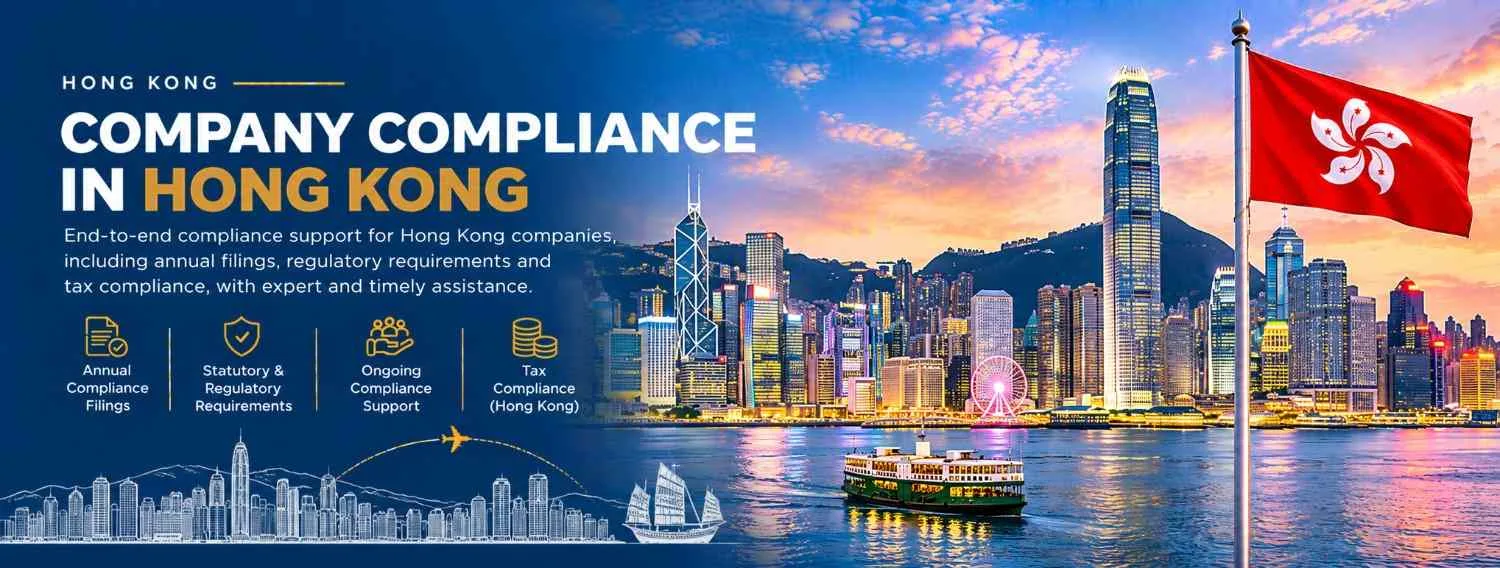
Annual Compliance and Filing Services in Hong Kong
Hong Kong remains an attractive location for international trading companies, investment holding structures and businesses serving Asian markets. However, maintaining a company requires more than submitting an annual return.
Businesses seeking annual compliance services in Hong Kong must coordinate corporate filings, financial reporting, tax declarations and company secretarial responsibilities.
A significant challenge is that these obligations follow different timelines. The Companies Registry uses the incorporation anniversary, business registration follows certificate validity, and profits tax reporting follows Inland Revenue Department procedures.
Understanding these differences is particularly important for overseas shareholders managing Hong Kong companies remotely.
1. Why Hong Kong Companies Need Multiple Compliance Calendars
Hong Kong does not operate a single consolidated annual filing system.
1.1 Companies Registry
The Companies Registry administers annual returns, corporate records and prescribed changes to company information.
1.2 Inland Revenue Department
The Inland Revenue Department (IRD) manages business registration, profits tax and applicable employer reporting.
1.3 Financial Reporting
Companies must separately maintain accounting records, prepare financial statements and arrange statutory audits where required.
A professional compliance service should track these responsibilities independently rather than rely on one annual reminder.
2. NAR1 Annual Return Filing
Form NAR1 is a central statutory obligation for ordinary Hong Kong private limited companies.
2.1 Filing Deadline
A private company generally submits its annual return within 42 days after its incorporation anniversary, excluding its incorporation year.
2.2 Information Required
The return contains prescribed particulars, including:
• Registered office address.
• Directors and company secretary.
• Shareholders and share capital.
• Other relevant corporate information.
2.3 Government Filing Fees
The standard on-time filing fee is HK$105.
Late filing fees increase according to the delay:
• Up to three months after the anniversary: HK$870.
• More than three months, up to six: HK$1,740.
• More than six months, up to nine: HK$2,610.
• More than nine months: HK$3,480.
Professional NAR1 filing services Hong Kong help companies avoid escalating registration fees and incorrect submissions.
3. Business Registration Renewal
The Business Registration Certificate is distinct from the Certificate of Incorporation.
3.1 Certificate Validity
Businesses generally hold one-year or three-year business registration certificates.
3.2 Renewal Procedure
The IRD normally issues renewal demand notes before the new registration period begins.
3.3 Applicable Charges
Fees and levies depend on the certificate period and prevailing government rates.
3.4 Why Renewal Matters
An expired registration certificate can create regulatory difficulties and affect routine business administration.
Reliable Hong Kong annual return filing services should therefore be coordinated with business registration monitoring.
4. Company Secretary and Statutory Registers
Hong Kong requires companies to maintain prescribed corporate records throughout their existence.
4.1 Company Secretary
A private company must have an eligible company secretary. A sole director cannot also act as the company's secretary.
4.2 Significant Controllers Register
Applicable local companies must maintain a Significant Controllers Register identifying persons or entities exercising qualifying control.
4.3 Designated Representative
Companies must appoint an eligible designated representative to assist law enforcement officers with access to the register.
4.4 Corporate Changes
Changes involving directors, the registered office or other prescribed particulars may require separate notifications.
4.5 Shareholder Records
Share transfers, allotments and ownership changes should be supported by proper statutory documentation.
Professional Hong Kong company secretary services help maintain accurate records between annual filing dates.
5. Annual Accounts and Statutory Audit
Hong Kong generally requires ordinary companies to prepare annual financial statements and arrange statutory audits.
5.1 Accounting Preparation
Businesses should maintain:
• Sales invoices and purchase records.
• Bank statements and reconciliations.
• Expense and payroll documentation.
• Intercompany transaction records.
• Asset and liability schedules.
5.2 Statutory Auditor
Where required, financial statements must be audited by an eligible practising certified public accountant.
5.3 Small Companies
Qualifying small companies may receive reporting concessions, but these do not automatically eliminate audit requirements.
5.4 Overseas Trading Companies
A company earning revenue from overseas customers generally remains responsible for maintaining proper accounting records and assessing audit obligations.
Hong Kong statutory audit services are particularly relevant to foreign-owned companies with international transactions.
6. Profits Tax and Electronic Filing in 2026
Hong Kong's profits tax system operates separately from corporate annual returns.
6.1 Corporate Profits Tax
The standard corporate profits tax rate is 16.5%.
Eligible corporations may benefit from an 8.25% rate on the first HK$2 million of assessable profits under the two-tiered regime.
6.2 Form BIR51
Corporations generally submit Form BIR51 when issued by the IRD.
Returns are ordinarily due within one month after issue, subject to applicable extensions.
6.3 Mandatory Electronic Filing
From 1 April 2026, specified corporations became subject to mandatory electronic profits tax return filing.
Companies must determine whether the new requirements apply to their circumstances.
6.4 Supporting Documentation
Returns may require audited financial statements, tax computations and prescribed supplementary forms.
Professional Hong Kong profits tax filing services help businesses coordinate tax calculations with their accounting and audit records.
7. Foreign-Owned Companies and Offshore Income
International ownership introduces additional considerations beyond routine filings.
7.1 Foreign Shareholders
Hong Kong companies with overseas shareholders generally remain subject to local statutory obligations.
7.2 Offshore Profits
Income earned from international transactions is not automatically exempt from Hong Kong profits tax.
Tax treatment depends on relevant operations, income sources and applicable legislation.
7.3 Foreign-Sourced Income Rules
Certain multinational enterprise groups must assess Hong Kong's foreign-sourced income exemption regime.
7.4 Related-Party Transactions
Intercompany loans, management fees and other cross-border transactions may require transfer pricing analysis.
Effective Hong Kong company compliance for foreign owners requires understanding both corporate obligations and international taxation exposure.
8. AGM, Dormant Status and Compliance Risks
Certain corporate governance requirements depend on company circumstances.
8.1 Annual General Meeting
An ordinary private company that is not a subsidiary of a public company generally holds its AGM within nine months after its accounting reference period ends.
8.2 AGM Exemptions
Qualifying companies may dispense with AGMs where statutory conditions are satisfied.
8.3 Dormant Companies
A company formally declared dormant under the Companies Ordinance may qualify for exemptions from certain annual reporting obligations.
Merely having no sales does not establish statutory dormant status.
8.4 Late Filing Consequences
Overdue filings may result in increased fees, penalties and potential prosecution.
Companies should assess outstanding obligations before considering deregistration.
9. How YKG Global Helps You
YKG Global assists Hong Kong companies, international entrepreneurs and overseas-owned subsidiaries with coordinated corporate compliance services.
9.1 Companies Registry Filings
Coordinating annual returns, statutory updates and supporting documentation.
9.2 Company Secretarial Compliance
Supporting statutory registers, shareholder resolutions and corporate governance requirements.
9.3 Accounting and Audit
Organising financial records and coordinating statutory audits with qualified Hong Kong professionals.
9.4 Profits Tax Compliance
Assisting with tax computations, electronic filing requirements and return preparation.
9.5 Foreign-Owned Business Support
Helping international shareholders monitor regulatory deadlines and cross-border documentation.
YKG Global provides structured compliance coordination through appropriately qualified local professionals.
Call us or fill out our contact form to schedule a consultation today.
📧 Email: Rishi@ykgglobal.com
🌐 Website: www.ykgglobal.com
📱 Call/WhatsApp: +91 76782 77665
📍 Offices: Delhi | Mumbai | Dubai | Singapore