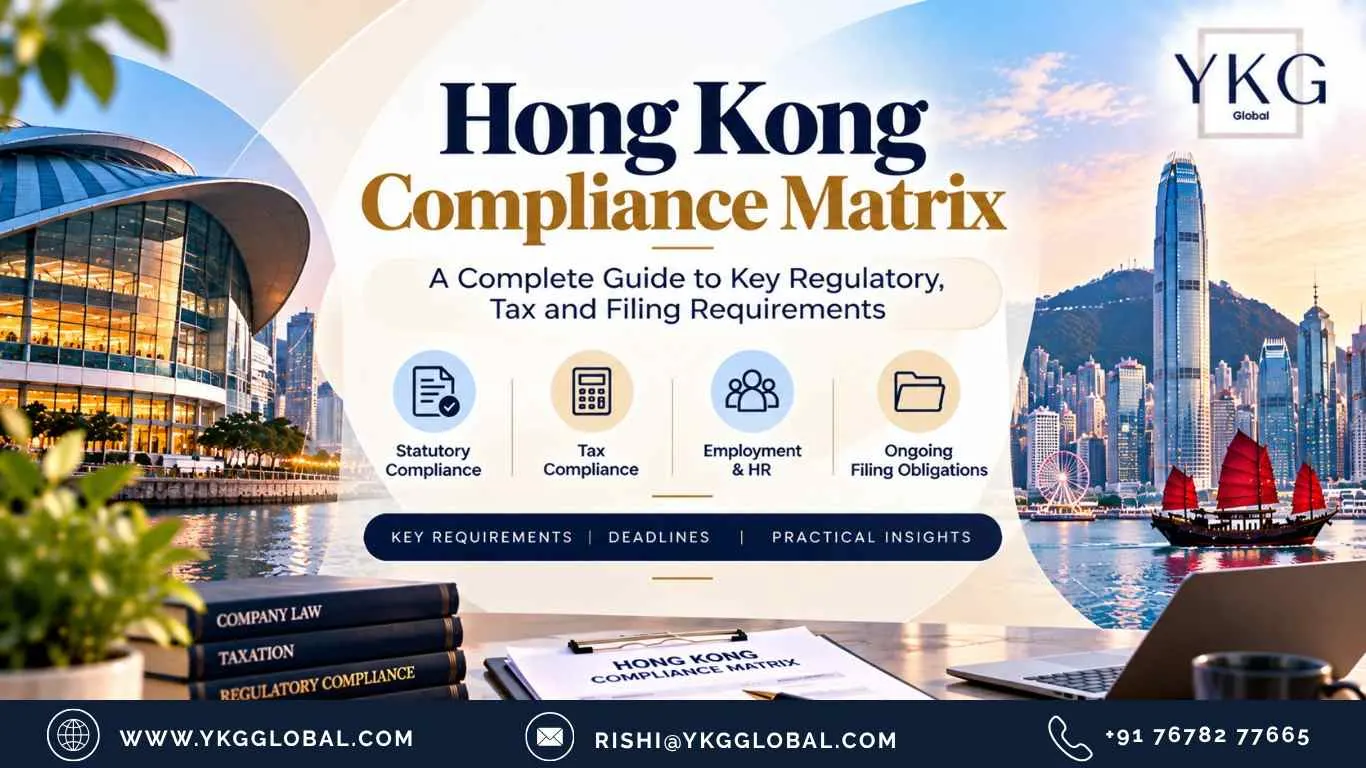
Hong Kong Compliance Matrix: A Practical Guide for Businesses
Hong Kong offers an established business environment, but registering a company is only the beginning. Businesses must meet ongoing obligations relating to company records, tax returns, financial statements, employment and industry-specific regulations.
A compliance matrix helps business owners organise these responsibilities by frequency, deadline and responsible person. It also reduces the risk of missing a filing because different authorities administer different requirements.
For businesses completing hong kong business registration, compliance planning should begin during incorporation, not when the first annual deadline approaches. The exact obligations depend on the entity type, business activities, employees and tax position.
1. What Is a Hong Kong Compliance Matrix?
A compliance matrix is a structured checklist of legal and regulatory obligations that a business must fulfil throughout its operations.
Rather than treating compliance as a single annual exercise, businesses can divide responsibilities into three categories.
1.1 Recurring compliance: Obligations that arise monthly, annually or at other regular intervals.
1.2 Event-triggered compliance: Filings required when directors, shareholders, addresses or business circumstances change.
1.3 Operational compliance: Ongoing responsibilities involving accounting records, employment, data protection and regulated activities.
A useful matrix identifies the requirement, responsible person, due date, supporting documents and completion status. It should also distinguish statutory deadlines from internal review dates.
2. Core Hong Kong Company Compliance Matrix
A. Annual return and company particulars
Frequency: Annual and whenever relevant particulars change.
Hong Kong companies incorporated locally generally need to file an annual return with the Companies Registry using Form NAR1.
For a local private company, the return is generally due within 42 days after the anniversary of its incorporation. The return records company particulars, including its registered office, directors, company secretary and shareholders.
Companies must also notify the Companies Registry of specified changes within the applicable statutory periods. These may include changes to the registered office, directors or company secretary.
Compliance action: Maintain an annual return calendar and update company records promptly when changes occur.
B. Business registration certificate
Frequency: Renewal according to the certificate's validity period.
A business must maintain a valid business registration certificate where required under Hong Kong's Business Registration Ordinance. The certificate's expiry date and applicable renewal requirements should be tracked separately from the annual company return.
Business registration and company incorporation are related but distinct matters. A company may have completed its incorporation formalities while still needing to manage business registration renewals and other applicable notifications.
Compliance action: Record the certificate's expiry date, review renewal notices and retain proof of payment and the valid certificate.
C. Accounting records and financial statements
Frequency: Continuous record-keeping, with periodic financial reporting.
Companies must maintain adequate accounting records to explain their transactions and financial position. Records should support revenue, expenses, assets, liabilities, payroll, banking transactions and tax calculations.
Hong Kong companies are generally required to prepare annual financial statements and arrange an audit, subject to applicable statutory exceptions. Certain qualifying companies may be eligible for simplified reporting arrangements, but the conditions should be assessed carefully.
Compliance action: Reconcile bank accounts regularly, maintain supporting documents and prepare financial statements in time for tax and corporate reporting.
D. Profits tax returns
Frequency: According to the Inland Revenue Department's filing requirements.
Companies carrying on business in Hong Kong must assess their profits tax obligations and respond to tax returns issued by the Inland Revenue Department (IRD).
The tax return may require supporting schedules, financial statements, tax computations and other information, depending on the company's circumstances. The deadline should be taken from the return and any applicable extension or filing arrangement rather than assumed to be identical for every company.
Hong Kong's territorial tax system makes it important to analyse the source of profits and the facts of the business. Incorporation in Hong Kong does not automatically mean that all profits are taxable there, nor does it automatically exempt offshore profits.
Compliance action: Maintain accurate accounting records, review assessable profits and monitor the filing and payment deadlines communicated by the IRD.
E. Significant Controllers Register
Frequency: Ongoing maintenance and updates when relevant information changes.
Most Hong Kong companies incorporated locally, other than specified exempt entities such as listed companies, must maintain a Significant Controllers Register (SCR).
The register helps identify individuals and relevant legal entities with significant control over the company. A person may qualify through shareholding, voting rights, board appointment rights or other forms of significant influence or control.
The register must be kept at the company's registered office or another permitted location in Hong Kong and be available for inspection by law enforcement officers as required by law.
Compliance action: Identify significant controllers, keep their particulars current and appoint an eligible designated representative.
3. Employment and Payroll Compliance
Companies employing staff must manage employment, tax reporting and mandatory provident fund (MPF) responsibilities where applicable.
A. Employer's tax returns
Frequency: Annual and event-triggered.
Employers generally need to file the annual Employer's Return, Form BIR56A, together with the relevant IR56B forms. The IRD normally issues the return in April, and the employer is generally required to submit it within one month of issue.
Additional notifications may be required when an employee joins, leaves employment or is expected to leave Hong Kong for a substantial period or permanently.
Compliance action: Maintain accurate payroll records, monitor IRD notices and submit the appropriate forms within the applicable deadlines.
B. MPF contributions
Frequency: Generally monthly for covered employees.
Employers must comply with applicable MPF enrolment and contribution requirements. For regular monthly-paid employees, contributions are generally due on or before the 10th day of the following month, subject to the applicable rules and calendar adjustments.
Employers should also retain contribution records and provide the required employee pay records.
Compliance action: Reconcile payroll against MPF contributions every month and monitor the relevant contribution dates.
C. Employment records and workplace obligations
Frequency: Ongoing.
Employers should maintain employment contracts, wage records, leave records and other documentation required by applicable employment laws. They should also review requirements concerning wages, statutory holidays, termination, occupational safety and employees' compensation insurance.
Compliance action: Review employment documentation whenever staff join, change roles or leave the organisation.
4. Event-Triggered Compliance: Changes That Require Action
Not every filing follows an annual calendar. Some obligations arise when the company's circumstances change.
1.1 Changes in directors or company secretary
Appointments, resignations and other changes may require notification to the Companies Registry within the applicable statutory period. The company should also update its internal registers and corporate records.
1.2 Changes in registered office
A change of registered office must be notified to the Companies Registry using the prescribed procedure and within the applicable deadline.
1.3 Changes in ownership or control
Share transfers and changes in beneficial ownership may require updates to company registers and the Significant Controllers Register. Supporting documents should be retained to demonstrate the transaction and the resulting ownership position.
1.4 Changes in business activities
A new business line may trigger additional licensing, registration, tax or regulatory requirements. Businesses should assess these requirements before beginning the activity rather than after operations have commenced.
Compliance action: Establish an internal process requiring management to notify the company secretary or compliance adviser before implementing material corporate changes.
5. Industry-Specific Regulatory Compliance
General company filings are only one part of the compliance picture. Certain activities are subject to additional regulatory requirements.
Businesses involved in financial services, insurance, money lending, trust or company services, import and export, food, education or other regulated sectors may need licences, approvals or specific registrations.
For example, a company providing regulated financial services should not assume that incorporation alone authorises it to offer those services. Similarly, importers and exporters should assess the registration and declaration requirements applicable to their goods and transactions.
Data protection is another important consideration. Businesses handling personal data should review their obligations under Hong Kong's Personal Data (Privacy) Ordinance, including appropriate safeguards for collecting, using, retaining and disclosing personal information.
Compliance action: Prepare a separate licensing checklist for each business activity, identify the relevant regulator and monitor renewal or reporting conditions.
6. How to Build an Effective Compliance Calendar
An effective compliance calendar converts legal obligations into assigned tasks with clear deadlines.
Start by identifying the entity type, business activities, employee count, financial year and relevant registrations. Then list the recurring filings and event-triggered notifications that apply.
For each obligation, record:
6.1 Requirement: The filing, payment, renewal or record-keeping task.
6.2 Deadline: The statutory due date or the date specified by the relevant authority.
6.3 Owner: The employee, director, company secretary, accountant or adviser responsible.
6.4 Evidence: The completed filing, payment confirmation, signed document or supporting record.
6.5 Review date: An earlier internal deadline that allows time to correct errors.
Set reminders well before statutory deadlines and review outstanding items monthly. Management should also review the calendar when the company hires employees, changes ownership, enters a new market or introduces a regulated activity.
A compliance calendar should be tailored to the company. A dormant company, a trading business with employees and a regulated financial services firm will not have identical requirements.
7. Common Compliance Mistakes to Avoid
1. Treating incorporation as complete compliance. Registration creates the entity, but ongoing filings and operational requirements continue afterwards.
2. Confusing annual returns with tax returns. The Companies Registry and IRD administer different obligations. Completing one does not satisfy the other.
3. Ignoring event-triggered deadlines. Director changes, address updates and ownership changes may require action before the next annual review.
4. Keeping incomplete records. Missing invoices, payroll records or transaction documents can complicate financial reporting and tax assessments.
5. Assuming offshore profits are automatically exempt. The tax treatment depends on the facts and applicable law, not merely the company's place of incorporation.
6. Relying on reminders without assigning responsibility. A deadline is more likely to be missed when no specific person owns the task and verifies completion.
How YKG Global Helps You
Managing multiple filings and regulatory obligations can become challenging, particularly for foreign-owned companies and businesses operating across borders.
YKG Global supports international entity setup, corporate compliance and cross-border advisory. For businesses requiring regulatory compliance hong kong support, assistance may include:
1. Organising corporate filing and renewal calendars.
2. Coordinating company records and required documentation.
3. Supporting accounting, tax compliance and reporting processes.
4. Identifying changes that may trigger additional filings or regulatory reviews.
5. Reviewing cross-border considerations relevant to overseas shareholders and group entities.
Businesses considering hong kong incorporation services should establish their compliance responsibilities alongside the incorporation process. A structured approach helps management understand what must be filed, when action is required and who is accountable.