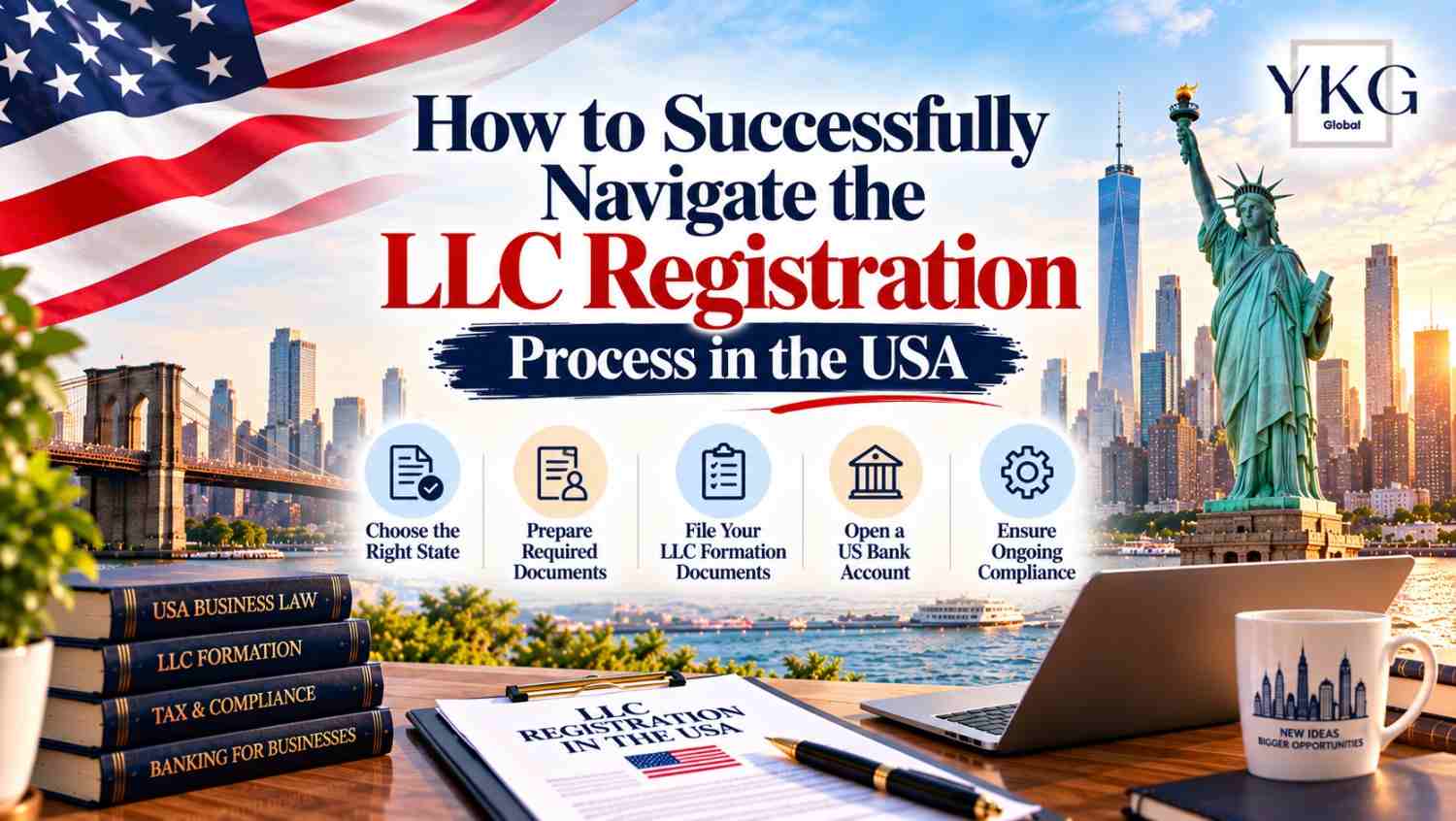
IRS Guide to Company Registration for US Businesses
Registering a business in the United States involves two important processes: establishing the legal entity under state law and completing the relevant federal tax registration requirements. Confusing these steps can create problems when opening a business bank account, hiring employees, or filing tax returns.
For many entrepreneurs, united states company registration begins with choosing a legal structure and registering with the relevant state authority. The next steps may include obtaining an Employer Identification Number (EIN) from the Internal Revenue Service (IRS), determining the business's federal tax classification, and reviewing additional compliance obligations.
Whether you are exploring usa company formation for a new venture or expanding an existing international business, understanding the difference between state incorporation and IRS registration can help you establish the right foundation.
What Is IRS Company Registration?
IRS company registration generally refers to completing the federal tax identification and registration steps applicable to a business. The central requirement for many businesses is obtaining an EIN, a unique nine-digit number issued by the IRS.
An EIN identifies a business for federal tax administration. Depending on the entity and its activities, it may be needed for tax returns, employment taxes, banking, and other business requirements.
However, an EIN does not create a legal entity. For example, an LLC is formed under state law, while the IRS determines how that LLC is classified for federal tax purposes.
This distinction matters for anyone planning company registration in america, because the state-issued entity records and the federal EIN serve different purposes.
State Registration vs IRS Registration
1. State-level business registration
State registration establishes the legal entity. Depending on the chosen structure, the application may be filed with the Secretary of State or another designated state agency.
For an LLC, the process generally involves checking the proposed business name, appointing a registered agent, and filing Articles of Organization or the equivalent formation document.
2. Federal IRS registration
The IRS process involves obtaining an EIN when required and addressing the business's applicable federal tax obligations. Some entities may also need to file an election to change their default federal tax classification.
A state registration number is not the same as an EIN. If a bank or tax form requests an EIN, submitting a state entity number instead may lead to delays.
Which Business Structures Can You Register?
The appropriate structure depends on ownership, liability considerations, tax treatment, management, and future plans.
1. Limited Liability Company (LLC)
A limited liability company in usa is a state-created legal entity that generally offers limited liability protection to its members, subject to applicable law. It can have one or multiple members, and many states permit foreign individuals and entities to own LLCs.
For federal income-tax purposes, a single-member domestic LLC is generally treated as a disregarded entity by default. A multi-member domestic LLC is generally treated as a partnership unless it elects corporate treatment.
2. Corporation
A corporation is a separate legal entity formed under state law. It generally has more formal governance requirements and may be appropriate for businesses planning to issue shares or pursue particular investment structures.
Corporations generally need an EIN and must meet their applicable federal and state tax obligations.
3. Sole Proprietorship
A sole proprietorship is generally associated with an individual conducting business without establishing a separate legal entity. Depending on the circumstances, the owner may be able to use an individual taxpayer identification number for certain federal tax purposes. Other requirements may make an EIN necessary.
Choosing the right structure before starting llc company registration in usa or another formation process can help avoid unnecessary changes later.
How to Register a Company with the IRS: Step-by-Step
Step 1: Choose the Business Structure
Determine whether an LLC, corporation, partnership, or sole proprietorship best suits the business. Consider ownership, personal liability, tax treatment, management, and future fundraising plans.
This decision influences the formation documents and the tax forms the business may need to file.
Step 2: Choose the State and Register the Entity
Before applying for an EIN for a newly formed LLC or corporation, complete the applicable state formation process.
For an LLC, this usually means selecting a state, confirming name availability, appointing a registered agent, and submitting the required formation documents.
Entrepreneurs researching llc registration in usa should compare states based on their actual business activities and compliance obligations, rather than choosing a state based on reputation alone.
Step 3: Obtain an Employer Identification Number (EIN)
The EIN application is available directly through the IRS, free of charge.
Before applying, prepare the legal business name, entity type, formation details, and information about the responsible party. The responsible party is generally the individual who ultimately owns or controls the entity, subject to the IRS rules.
Eligible applicants whose principal place of business is in the United States or a US territory may use the IRS online application if they satisfy its eligibility requirements. Applicants whose principal place of business is outside the United States generally need to use an alternative procedure, such as fax, mail, or telephone where eligible.
If you plan to register llc in usa, complete the state formation first and then follow the appropriate EIN application route.
Step 4: Review the Federal Tax Classification
An LLC's legal form does not automatically mean it is taxed as a corporation.
For federal income-tax purposes, a domestic single-member LLC is generally a disregarded entity by default, while a domestic multi-member LLC is generally classified as a partnership. An eligible LLC may elect corporate treatment by filing Form 8832.
The election should be considered carefully because it can affect tax returns and other obligations. Businesses should confirm the appropriate classification with a qualified tax professional before filing an election.
Step 5: Complete Additional Tax Registrations
An EIN does not replace every tax or regulatory registration.
Depending on the business, additional steps may include registering for state income or franchise taxes, sales and use taxes, payroll taxes, and local licences. Requirements depend on the state, business activities, and whether the company has employees or a physical presence in other locations.
Step 6: Maintain Business Records and Compliance
After registration, retain the approved formation documents, EIN confirmation, operating agreement where applicable, accounting records, and tax filings.
Check whether the business needs annual or periodic state reports, licence renewals, or registrations in other states where it operates. A compliance calendar can help keep deadlines organised.
Should You Consider Delaware for Company Registration?
Delaware is a popular state for certain businesses because of its established corporate law framework and business court system. However, it is not automatically the best choice for every LLC or small business.
When evaluating company registration in delaware usa, consider where the business will actually operate, where its owners are based, and whether forming in Delaware would create additional registration obligations elsewhere.
Entrepreneurs looking to register a company in delaware usa should also understand that incorporation in Delaware does not remove federal tax obligations or automatically eliminate taxes and filings in other states.
If the company operates primarily in another state, it may need to register there as well. Compare the full compliance picture before making a decision.
Can Non-US Residents Register a Company and Obtain an EIN?
In many cases, foreign individuals and entities can own a US LLC, subject to state rules and restrictions that may apply to particular industries. US citizenship or residency is not generally a universal prerequisite for LLC ownership.
For people exploring llc for non us residents, the main considerations include choosing a suitable state, appointing a registered agent, preparing acceptable documentation, applying for an EIN through the appropriate route, and understanding US tax reporting.
Foreign founders should not assume that company formation automatically grants immigration or work authorisation, guarantees a bank account, or removes tax obligations in their home country.
If you plan to register company in america from overseas, check the IRS application instructions for applicants whose principal place of business is outside the United States. The correct process depends on the responsible party and the entity's circumstances.
Common Mistakes to Avoid
During llc formation in usa, founders should avoid these frequent errors:
1. Confusing an EIN with a state registration number: They serve different purposes and are issued by different authorities.
2. Paying for an EIN unnecessarily: The IRS issues EINs free of charge. Third-party providers may charge separately for assistance.
3. Applying before forming the entity: The IRS generally advises forming the legal entity with the state before requesting an EIN.
4. Choosing the wrong tax classification: Default treatment and elective treatment can have different reporting consequences.
5. Overlooking foreign-owner obligations: Foreign-owned LLCs may have additional federal information-reporting requirements, depending on their classification and circumstances.
6. Ignoring ongoing compliance: Annual reports, taxes, licences, and other filings may remain necessary after the initial registration.
Understanding how to open a company in usa requires looking beyond the application itself. A complete plan should cover formation, federal identification, tax classification, and continuing compliance.
How YKG Global Helps You
YKG Global supports international entrepreneurs and businesses exploring US market entry and cross-border operations. The appropriate assistance depends on the proposed entity, ownership structure, and business activity.
Our support may include:
1. Explaining the distinction between state incorporation and IRS registration.
2. Coordinating documentation for eligible register company in usa projects.
3. Helping founders understand the EIN application process and relevant tax classification considerations.
4. Identifying federal, state, and cross-border compliance matters that may require professional review.
5. Supporting businesses comparing formation options, including company registration in delaware usa, based on their commercial plans.
For businesses considering register llc in usa or another US entity structure, the goal is to establish the entity correctly and plan for its tax and compliance responsibilities from the beginning.