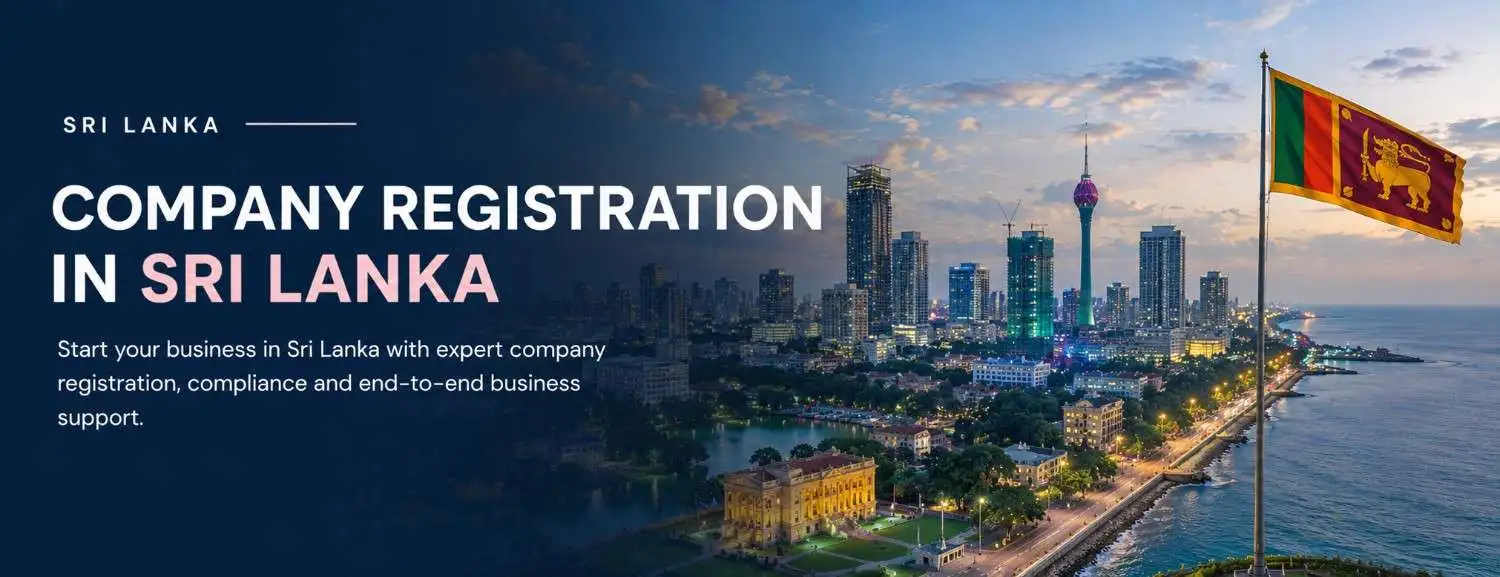
Sri Lanka Company Registration
Sri Lanka offers business opportunities in tourism, manufacturing, logistics, information technology, agriculture and export-oriented industries. Its location along major Indian Ocean shipping routes also makes it relevant for international trading and regional investment.
Entrepreneurs planning business registration in sri lanka must understand the country's incorporation procedures, legal structures, foreign investment regulations and taxation requirements.
Company incorporation is administered by the Registrar of Companies under the Companies Act No. 7 of 2007. Most private limited companies can complete their registration through the electronic Registrar of Companies system, known as eROC.
Understanding these procedures helps investors establish a legally recognised business and prepare for continuing regulatory obligations.
1. Understanding Sri Lanka's Company Registration System
The Department of the Registrar of Companies is responsible for incorporating companies and maintaining statutory corporate records.
1.1 Registrar of Companies
The Registrar examines incorporation applications, maintains company records and administers prescribed filings.
1.2 eROC Platform
The electronic Registrar of Companies platform enables applicants to complete various registration and filing procedures online.
1.3 Public Company Information
The sri lanka business registry provides a framework for maintaining information concerning incorporated entities, directors and relevant corporate particulars.
1.4 Legal Recognition
A company receives separate legal personality upon incorporation, allowing it to enter contracts, own assets and conduct permitted commercial activities.
2. Business Structures Available in Sri Lanka
Investors should select a structure according to ownership, liability and operational requirements.
2.1 Private Limited Company
A private company limited by shares is commonly used for commercial operations. Shareholder liability is generally limited to unpaid amounts on shares.
2.2 Public Limited Company
Public companies are subject to additional governance and regulatory requirements.
2.3 Overseas Company
Foreign companies establishing a place of business in Sri Lanka may need to register under the applicable overseas company provisions.
2.4 Sole Proprietorship
Individual entrepreneurs may register businesses through the relevant local or provincial registration arrangements.
2.5 Partnership
Partnerships may be appropriate for certain jointly operated businesses, subject to applicable registration requirements.
For many domestic and foreign investors, private limited company registration in sri lanka provides a recognised corporate structure with separate legal identity.
3. Requirements for a Private Limited Company
Before incorporation, applicants must arrange the company's essential legal and administrative details.
3.1 Company Name
The proposed name must comply with applicable naming requirements and receive approval through the registration process.
3.2 Shareholders
A private limited company may generally be established with one shareholder, subject to applicable restrictions.
3.3 Directors
At least one director must be appointed, and directors must satisfy statutory eligibility requirements.
3.4 Company Secretary
A qualified company secretary must be appointed in accordance with applicable regulations.
3.5 Registered Office
The company must maintain a registered office address in Sri Lanka.
3.6 Articles of Association
The articles establish the company's internal governance arrangements and relevant shareholder rights.
Proper pvt ltd company registration sri lanka requires consistent information across incorporation forms, constitutional documents and shareholder records.
4. Step-by-Step Online Incorporation Process
The eROC platform facilitates the incorporation of eligible companies.
4.1 Reserve the Company Name
Submit the proposed name and obtain the necessary approval.
4.2 Prepare Incorporation Information
Collect director particulars, shareholder information, registered office details and proposed business activities.
4.3 Prepare Statutory Forms
Relevant incorporation documentation generally includes Form 1, Form 18 and Form 19, together with the articles of association.
4.4 Submit the Application
Upload the prescribed documents and complete the required electronic procedures.
4.5 Pay Registration Fees
Government fees depend on the relevant filing categories and prevailing fee schedule.
4.6 Receive Incorporation Confirmation
After approval, the Registrar issues the Certificate of Incorporation.
The availability of online business registration in sri lanka simplifies document submission, although applications must still satisfy statutory requirements.
5. Foreign Ownership and Investment Considerations
Sri Lanka permits foreign investment in numerous sectors, but ownership restrictions apply to certain activities.
5.1 Foreign Shareholders
Overseas individuals and companies may hold shares in Sri Lankan companies, subject to applicable restrictions.
5.2 Restricted Activities
Certain sectors impose limitations or require prior approval for foreign participation.
5.3 Board of Investment
Eligible investment projects may seek approvals or incentives through the Board of Investment of Sri Lanka.
5.4 Investment Remittances
Foreign investment funds must be transferred through appropriate banking channels under applicable foreign exchange regulations.
5.5 Director Residency
The Companies Act does not impose a general requirement that every director of a private company must be resident in Sri Lanka.
Foreign investors should evaluate sector-specific restrictions before submitting incorporation documents.
6. Tax Registration and Corporate Banking
After incorporation, companies must complete relevant tax and banking procedures.
6.1 Taxpayer Identification Number
Companies must obtain the applicable Taxpayer Identification Number from the Inland Revenue Department.
6.2 Corporate Income Tax
The standard corporate income tax rate is generally 30%, although different rates or concessions may apply to specified activities.
6.3 VAT Registration
Businesses must assess VAT registration according to prevailing turnover thresholds and applicable rules.
6.4 Employer Obligations
Companies hiring employees must evaluate payroll taxation, Employees' Provident Fund and Employees' Trust Fund requirements.
6.5 Corporate Bank Account
Banks generally request incorporation documents, ownership information, identification records and evidence of business activities.
Accurate information appearing in the register of company sri lanka supports corporate verification during banking and commercial transactions.
7. Post-Incorporation Statutory Compliance
Registration creates continuing responsibilities under Sri Lankan corporate legislation.
7.1 Annual Returns
Companies generally must submit prescribed annual returns to the Registrar within applicable deadlines.
7.2 Financial Statements
Companies must maintain accounting records and prepare financial statements according to applicable standards.
7.3 Statutory Audit
Audit requirements should be assessed according to the company's legal classification and applicable legislation.
7.4 Corporate Changes
Changes involving directors, company secretaries, registered offices or share capital may require prescribed filings.
7.5 Tax Returns
Companies must comply with applicable income tax, VAT and employment-related reporting obligations.
Ongoing compliance helps maintain accurate corporate records and supports commercial credibility.
8. Common Challenges During Incorporation
Entrepreneurs may encounter delays when documentation or regulatory planning is incomplete.
8.1 Name Approval
Proposed names may be rejected if they conflict with existing registrations or naming rules.
8.2 Foreign Ownership Restrictions
Investors must verify whether their proposed activities permit the intended ownership structure.
8.3 Documentation
Incorrect director information or inconsistent shareholder details can delay registration.
8.4 Banking Verification
Foreign-owned companies may face additional due diligence requirements.
8.5 Industry Approvals
Tourism, financial services and other regulated sectors may require separate licences.
Proper planning before company registration in srilanka helps address these issues before commercial operations begin.
9. How YKG Global Helps You
YKG Global assists entrepreneurs and international investors with Sri Lankan business establishment through appropriately qualified local professionals.
9.1 Business Structure Assessment
Helping investors evaluate private limited companies and other permitted structures.
9.2 Incorporation Documentation
Coordinating shareholder information, director particulars and constitutional documents.
9.3 eROC Registration Support
Assisting with document preparation and incorporation coordination.
9.4 Foreign Investment Assistance
Helping investors identify relevant ownership restrictions and regulatory considerations.
9.5 Tax and Banking Documentation
Supporting information required for tax registration and corporate banking applications.
9.6 Continuing Compliance
Coordinating annual returns, accounting documentation and statutory reporting with qualified Sri Lankan professionals.
YKG Global helps businesses establish organised incorporation procedures and maintain continuing corporate compliance.
Call us or fill out our contact form to schedule a consultation today.
📧 Email: Rishi@ykgglobal.com
🌐 Website: www.ykgglobal.com
📱 Call/WhatsApp: +91 76782 77665
📍 Offices: Delhi | Mumbai | Dubai | Singapore